

 Se i rummet
 Send
Send Del
Del
 Detaljer
 Studieguide til kunstværker

 Download
 Lignende værker
 Røntgenundersøgelse
 Se diasshow
 Statistik
Reading the Bible
 Acrylic On Canvas
- WallArt
- Dutch Golden Age Painting
 1645
1645 60.0 x 46.0 cm
 Louvren
 Læs mere
Håndlavet oliereproduktion
Håndmalet olie på lærred i din valgte størrelse og ramme, udført efter bestilling af vores kunstnere. ( Skift til printversion Skift til digitalt billede)




P118B Dkr10

P118H Dkr10

P118W Dkr10

P438Z Dkr10

P508JH Dkr12

P508YH Dkr12

P805H Dkr10

P805Z Dkr10

P919BZ Dkr10

P919G Dkr10

P919XJ Dkr10

P959ZH Dkr10

P968JZ Dkr12

W106C Dkr8

W218G Dkr10

W218JH Dkr8

W218Y Dkr10

W307PJ Dkr10

W316G Dkr10

W316PJ Dkr8

W316Y Dkr10

W398PJ Dkr8

W4111J Dkr10

W500HY Dkr15

W500JH Dkr15

W692G Dkr12

W849H Dkr8

W940BG Dkr15

W953PJ Dkr8




Vælg mellem vores forudindstillede størrelser, der matcher kunstværkets originale proportioner.

Type the width and the height you need, to fit your frame or your wall. This is hand-painted, so for a size with a different shape the artist can paint a bit more around the picture, or cut a bit — you choose. We send you a digital mockup to approve before the painting starts. The picture shown on this page does not show the real result — only the mockup does.
Efter bestilling vil OriginalUniqueArt.com team sende en e-mail til kunden for at indhente instruktioner og fremsende et udkast til gennemgang.
Levering i hele verden () på 3-4 uger i stedet for de standard 5 uger. (14 oktober). Ingen kompromiser med kvaliteten.

Gratis ekspresforsendelse til hele verden

Lærred af linned i høj kvalitet

Komplet transportforsikring

Garanti for refusion af told og importafgifter

Garanti for autentisk farvegengivelse

100 dages returret ved fabrikationsfejl

100% fuld returret

Mængderabat ved flere køb
 Glasmulighed er kun tilgængelig i størrelser under 110 cm

Reading the Bible
Reproduktionsmateriale
Reproduktionsstørrelse
-


Samlet pris
Dkr 1943
A Moment of Quiet Contemplation: Unveiling Gerrit Dou’s “Reading the Bible”
Gerrit Dou's "Reading the Bible," painted in 1645, isn’t merely a portrait; it’s a carefully constructed tableau of domestic piety and profound introspection. The scene unfolds within a modestly furnished room – a chair, a potted plant, two vases, and a simple bowl offering a glimpse into the everyday life of a Dutch family. Yet, it's the central figures, a man absorbed in scripture and a woman seated beside him, that immediately draw the eye, radiating an aura of serene engagement. Dou’s masterful manipulation of light and shadow, characteristic of his “fijnschilder” style, elevates this intimate moment to something far more resonant – a meditation on faith, family, and the quiet power of shared devotion.
Dou's technique is remarkably detailed, almost obsessively so. He employs a meticulous layering of glazes, building up color gradually to achieve an astonishing level of realism and luminosity. Notice how the light streams through the window, illuminating the man’s face and hands as he pores over the Bible, while casting subtle shadows across the woman's features. This chiaroscuro effect isn’t simply decorative; it serves to emphasize the drama within the scene – the intensity of his concentration juxtaposed with her quiet attentiveness. The textures are equally convincing: the rough weave of the chair upholstery, the delicate leaves of the plant, and the sheen on the woman's dress all contribute to a palpable sense of presence.
The Leiden Fijnschilder and the Pursuit of Perfection
Gerrit Dou was a pivotal figure in the Dutch Golden Age, belonging to the esteemed group known as the “Leiden fijnschilders.” This collective of artists distinguished themselves through their commitment to painstaking detail, refined technique, and an almost photographic realism. Unlike many of their contemporaries who favored grand historical or mythological subjects, the fijnschilders focused on intimate genre scenes – everyday moments of domestic life, portraits of ordinary people, and still lifes brimming with subtle nuances. Dou’s work embodies this ethos perfectly; he sought not to simply depict reality but to capture its essence with unparalleled precision and emotional depth.
Born in Leiden in 1613, Dou's artistic journey was shaped by his apprenticeship under Rembrandt van Rijn. While absorbing the master’s innovative use of light and shadow, Dou quickly developed a distinct style – one characterized by an extraordinary level of polish and a meticulous attention to detail that bordered on obsessive. He famously employed a unique method for achieving this precision: using a concave lens and convex mirror to create a magnified image of his subject, allowing him to render every minute detail with astonishing accuracy.
Symbolism and the Values of Early Modern Dutch Society
Beyond its technical brilliance, “Reading the Bible” is rich in symbolic meaning. The act of reading scripture represents a cornerstone of early modern Dutch society – a time when religious observance was deeply ingrained in daily life. The couple’s quiet contemplation suggests a shared commitment to faith and family values. The woman's presence isn’t merely decorative; she embodies domesticity, piety, and the nurturing role within the household. The room itself, though modest, speaks volumes about their status – a comfortable space dedicated to intellectual and spiritual pursuits.
Furthermore, the inclusion of objects like the potted plant and the vases hints at the importance of nature and beauty in Dutch culture. These elements contribute to a sense of harmony and balance within the scene, reflecting the ideals of the Golden Age. The painting, therefore, offers a window into the values and beliefs that shaped 17th-century Holland – a society deeply committed to faith, family, and the pursuit of excellence.
Bringing “Reading the Bible” Home: A Reproduction for Today
OriginalUniqueArt is proud to offer high-quality reproductions of Gerrit Dou’s "Reading the Bible," capturing the artist's remarkable skill and evocative atmosphere. Whether you are an art collector, interior designer, or simply someone seeking a piece that embodies quiet contemplation and timeless beauty, this reproduction provides a stunning tribute to one of the Dutch Golden Age’s most accomplished painters. Available in various sizes and on premium archival paper, it is a perfect addition to any home or office – a reminder of the enduring power of faith, family, and artistic mastery.
Spørgsmål & svar
Kan jeg bruge augmented reality til at se "Reading the Bible" af Gerrit Dou i mit eget rum?
"Reading the Bible" har en augmented reality-forhåndsvisning: kunstværkets AR-forhåndsvisning-side viser det i dit eget rum på en kompatibel enhed.
Hvem har skabt "Reading the Bible", og hvilken stilart er det?
Bag "Reading the Bible" står Gerrit Dou og Dutch Golden Age Painting-bevægelsen.
Hvilken følelse formidler Dutch Golden Age Painting-værket "Reading the Bible"?
Inden for Dutch Golden Age Painting-bevægelsen er "Reading the Bible" nedfældet med en Reflective tone.
Om kunstneren
Gerrit Dou (1613 – 1675)
Gerrit Dou was one of the most celebrated painters of the Dutch Golden Age until the beginning of the nineteenth century. He trained under Rembrandt van Rijn, whose impact is evident in his early oeuvre. His fame rested on meticulously rendered scenes of everyday life—often depicted within arched stone openings known as ‘niche’ paintings—characterized by an unparalleled mastery of chiaroscuro. This distinctive artistic approach cemented his place among the foremost figures of Leiden’s artistic heritage.Early Life and Training
Gerrit Dou was born in Leiden on April 7, 1613, the youngest son of Marytje Jansdr van Rosenburg and the glazier Douwe Jansz de Vries van Arentsvelt of Harlingen (ca. 1584–ca. 1656). According to Jan Jansz. Orlers, burgomaster of Leiden and author of a city chronicle in 1641, Dou demonstrated “a pleasure and desire toward painting” from a young age. At the tender age of nine, he commenced his artistic education with Bartholomeus Dolendo (ca. 1570–1629), a copper engraver who instilled in him foundational skills in printmaking alongside painting. Subsequently, Dou pursued further training under Pieter Couwenhorn (ca. 1599–1654), a master glass painter, honing his craft and broadening his artistic horizons.Rembrandt’s Influence
Gerrit Dou's formative years coincided with Rembrandt’s residency in Leiden, where he served as Douwe Jansz.’s apprentice until the latter moved to Amsterdam in 1631. During this period, Dou benefited immensely from Rembrandt’s guidance—a relationship that profoundly shaped his artistic style and technique. As Arnold Houbraken recounts, Rembrandt's influence was palpable: “Whoever was surprised ‘that such noble painterly ability had sprouted from the school of Rembrandt’ had forgotten that Rembrandt, too, in his early years ‘had painted meticulously.’” This meticulous attention to detail—a hallmark of Rembrandt’s oeuvre—became a defining characteristic of Dou’s own artistic endeavors.The Leiden Fijnschilders and Artistic Innovation
Gerrit Dou emerged as a pivotal figure within the Leiden *fijnschilderij* school, alongside artists like Frans van Mieris the Elder and Gabriel Metsu. This movement championed an exacting style—characterized by minute detail and polished realism—primarily focused on genre scenes and nocturnal interiors illuminated with dramatic chiaroscuro effects. Dou’s groundbreaking technique of capturing subtle nuances of light—particularly in his iconic candlelit compositions—established him as a pioneer of artistic innovation, influencing generations of painters to come. His work stands apart from its contemporaries due to its profound psychological depth and masterful rendering of atmosphere.Notable Works and Legacy
Gerrit Dou's enduring legacy resides in his captivating paintings—among which “The Astronomer by Candlelight” exemplifies his unparalleled skill in portraying the interplay of light and shadow. These works are housed in prestigious institutions such as The Leiden Collection, New York, where visitors can immerse themselves in the splendor of European art from the sixteenth to eighteenth centuries. Furthermore, Dou’s influence extends beyond Leiden's artistic circles, permeating museums across Europe—including the Mauritshuis in Delft—where his masterpieces continue to inspire awe and admiration. Gerrit Dou remains a cornerstone of Dutch artistic history, celebrated for his unwavering dedication to craftmanship and his contribution to shaping the visual culture of his time.
Gerrit Dou
1613 - 1675 , Nederland
Hurtige fakta
- Artistic Movement Or Style: Fijnschilder
- Artists Or Movements Influenced By This Artist: ['Frans van Mieris den Ældre']
- Artists Who Influenced This Artist: ['Rembrandt van Rijn']
- Date Of Birth: April 7, 1613
- Full Name: Gerrit Dou
- Nationality: Nederlandsk
- Notable Artworks:
- The Astronomer by Candlelight
- Portrait of an Old Woman
- Place Of Birth: Leiden, Netherlands
Relaterede artikler

Golden Age Reflections: Dutch Baroque Painting & Cultural Innovation
Explore the Dutch Golden Age of painting! Discover key artists like Vermeer & ter Borch, their innovative techniques, and the rich cultural context behind these Baroque masterpieces. Learn about collecting & appreciating this iconic art period.
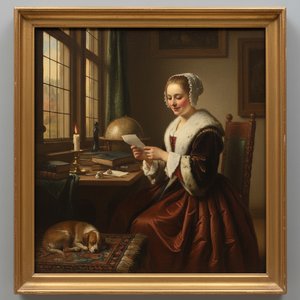
Gerrit Dou: Intimacy & Light in the Dutch Golden Age
Explore the exquisite world of Gerrit Dou, a master of Dutch Golden Age painting. Discover his intimate genre scenes, signature use of light, and lasting legacy. Learn about collecting Dou's works & their value.

Hollandske Mestre: Top 10 Værker fra Guldalderen – Kunst til Dit Hjem
Oplev de 10 mest ikoniske værker fra den hollandske guldalder! Rembrandt, Vermeer og andre mestre afsløres. Find inspiration til dit hjem & køb museumskvalitets kunsttryk på OriginalUniqueArt.com.
Illuminating Realism: Exploring the Dutch Golden Age of Painting (1600-1700)
Explore the Dutch Golden Age of painting (1600-1700) with OriginalUniqueArt. Discover Rembrandt, Vermeer & other masters. Learn about techniques, history & find museum-quality reproductions.

Golden Light & Dutch Skies: The Timeless Magic of Dutch Golden Age Landscapes
Discover the breathtaking beauty of Dutch Golden Age landscapes. Explore the mastery of light, chiaroscuro, and 17th-century realism through an expert art history lens, celebrating the enduring legacy of the Dutch Masters for discerning collectors and art lovers.


