

 Se i rummet
 Send
Send Del
Del
 Detaljer
 Studieguide til kunstværker

 Download
 Lignende værker
 Røntgenundersøgelse
 Se diasshow
 Statistik
Betender Einsiedler
 Oil
Oil- WallArt
- Dutch Golden Age Painting
 1670
1670- Early Modern
 25.0 x 19.0 cm
 Billedgalleri Sanssouci
 Læs mere
Giclée / Kunsttryk
Giclée- eller lærredstryk i museumskvalitet med hurtig produktion og fleksible muligheder for finish. ( Bestil håndmalet reproduktion Skift til digitalt billede)




P118B Dkr10

P118H Dkr10

P118W Dkr10

P438Z Dkr10

P508JH Dkr12

P508YH Dkr12

P805H Dkr10

P805Z Dkr10

P919BZ Dkr10

P919G Dkr10

P919XJ Dkr10

P959ZH Dkr10

P968JZ Dkr12

W106C Dkr8

W218G Dkr10

W218JH Dkr8

W218Y Dkr10

W307PJ Dkr10

W316G Dkr10

W316PJ Dkr8

W316Y Dkr10

W398PJ Dkr8

W4111J Dkr10

W500HY Dkr15

W500JH Dkr15

W692G Dkr12

W849H Dkr8

W940BG Dkr15

W953PJ Dkr8




Vælg mellem vores forudindstillede størrelser, der matcher kunstværkets originale proportioner.

Indtast den bredde og højde, du har brug for, så det passer til din ramme eller din væg. Et print kan kun beskæres, aldrig gøres større end billedet, så en størrelse med en anden form vil miste en del af motivet. Vi sender dig en digital mockup til godkendelse, før vi printer noget. Billedet vist på denne side viser ikke den faktiske beskæring — det er kun mockuppen, der gør.
Verdensomspændende levering () på 2 uger i stedet for de sædvanlige 4/5 uger. (22 oktober)

Gratis ekspresforsendelse til hele verden

Lærred af linned i høj kvalitet

Komplet transportforsikring

Garanti for refusion af told og importafgifter

Garanti for autentisk farvegengivelse

100 dages returret ved fabrikationsfejl

100% fuld returret

Mængderabat ved flere køb
 Glasmulighed er kun tilgængelig i størrelser under 110 cm

Betender Einsiedler
Giclée / Kunsttryk
Reproduktionsstørrelse
-


Samlet pris
Dkr 528
A Quiet Devotion: The Luminous World of Gerrit Dou
In the hushed atmosphere of a seventeenth-century interior, a single figure emerges from the shadows, caught in a profound moment of spiritual introspection. Betender Einsiedler, or the Praying Hermit, is not merely a painting but an invitation into a private sanctuary of thought. Executed around 1670 by the master of the Leiden School, Gerrit Dou, this diminutive masterpiece commands attention through its sheer psychological weight. The subject—an elderly man with a weathered face and a flowing white beard—is deeply immersed in his devotion, his eyes cast downward toward a book held firmly in his hands. Through Dou’s unparalleled ability to capture the essence of human vulnerability, the viewer is drawn into a silent dialogue with the hermit, feeling the weight of his solitude and the sanctity of his prayer.
The brilliance of this work lies in its technical execution, specifically Dou's legendary command of chiaroscuro. Rather than relying on broad strokes or bright, distracting colors, the artist employs a sophisticated interplay of light and shadow to sculpt the hermit’s form. The subtle gradations of tone create a palpable sense of three-dimensionality; one can almost feel the coarse texture of his heavy robes and the delicate, papery quality of his aged skin. This meticulous approach, characteristic of the fijnschilder or "fine painter" tradition, allows light to behave as if it were emanating from a soft, unseen source, perhaps a flickering candle just out of view. Such precision transforms the small canvas into a window of immense depth, where every fold of fabric and every strand of hair serves to heighten the illusion of reality.
Historical Resonance and Symbolic Depth
Beyond its technical splendor, Betender Einsiedler is a profound artifact of the Dutch Golden Age and the burgeoning spirit of the Enlightenment. During this era, there was an increasing fascination with the intersection of empirical observation and inner psychological truth. Dou, a student of Rembrandt, took the dramatic lighting of his master and refined it into something much more intimate and controlled. The painting’s history is equally captivating; it was famously acquired by Friedrich II for the Staatliche Bildergalerie in Berlin, reflecting the era's aristocratic passion for Northern European realism. This connection to royal patronage underscores the work's status as a treasure of cultural significance, representing a period when art sought to document the human condition with unprecedented accuracy.
Symbolically, the painting serves as a meditation on time and the eternal. The presence of a clock visible in the background acts as a memento mori, a gentle reminder of the fleeting nature of earthly existence compared to the enduring nature of faith. This tension between the ticking seconds of the physical world and the timelessness of the hermit's prayer creates a poignant emotional resonance. For the modern collector or interior designer, a high-quality reproduction of this piece offers more than just aesthetic beauty; it brings a sense of contemplative stillness and intellectual sophistication to any space. It is an ideal centerpiece for those seeking to evoke a mood of quiet elegance, scholarly depth, and a timeless connection to the masters of the Dutch Golden Age.
Spørgsmål & svar
Kan jeg se "Betender Einsiedler" af Gerrit Dou under forskellig belysning?
Røntgenvisningen af "Betender Einsiedler" af Gerrit Dou findes på værkets Røntgenundersøgelse-side: en interaktiv undersøgelse af billedet gennem elleve optiske lag.
Hvor stor er den originale "Betender Einsiedler"?
Det originale værk "Betender Einsiedler" af Gerrit Dou måler 25 x 19 cm.
Hvad er den farvemæssige identitet i "Betender Einsiedler" af Gerrit Dou?
"Betender Einsiedler" er defineret af en Earthy farvepalette med Phthalo Green (#2c2521) som den dominerende farve.
Om kunstneren
Gerrit Dou (1613 – 1675)
Gerrit Dou was one of the most celebrated painters of the Dutch Golden Age until the beginning of the nineteenth century. He trained under Rembrandt van Rijn, whose impact is evident in his early oeuvre. His fame rested on meticulously rendered scenes of everyday life—often depicted within arched stone openings known as ‘niche’ paintings—characterized by an unparalleled mastery of chiaroscuro. This distinctive artistic approach cemented his place among the foremost figures of Leiden’s artistic heritage.Early Life and Training
Gerrit Dou was born in Leiden on April 7, 1613, the youngest son of Marytje Jansdr van Rosenburg and the glazier Douwe Jansz de Vries van Arentsvelt of Harlingen (ca. 1584–ca. 1656). According to Jan Jansz. Orlers, burgomaster of Leiden and author of a city chronicle in 1641, Dou demonstrated “a pleasure and desire toward painting” from a young age. At the tender age of nine, he commenced his artistic education with Bartholomeus Dolendo (ca. 1570–1629), a copper engraver who instilled in him foundational skills in printmaking alongside painting. Subsequently, Dou pursued further training under Pieter Couwenhorn (ca. 1599–1654), a master glass painter, honing his craft and broadening his artistic horizons.Rembrandt’s Influence
Gerrit Dou's formative years coincided with Rembrandt’s residency in Leiden, where he served as Douwe Jansz.’s apprentice until the latter moved to Amsterdam in 1631. During this period, Dou benefited immensely from Rembrandt’s guidance—a relationship that profoundly shaped his artistic style and technique. As Arnold Houbraken recounts, Rembrandt's influence was palpable: “Whoever was surprised ‘that such noble painterly ability had sprouted from the school of Rembrandt’ had forgotten that Rembrandt, too, in his early years ‘had painted meticulously.’” This meticulous attention to detail—a hallmark of Rembrandt’s oeuvre—became a defining characteristic of Dou’s own artistic endeavors.The Leiden Fijnschilders and Artistic Innovation
Gerrit Dou emerged as a pivotal figure within the Leiden *fijnschilderij* school, alongside artists like Frans van Mieris the Elder and Gabriel Metsu. This movement championed an exacting style—characterized by minute detail and polished realism—primarily focused on genre scenes and nocturnal interiors illuminated with dramatic chiaroscuro effects. Dou’s groundbreaking technique of capturing subtle nuances of light—particularly in his iconic candlelit compositions—established him as a pioneer of artistic innovation, influencing generations of painters to come. His work stands apart from its contemporaries due to its profound psychological depth and masterful rendering of atmosphere.Notable Works and Legacy
Gerrit Dou's enduring legacy resides in his captivating paintings—among which “The Astronomer by Candlelight” exemplifies his unparalleled skill in portraying the interplay of light and shadow. These works are housed in prestigious institutions such as The Leiden Collection, New York, where visitors can immerse themselves in the splendor of European art from the sixteenth to eighteenth centuries. Furthermore, Dou’s influence extends beyond Leiden's artistic circles, permeating museums across Europe—including the Mauritshuis in Delft—where his masterpieces continue to inspire awe and admiration. Gerrit Dou remains a cornerstone of Dutch artistic history, celebrated for his unwavering dedication to craftmanship and his contribution to shaping the visual culture of his time.
Gerrit Dou
1613 - 1675 , Nederland
Hurtige fakta
- Artistic Movement Or Style: Fijnschilder
- Artists Or Movements Influenced By This Artist: ['Frans van Mieris den Ældre']
- Artists Who Influenced This Artist: ['Rembrandt van Rijn']
- Date Of Birth: April 7, 1613
- Full Name: Gerrit Dou
- Nationality: Nederlandsk
- Notable Artworks:
- The Astronomer by Candlelight
- Portrait of an Old Woman
- Place Of Birth: Leiden, Netherlands
Relaterede artikler
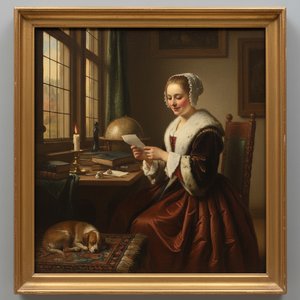
Gerrit Dou: Intimacy & Light in the Dutch Golden Age
Explore the exquisite world of Gerrit Dou, a master of Dutch Golden Age painting. Discover his intimate genre scenes, signature use of light, and lasting legacy. Learn about collecting Dou's works & their value.

Golden Age Reflections: Dutch Baroque Painting & Cultural Innovation
Explore the Dutch Golden Age of painting! Discover key artists like Vermeer & ter Borch, their innovative techniques, and the rich cultural context behind these Baroque masterpieces. Learn about collecting & appreciating this iconic art period.
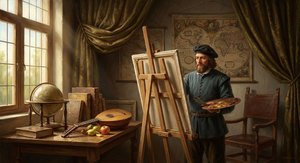
Illuminating Realism: Exploring the Dutch Golden Age of Painting (1600-1700)
Explore the Dutch Golden Age of painting (1600-1700) with OriginalUniqueArt. Discover Rembrandt, Vermeer & other masters. Learn about techniques, history & find museum-quality reproductions.

Golden Light & Dutch Skies: The Timeless Magic of Dutch Golden Age Landscapes
Discover the breathtaking beauty of Dutch Golden Age landscapes. Explore the mastery of light, chiaroscuro, and 17th-century realism through an expert art history lens, celebrating the enduring legacy of the Dutch Masters for discerning collectors and art lovers.

Hollandske Mestre: Top 10 Værker fra Guldalderen – Kunst til Dit Hjem
Oplev de 10 mest ikoniske værker fra den hollandske guldalder! Rembrandt, Vermeer og andre mestre afsløres. Find inspiration til dit hjem & køb museumskvalitets kunsttryk på OriginalUniqueArt.com.


