Skift til printsalg
 Vis mere







































 For kunstværker eller reproduktioner, der er større end 105 cm (ca. 41 tommer) på en hvilken som helst side, vil rammen blive leveret som et adskilt sæt. Denne metode sikrer sikker levering og forhindrer skader under transport.


The Serene Embrace of Early Netherlandish Devotion
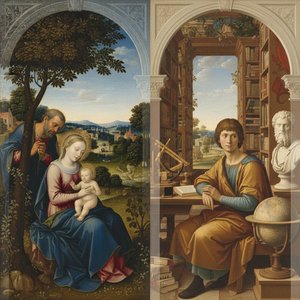
To gaze upon this detail from Gerard David’s depiction of Mary and Child is to step directly into the hushed, luminous world of the early Northern Renaissance. The scene immediately arrests the viewer with its profound sense of intimacy. Here, the Virgin Mary cradles her divine child, a tableau vivant steeped in quiet devotion. The richness suggested by Mary's attire, particularly the striking red veil or robe, speaks not merely of fashion but of symbolic importance—a color often associated with passion, royalty, and human connection within Christian iconography. David masterfully captures that delicate balance between the sacred mystery and the palpable warmth of maternal love.
Mastery in Light and Detail: A Technical Marvel
Gerard David was celebrated for his ability to render light—a quality that permeates every corner of this composition. His technique, characteristic of the Flemish school, emphasizes minute detail, allowing the viewer's eye to wander over textures, from the soft folds of fabric to the distant architectural elements visible in the background. While Mary and Child form the emotional anchor, the inclusion of figures on horseback and the suggestion of a townscape beyond adds incredible depth. This juxtaposition—the intensely personal moment against the backdrop of a bustling, ordered world—is a hallmark of David’s genius. It suggests that even within the grand sweep of human activity, moments of divine connection persist.
Symbolism Woven into the Fabric
The symbolism at play here is both deeply religious and subtly humanist. Mary herself embodies grace, while the child represents the Incarnation. The surrounding elements—the architecture, the journey implied by the figures in the distance—ground this divine narrative within a recognizable, earthly reality. It invites contemplation: how does the eternal intersect with the temporal? For the collector or decorator, this piece offers more than mere decoration; it offers a meditation point, a visual anchor of peace amidst the clamor of modern life. The overall atmosphere is one of profound serenity, inviting quiet reflection.
Bringing Renaissance Calm Home
Owning a reproduction inspired by Gerard David’s hand is to curate a piece of history's most luminous moments for your own sanctuary. Whether adorning a formal drawing-room or lending an air of cultured contemplation to a private study, this artwork speaks of enduring quality and masterful artistry. It captures the sophisticated taste of the Renaissance patron while remaining emotionally accessible today. The exquisite detail ensures that even at a glance, the viewer is drawn into its gentle narrative embrace, making it a timeless focal point for any discerning interior design scheme.
Spørgsmål og svar
Hvordan forenes kunstretning og epoke i "Mary and Child (detail)" af Gerard David?
"Mary and Child (detail)" af Gerard David tilhører Early Netherlandish Renaissance-bevægelsen fra sin skabers Renæssancen-æra.
Kan jeg se "Mary and Child (detail)" af Gerard David under forskellig belysning?
"Mary and Child (detail)" kan undersøges lag for lag på værkets Røntgenoptagelse-side, en interaktiv viewer inspireret af en konservators lysbænk med elleve optiske lag af billedet.
Hvad er rettighederne til reproduktion af "Mary and Child (detail)" hos Staatliche Museen zu Berlin?
Ophavsretten til "Mary and Child (detail)" af Gerard David er afklaret: værket er i det offentlige domæne – ophavsretten er udløbet. Dets placering hos Staatliche Museen zu Berlin ændrer ikke på denne status.
 Se i rummet
 Del som kort
 Del
Del
 Detaljer
 Guide
Guide

 Download
 Lignende værker
 Røntgenundersøgelse
 Diasshow
 Spørgsmål og svar
 Statistikker