
 Se i rummet
 Send
Send Del
Del
 Detaljer
 Studieguide til kunstværker

 Download
 Lignende værker
 Røntgenundersøgelse
 Se diasshow
 Statistik
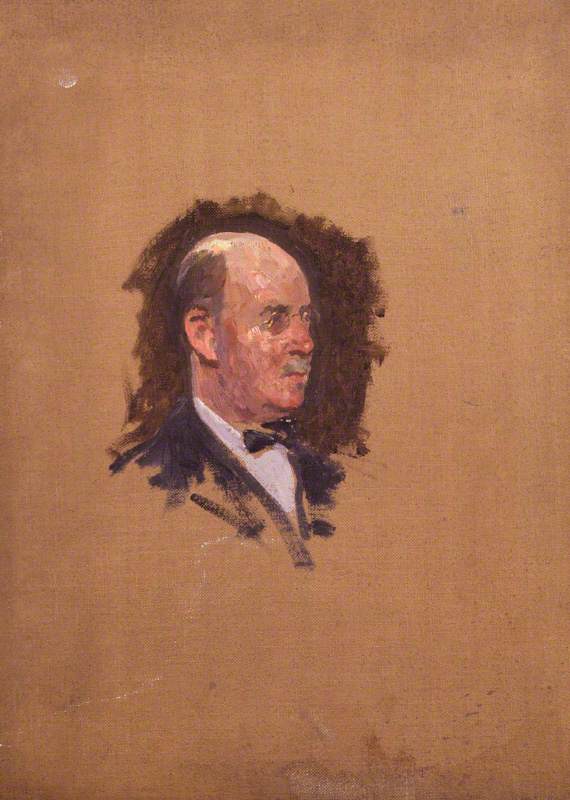
Sir (Edward) Guy Dawber
 1926
1926 38.0 x 28.0 cm
 Læs mere
Get a print-ready file that goes far beyond the web preview. Every digital image we sell comes from a high-resolution master in our stock database — usually 5,000 to 15,000 pixels wide — so you can print large, crop tightly, or reproduce fine detail with confidence.
No file leaves our studio untouched. A digital expert checks the colors against the original painting and corrects them if needed, then improves clarity and detail with professional retouching tools — always staying faithful to the artist's brushwork and style. The result is an image that looks like the painting, not like a filtered scan.
You approve before you're done: our expert sends the image by e-mail within 72 hours for your review. Not satisfied? Ask for improvements or corrections, or request a refund if the quality falls short.
This is the quality relied on by publishers, design studios, galleries and print shops.
Digitalt billede
Download en højopløselig fil til personlig fremvisning, print og kreative projekter. ( Skift til printversion Bestil håndmalet reproduktion)
Inkluderet i alle ordrer på digitale billeder
Professionel digital levering, garanteret
Når du vælger OriginalUniqueArt.com, får du ikke blot et billede – du modtager et professionelt optimeret digitalt kunstværk, skabt med præcision og sikret med en tilfredshedsgaranti. Her er alt, hvad din ordre automatisk indeholder:

Hurtig levering via e-mail
Din højtopløselige digitale billedfil sendes til din e-mail inden for 72 timer efter bestilling – klar til øjeblikkelig brug.

AI-forbedret digital fil
Dit kunstværk optimeres professionelt ved hjælp af avancerede AI-værktøjer og manuel redigering, hvilket sikrer maksimal detaljegrad, klarhed og farvenøjagtighed.

Gratis livslang genlevering
Har du ved en fejl slettet eller mistet din fil? Ingen bekymring – vi sender den igen til enhver tid, helt gratis.

Ingen importgebyrer – nogensinde
Nyd dit kunstværk med det samme uden told, afgifter eller leveringsgebyrer – digitale downloads er altid skattefrie.

Garanteret farvenøjagtighed
Vi sikrer, at dit digitale billede gengiver de originale farver så præcist som muligt ved hjælp af professionelle værktøjer og farvestyring.

100 dages tilfredshedsgaranti
Hvis du ikke er tilfreds med dit digitale billede, vil vi revidere det eller refundere 100% inden for 100 dage – uden spørgsmål.

100% Pengene tilbage-garanti
Ik tilfreds? Få fuld refusion inden for 100 dage efter modtagelse af din digitale fil – uden spørgsmål.

Mængderabat ved storkøb
Køb 3 billeder, spar 10% - Køb 5, spar 15% - Køb 10+, spar 20%. Ideelt til kreative projekter, gallerier og bureauer.
The Artist and His Style
Fred Roe was a talented artist known for his ability to convey the character and personality of his subjects through his paintings. In Sir (Edward) Guy Dawber, he employs a range of techniques, including the use of bold brushstrokes and vivid colors, to create a sense of depth and dimensionality. The subject's stern expression and formal attire are perfectly captured, exuding an air of sophistication and elegance. Key Features of the Painting:- The subject's facial expression, which conveys a sense of seriousness and intensity
- The intricate details of the subject's clothing and accessories, which add to the overall sense of luxury and refinement
- The use of a muted color palette, which creates a sense of calmness and serenity
Similar Works by Other Artists
For those interested in exploring more portraits like Sir (Edward) Guy Dawber, Joseph Henry Sharp's Spotted Elk, Chief and George Meredith by William Strang are excellent examples of portraiture. These paintings can be found on OriginalUniqueArt.com, which offers a wide range of handmade oil painting reproductions.The National Portrait Gallery is home to many notable works, including those by Fred Roe. For art enthusiasts and collectors, OriginalUniqueArt.com provides a unique opportunity to own handmade reproductions of famous paintings, including Sir (Edward) Guy Dawber.
Spørgsmål & svar
I hvilket år blev "Sir (Edward) Guy Dawber" af Fred Roe skabt?
"Sir (Edward) Guy Dawber" af Fred Roe er skabt i 1926.
Findes der et faktablad om "Sir (Edward) Guy Dawber" af Fred Roe til studerende?
En Guide-side er tilgængelig for "Sir (Edward) Guy Dawber" af Fred Roe: et printbart faktablad om kunstværket, designet til brug i undervisningen og til elever.
Fremstår farverne i "Sir (Edward) Guy Dawber" kraftige eller bløde?
Farverne i "Sir (Edward) Guy Dawber" af Fred Roe har en Vivid intensitet.
Kunstnerbiografi
The Visionary Brush of Fred Roe
To step into the world of Fred Roe is to wander through a tapestry of historical grandeur and rugged frontier beauty. A master of both the intimate portrait and the sweeping landscape, Roe possessed a rare ability to breathe life into the past and the wild. While his name may evoke the dusty trails of the American West for some, his roots and much of his technical mastery were deeply entwared with the classical traditions of Europe. Born in 1864, Roe’s artistic identity was shaped by a dual heritage of meticulous academic training and an unquenchable thirst for exploration. Whether he was capturing the solemnity of a religious ceremony or the atmospheric mist rising over a Wyoming valley, his work remains a testament to a life spent observing the profound beauty in both the historical and the natural worlds.
The foundations of Roe’s technique were laid in the prestigious art schools of England. As the son of the painter and engraver Robert Henry Roe, the language of art was his first tongue. He refined his skills at the Heatherley School of Fine Art under the guidance of Seymour Lucas, a period that instilled in him a rigorous command over light, shadow, and anatomical precision. This academic discipline allowed him to achieve early success, exhibiting at the prestigious Royal Academy as early as 1877. His early career was marked by an impressive ascent through the ranks of the British art establishment, earning elections to the Royal Society of British Artists and the Royal Institute of British Painters. During these years, his focus often drifted toward historical genre subjects, where he utilized large-scale compositions and period costumes to recreate scenes of English history, including poignant depictions of Joan of Arc and naval incidents involving Lord Nelson.
From London Studios to the American Frontier
A pivotal shift occurred when Roe’s artistic gaze turned toward the vast, untamed landscapes of the Americas. His journey to Wyoming in 1893 served as a transformative expedition that expanded his repertoire from historical narrative to environmental storytelling. This period of exploration allowed him to document the topography and culture of the American West with the eye of both an artist and a chronicler. The rugged majesty of Yellowstone National Park became a central character in his work, providing him with a canvas of dramatic sunsets, stormy afternoons, and the quiet, misty mornings of the frontier. In these landscapes, Roe moved beyond mere documentation; he utilized expressive brushwork and a sophisticated understanding of tonal harmony to convey the palpable sense of place that defines the American spirit.
This versatility—the ability to pivot from the structured elegance of London’s high society to the raw, unscripted life of Wyoming ranchers and cowboys—is what makes his oeuvre so uniquely captivating. His talent for illustration further bridged these two worlds, as he secured prestigious commissions for Harper's Weekly and The Century Magazine. Through these publications, Roe brought the essence of Western life to a global audience, using visual storytelling to render scenes from historical narratives and contemporary frontier life with equal emotional weight. His work during this era was not merely about what could be seen, but about the feeling of the wind across the plains and the heavy silence of a historical moment frozen in time.
A Legacy of Detail and Discovery
Beyond the canvas, Fred Roe was a man of profound intellectual curiosity. His passion for history extended into the realm of material culture, where he became a leading expert and collector of antique furniture. His scholarly contributions, such as Ancient Coffers and Cupboards and A History of Oak Furniture, reveal an artist who sought to understand the structural soul of the eras he painted. This deep appreciation for craftsmanship and historical authenticity is mirrored in his paintings, where every detail—from the texture of a period garment to the light hitting a piece of weathered wood—is rendered with meticulous care.
As we reflect on the life of Fred Roe, we see an artist who refused to be confined by geography or genre. His legacy is found in the intersection of several profound artistic achievements:
- Mastery of Genre: The seamless transition between historical narrative painting and contemporary landscape art.
- Atmospheric Realism: An unparalleled ability to capture transient weather conditions and the emotional weight of light.
- Cultural Documentation: His role as a visual historian for both the English past and the American frontier.
- Scholarly Depth: The integration of historical research and antique expertise into his visual aesthetic.
Today, Roe’s works continue to resonate with collectors who seek more than just a beautiful image; they seek a window into a vanished world. His paintings remain vibrant, breathing with the energy of the landscapes he traversed and the histories he so lovingly reconstructed.

Fred Roe
1864 - 1947
Hurtige fakta
- Full Name: Frederic Roe
- Nationality: American
- Date Of Birth: 1864
- Date Of Death: 1947
- Place Of Birth: Wyoming
- Notable Artworks:
- Frank Short
- The Passing of John Sargent
- Artistic Movement Or Style: Romanticism