Abstract Expressionism · 1956
Mahoning (Franz Kline, 1956)
Franz Kline (1910–1962) har skabt Mahoning. Det er fra 1956. Det tilhører Abstract Expressionism-bevægelsen. Den er udført i Oil On Canvas. Det opbevares på Whitney Museum of American Art i New York, USA. Målene er 203 × 254 cm.
- 1956
- Oil On Canvas
- 203 × 254 cm
- Whitney Museum of American Art, New York

 Se i rummet

 Håndmalet oliemalerie
 Del som kort
 Del
 Faktablad


 Download
 Lignende værker
 Røntgenundersøgelse
 Diasshow
 Spørgsmål og svar

 Statistikker
Mahoning kort fortalt
- Titel
- Mahoning
- Kunstner
- Franz Kline (1910–1962)
- Kunstner født i
- Wilkes-Barre, USA
- Dato
- 1956
- Medium
- Oil On Canvas
- Dimensioner
- 203 × 254 cm
- Hvor det kan ses
- Whitney Museum of American Art, New York, USA
- Bevægelse
- Abstract Expressionism
- Periode
- Modern
- Motiv
- black and white, brushstrokes, geometric shapes, texture, composition, line art
Hvad forestiller Mahoning?
The Architecture of Chaos: Rediscovering Franz Kline’s Mahoning
In the pantheon of Abstract Expressionism, few works command the room with such visceral authority as Franz Kline’s “Mahoning,” completed in 1956. To stand before this monumental canvas is to witness a profound dialogue between presence and absence, a struggle captured in the rhythmic collision of black enamel and stark white space. This is not merely a painting; it is an event. As a cornerstone of the New York School, “Mahoning” embodies the very essence of Action Painting, where the artist’s physical gesture becomes the primary subject. The work eschews traditional representation to instead offer a raw, kinetic energy that vibrates with the pulse of mid-century urban life.
The brilliance of Kline’s technique lies in his ability to orchestrate what might initially appear as spontaneous disorder. While many associate the era with the unpredictable drips of Jackson Pollock, Kline’s approach was far more structural and deliberate. He often utilized a projector to enlarge sketches onto massive canvases, allowing him to manipulate the scale of his strokes with architectural precision. In “Mahonoming,” the heavy, black muscularity of the brushwork is balanced by the luminous white voids that press back against the dark forms. Through the meticulous layering of oil and enamel, Kline created a textured, tactile surface that invites the eye to wander through its thick impasto, discovering how light catches the ridges of his energetic, sweeping movements.
A Symphony of Contrast and Memory
Beyond its formalist triumphs, “Mahoning” is deeply rooted in the artist's personal geography and the turbulent zeitgeist of the 1950s. The title itself serves as a poignant tether to Kline’s origins in Pennsylvania, evoking the industrial landscapes and river valleys of his youth. This connection between the monumental scale of the painting and the ruggedness of his namesake suggests a bridge between personal memory and universal abstraction. During the height of the Cold War, as the world grappled with technological shifts and societal anxieties, Kline’s work offered an alternative language—one rooted in primal instinct rather than the sterile rationality of the age.
For the discerning collector or interior designer, “Mahoning” represents a masterclass in tonal balance. Its monochromatic palette provides a sophisticated anchor for modern spaces, offering a sense of dramatic weight that can transform a minimalist room into a gallery-worthy sanctuary. The painting does not merely decorate a wall; it commands the atmosphere, injecting a sense of movement and intellectual depth. Whether viewed as a study of structural tension or an emotional release of energy, this masterpiece remains an enduring symbol of the human struggle to find order within chaos, making it an incomparable centerpiece for any curated collection.
Hvilket museum udstiller Mahoning?
Whitney Museum of American Art
New York, USA
Oprindelse og historie for Whitney Museum of American Art Whitney Museum of American Art opstod fra et øjebliks institutionel afvisning. I 1929 afslog Metropolitan Museum of Art en gave på næsten 500 nye kunstværker, som blev tilbudt af Gertrude Vanderbilt Whitney. Denne beslutning satte gang i etableringen af et dedikeret rum for en anden form for vision.


Højopløselige billeder af Mahoning

Protected by copyright: these files are for personal reference, not a licence to republish.
Franz Kline, Mahoning (1956), Whitney Museum of American Art.
Spørgsmål om Mahoning besvaret
Hvor kan man i dag se "Mahoning" af Franz Kline udstillet?
"Mahoning" af Franz Kline er udstillet på Whitney Museum of American Art, New York, USA. Museets fortegnelse henviser til det originale værk og ikke til reproduktioner.
Hvornår er "Mahoning" af Franz Kline skabt?
"Mahoning" af Franz Kline er dateret til 1956.
Hvilken teknik er "Mahoning" udført med?
Franz Kline brugte Oil On Canvas-teknikken til "Mahoning". Teknikken definerer det originale værks materielle karakter.
Hvad er målene på det originale værk "Mahoning"?
De registrerede mål for "Mahoning" af Franz Kline er 203 x 254 cm. Reproduktioner kan bestilles i andre størrelser, mens de samme proportioner bevares.
Hvad forestiller "Mahoning" af Franz Kline?
Temaerne i "Mahoning" af Franz Kline omfatter black and white, brushstrokes, geometric shapes, texture, composition, line art, action painting, som tilsammen udgør værkets motivverden.
Er "Mahoning" af Franz Kline i det offentlige domæne?
Ophavsretsstatus for "Mahoning" af Franz Kline: værket er stadig beskyttet af ophavsret. Dette afgør, om der frit må foretages reproduktioner af billedet.
Hvem har skabt "Mahoning"?
"Mahoning" tilskrives Franz Kline.
Hvilken kunstretning tilhører "Mahoning" af Franz Kline?
"Mahoning" af Franz Kline tilhører Abstract Expressionism-bevægelsen. Denne bevægelse giver den stilistiske kontekst for værket.
Hvor i Franz Klines karriere placerer "Mahoning" sig?
Inden for Franz Klines karriere tilhører "Mahoning" perioden Mature Period, hvilket gør det muligt at sammenligne værket med kunstnerens øvrige værker.
Om kunstneren, Franz Kline

1910–1962, USA
Franz Kline
A Life Forged in Contrast: The World of Franz Kline Franz Kline, en pivotal figur i Ekspressionismen, fortsætter med at være kunstner hvis værk resonerer med rå kraft og følelsesmæssig dybde. Han blev født i Wilkes-Barre, Pennsylvania, i 1910, og hans liv var præget af tidlig smerte – hans fars selvmord da han kun var syv år gammel kastede en lang skygge over en følsomhed, der senere ville finde udtryk i de skarpe kontraster definerende hans kunst. Denne formative erfaring førte til et nomader ungdom og eventualt tilmelding til Girard College, en Philadelphia boarding skole for drenge hvis fædre var døde. Det var her, mellem struktureret disciplin, at Kline’s kunstneriske ambitioner begyndte at dukke op, næret af traditionel træning i illustration og tegning.
Også af Franz Kline
 Sort og Hvid1959
 New York, N.Y.1953
 Zinc Yellow1959
 Untitled1956
Essays om Mahoning
 Beyond the Canvas: A Definitive Guide to Abstract Expressionism, Action Painting, and Color Field MastersExplore the profound history of Abstract Expressionism, from the visceral energy of Action Painting to the serene depth of Color Field mast…
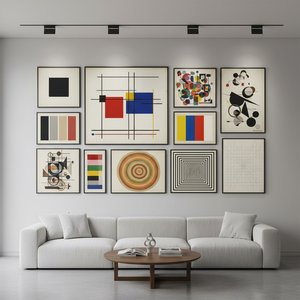 Geometrisk Abstraktion: Top 10 Kunstværker der Definerede Bevægelsen | OriginalUniqueArt.dkOplev de 10 mest ikoniske værker inden for geometrisk abstraktion! Fra Kandinsky til Mondrian – lær historierne bag disse banebrydende kuns…
 The Psychological Resonance of Erwartung: Schoenberg’s Musical Expressionism and the Visual Language of ModernityExplore the profound link between Schoenberg’s music and Expressionist art. Discover the visual language of modernism now.