Køb håndmalet maleri
 Vis mere







































 For kunstværker eller reproduktioner, der er større end 105 cm (ca. 41 tommer) på en hvilken som helst side, vil rammen blive leveret som et adskilt sæt. Denne metode sikrer sikker levering og forhindrer skader under transport.


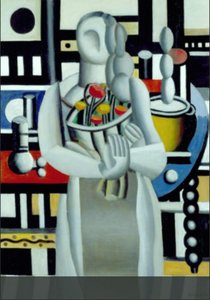
A Mechanical Vision: Decoding Fernand Léger’s ‘Composition’
Created in 1924, this striking work by French artist Fernand Léger is a powerful example of his distinctive “Tubism” – a unique offshoot of Cubism. The artwork presents a tightly cropped and detailed depiction of complex machinery, rendered with meticulous precision in sepia tones. It’s an image that immediately draws the eye, inviting contemplation on themes of industry, modernity, and the beauty found within mechanical structures.Style & Technique: The Essence of Tubism
Léger's style is instantly recognizable for its emphasis on cylindrical forms and geometric shapes – hence the term “Tubism.” ‘Composition’ exemplifies this approach perfectly. Notice how circles, rectangles, and angled planes interlock to create a sense of depth and complexity. The artist masterfully employs hatching and cross-hatching techniques to build form and texture, giving the impression of solidity and weight despite the two-dimensional surface. This isn't simply a drawing; it’s an exploration of volume and space achieved through line work alone. The monochromatic palette further emphasizes the focus on structure and form, reminiscent of technical illustrations or blueprints.Historical Context: Post-War Modernity
Fernand Léger’s artistic development was profoundly impacted by his experiences during World War I. Witnessing the power and precision of machinery in wartime led him to embrace industrial motifs as subjects for his art. ‘Composition’ reflects this shift, moving away from traditional representational painting towards a celebration of the modern, machine age. The 1920s were a period of rapid technological advancement and social change, and Léger's work captures the spirit of optimism and dynamism that characterized this era. He was part of the Puteaux Group (Section d’Or), exploring new ways to represent reality in a post-Cubist world.Symbolism & Interpretation: Beyond the Gears
While seemingly abstract, ‘Composition’ is rich with symbolic potential. The intricate machinery can be interpreted as representing the interconnectedness of modern life, the power of industry, or even the human body itself – reduced to its essential mechanical components. The absence of any human figures encourages viewers to focus on the machine as an entity in its own right. It prompts questions about humanity’s relationship with technology and the impact of industrialization on society.Emotional Impact & Aesthetic Appeal
Despite its subject matter, ‘Composition’ isn't cold or sterile. The meticulous detail and dynamic arrangement of forms create a visually engaging experience. The artwork evokes a sense of awe at human ingenuity and the elegance of engineering. Its neutral color palette makes it incredibly versatile for interior design – complementing both modern and traditional spaces. A reproduction of this piece would serve as a striking focal point in a study, living room, or office, sparking conversation and inspiring contemplation.Key Features
- Artist: Fernand Léger
- Date: 1924
- Medium: Graphite or Charcoal on Paper
- Dimensions: 25 x 23 cm
- Style: Tubism, Cubism, Technical Illustration
Spørgsmål og svar
Er dette Composition malet i hånden eller er det et print?
Håndmalet: en uddannet maler kopierer Composition i olie på lærred.
Hvilken størrelse skal jeg vælge til Composition?
Originalen måler 25 x 23 cm. Størrelserne går fra 30.3 x 33.0 cm (Dkr1339) til 229.8 x 249.9 cm (Dkr13862); tabellen på denne side viser de vigtigste trin og deres priser.
Hvor lang tid tager leveringen?
Levering tager 4 til 5 uger med gratis ekspresforsendelse over hele verden; en mulighed for hasteproduktion tilbydes på denne side. Du kan returnere varen inden for 100 dage med fuld refusion, uden betingelser.
Hvilket medie brugte Fernand Léger til Composition?
Acrylic On Canvas
 Se i rummet

 Del som kort
 Del
 Detaljer
 Guide


 Download
 Lignende værker
 Røntgenundersøgelse
 Diasshow
 Spørgsmål og svar

 Statistikker