Realism · 1861
Catacombes De Paris (Nadar, 1861)
Nadar (1820–1910) har skabt Catacombes De Paris. Det er fra 1861. Det tilhører Realism-bevægelsen. Den er udført i Photography.
- 1861
- Photography

 Håndmalet oliemalerie
 Del som kort
 Del
 Faktablad


 Download
 Lignende værker
 Diasshow
 Spørgsmål og svar

 Statistikker
Catacombes De Paris kort fortalt
- Titel
- Catacombes De Paris
- Kunstner
- Nadar (1820–1910)
- Kunstner født i
- Rue Saint-Honoré, Frankrig
- Dato
- 1861
- Medium
- Photography
- Bevægelse
- Realism
- Periode
- 19th Century
- Motiv
- skulls, bones, man, stone walls, monochrome, human remains
Hvad forestiller Catacombes De Paris?
Identification of Catacombes De Paris by Nadar
The photograph titled Catacombes De Paris was captured by the artist Nadar about 1861. It presents a chamber within the Paris Catacombs in Paris, France. Inside this subterranean space, stacks of human skulls and bones are arranged in rows. The image documents a quiet, organized architecture of remains.
This work represents one of the earliest examples of underground photography. The lens captures a realm of bone and shadow. It records the stillness of the ossuary through a stark, monochrome view. A heavy silence resides within the frame.
Composition and Visual Elements of the Work
A high-contrast monochrome palette defines this subterranean space, where light and shadow engage in a stark struggle. On the left side of the frame, a man stands as a silent observer, a visual anchor amidst the stillness. The darkness is not empty; it is a heavy presence that shrouds the periphery, pushing the eye toward the central arrangement of remains. Artificial light, likely cast from a lantern or flash, strikes the surfaces of the bones, carving them out of the gloom.
Geometry emerges from the organic chaos of the ossuary. Strong vertical lines rise from the stacks of bones and skulls, while horizontal lines define the orderly rows of the display. These intersecting paths create a rigid structure within the cramped chamber. Amidst these straight edges, circular shapes dominate the view, repeated endlessly through the numerous skulls that populate the scene. The textures shift from the smooth, pale surfaces of the crania to the rough, grainy quality of the stone walls. Every shadow holds a secret of the dark.
Technique and Photographic Materials Used
The darkness of the subterranean chamber required a calculated conquest of light. To pierce the shadows, the photographer employed artificial lighting, utilizing Bunsen batteries to provide a steady, controlled glow. Mannequins were positioned within the scene to assist in managing the illumination. This deliberate use of light allowed the camera and lens to capture the stark geometry of the bone stacks where natural light could not reach.
The image was captured through the wet collodion process, a method demanding immediate action and chemical precision. Light-sensitive chemicals, likely silver nitrate, were applied to the plates while they remained damp. These records were fixed onto glass or paper plates, preserving the textures of the skulls and the grain of the stone. Each exposure was a struggle against the damp, heavy air of the underground.
The resulting monochrome print holds the shadows in place. The chemical reaction binds the light to the surface, turning a fleeting moment of artificial brightness into a permanent, silent record. The light remains trapped in the silver.
Historical Context and Subject Matter
The image captures a subterranean reality beneath the streets of Paris, France. It documents a chamber filled with stacks of human skulls and bones, an ossuary that holds the remains of millions of Parisians. These bones were moved here from overcrowded cemeteries during the late 18th and early 19th centuries. The photograph, made about 1861, emerged during a period of rapid urbanization and social change within the city.
The subject matter provides a visual record of a unique and somewhat macabre location. It reveals the scale of the remains held within the dark, stone-walled passages. This work documents the infrastructure of the Parisian underground, a space that remained hidden from the public eye during the mid-nineteenth century. The stillness of the bones contrasts with the shifting, growing city above.
Related Works by the Artist Nadar
The shadows of the Parisian underground extend into other captures from 1861. In Égouts De Paris, the lens turns toward the city's sewer system. Here, the darkness is not filled with bone, but with the damp stone walls and flowing water of the subterranean tunnels. It is a study of the hidden veins beneath the streets, where light struggles against the heavy gloom of the masonry.
This work belongs to the movements of Realism and Pictorialism of the 19th Century. It shares a certain monochrome gravity with the catacombs, focusing on the functional, shadowed passages that exist far below the surface. The image captures a specific, gritty reality of the urban environment. It remains a quiet record of the infrastructure that remains out of sight.
Højopløselige billeder af Catacombes De Paris

Public domain: kunstneren døde i 1910.
Andre størrelser, beskæringer og kildehenvisning →Nadar, Catacombes De Paris (1861). Public domain
Farverne er matchet til originalen af en digital ekspert, og filen er finretoucheret og tro mod kunstnerens penselstrøg.
Køb filen i høj opløsningSpørgsmål om Catacombes De Paris besvaret
I hvilket år blev "Catacombes De Paris" af Nadar skabt?
"Catacombes De Paris" af Nadar er dateret til 1861.
Hvilken teknik er brugt til "Catacombes De Paris" af Nadar?
"Catacombes De Paris" af Nadar er udført i Photography. Reproduktionerne har til formål at gengive denne tekniks visuelle udtryk.
Hvad forestiller "Catacombes De Paris"?
"Catacombes De Paris" af Nadar forestiller: skulls, bones, man, stone walls, monochrome, human remains.
Er "Catacombes De Paris" af Nadar i det offentlige domæne?
Ophavsretsstatus for "Catacombes De Paris" af Nadar: værket er i det offentlige domæne – ophavsretten er udløbet. Dette afgør, om der frit må foretages reproduktioner af billedet.
Hvem er kunstneren bag "Catacombes De Paris"?
"Catacombes De Paris" blev skabt af Nadar. Informationen på denne side beskriver Nadars originale værk.
Hvilken stilart tilhører "Catacombes De Paris"?
"Catacombes De Paris" af Nadar tilhører Realism-bevægelsen. Denne bevægelse giver den stilistiske kontekst for værket.
Hvor i Nadars karriere placerer "Catacombes De Paris" sig?
"Catacombes De Paris" repræsenterer Nadars Mature Period.
Hvor gammel var Nadar, da vedkommende skabte "Catacombes De Paris"?
Nadar skabte "Catacombes De Paris" i en alder af 41. Kunstneren blev født i 1820, og værket er dateret 1861.
Er "Catacombes De Paris" af Nadar i det offentlige domæne, og hvorfor?
"Catacombes De Paris" af Nadar er i det offentlige domæne – ophavsretten er udløbet. Ophavsretten beregnes ud fra kunstnerens dødsår, og Nadar døde i 1910.
Om kunstneren, Nadar
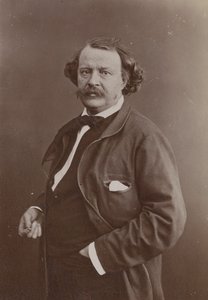
1820–1910, Frankrig
Nadar
Félix Nadar: En pioner inden for fotografi Tidligt liv og begyndelser Født: Gaspard-Félix Tournachon den 5. april 1820 i Paris (selvom nogle kilder antyder Lyon). Hans far, Victor Tournachon, var bogtrykker og boghandler. Studerede oprindeligt medicin, men måtte opgive det på grund af økonomiske vanskeligheder efter sin fars død.
Også af Nadar
 Alexandre Dumas père (1802-1870)1855
 Sarah Bernhardt1864
 [Sarah Bernhardt as the Empress Theodora in Sardou1889
 Paul and His Dog1865

Essays om Catacombes De Paris
 Beyond the Portrait: Félix Nadar & the Psychological Depths of 19th-Century PhotographyExplore the revolutionary photography of Félix Nadar – pioneer of portraiture, aerial imaging & psychological depth. Discover his iconic po…
 Dreams on Canvas: Understanding Automatist and Veristic SurrealismMaster the differences between Automatist and Veristic Surrealism. Explore the works of Dali and Miro to decode the dreamscape today.
 Top 25 Masterpieces by Laurent Fabre: A Journey Through Neo-Abstract GeometryImmerse yourself in the luminous world of Laurent Fabre. Explore 25 iconic Neo-Abstract masterpieces defined by geometric precision and chr…