Social Realism
Execution (Evan Walters)
Evan Walters (1892–1951) har skabt Execution. Det tilhører Social Realism-bevægelsen. Den er udført i Oil On Canvas. Målene er 77 × 107 cm.
- Oil On Canvas
- 77 × 107 cm

 Se i rummet

 Håndmalet oliemalerie
 Del som kort
 Del
 Faktablad


 Download
 Lignende værker
 Røntgenundersøgelse
 Diasshow
 Spørgsmål og svar

 Statistikker
Execution kort fortalt
- Titel
- Execution
- Kunstner
- Evan Walters (1892–1951)
- Kunstner født i
- Llangyfelach, Wales
- Materiale
- Oil On Canvas
- Dimensioner
- 77 × 107 cm
- Bevægelse
- Social Realism
- Periode
- Modern
- Motiv
- industrial workers, social commentary, welsh art scene”, “factory life”, “black and white”, “portraiture”
Hvad forestiller Execution?
Identification of the Artwork and Artist
The artwork titled Execution is a painting by the Welsh artist Evan Walters. This piece is an oil on canvas that measures 77 x 107 cm. The work depicts a group of figures gathered around a central individual in a scene of execution. The composition focuses on the tension between the surrounding onlookers and the solitary figure at the center of the arrangement.
Evan Walters was born in 1892 and died in 1951. His technical background included training as a painter and decorator in Morriston, Swansea, before he pursued formal studies at the Swansea School of Art, the Regent Street Polytechnic in London, and the Royal Academy Schools. His experience as a camouflage painter during World War I contributed to his specific understanding of light, shadow, and shape.
The subject matter of Execution explores themes of mortality and authority through a figurative arrangement. The painting utilizes a horizontal format to organize the figures within a shallow space. The background remains indistinct, which keeps the visual focus on the human forms in the foreground.
Composition and Visual Elements
The painting utilizes a horizontal format to organize a somber and dramatic execution scene. The composition is dominated by a group of figures that surround a central subject. This central figure is distinguished by a vertical orientation and a level of clarity that contrasts with the surrounding crowd. The arrangement of these figures creates a sense of encirclement, emphasizing the vulnerability of the individual at the center of the group. The background remains washed out and indistinct, providing little spatial recession and keeping the focus on the immediate interaction of the figures.
The color palette is predominantly muted and earthy. Shades of grey, brown, and beige define the scene, contributing to a sense of bleakness. These tones are applied across the canvas to maintain a heavy atmosphere. The lack of bright or saturated colors reinforces the gravity of the subject matter, which explores themes of power, violence, and mortality. The figures are positioned in a way that directs the viewer's eye toward the tension held within the central grouping.
Technique and Artistic Style
The work is executed in an expressive and impressionistic style, sharing visual characteristics with Expressionism. The application of oil paint on canvas involves layering the medium in broad, gestural strokes. These visible brushstrokes create a rough and uneven texture across the surface of the piece. The lines used to define forms are loose and gestural rather than precise or defined, contributing to a sense of fluidity. Outlines remain blurred, which avoids sharp detail in favor of a more immediate, tactile quality.
Lighting within the composition is diffused and somewhat indistinct, providing an even illumination that lacks strong highlights or deep shadows. This lack of high-contrast lighting contributes to a flat appearance. The perspective is similarly flattened, offering little sense of spatial recession or depth. The background remains washed out and indistinct, which minimizes the separation between the foreground figures and the space behind them. This approach emphasizes the physical presence of the paint and the immediate visual impact of the forms over realistic representation.
Højopløselige billeder af Execution

Public domain: kunstneren døde i 1951.
Andre størrelser, beskæringer og kildeangivelse →Evan Walters, Execution.
Evan Walters (1892–1951), Execution, oil on canvas. Frit tilgængelig Billede: OriginalUniqueArt.com.
Spørgsmål om Execution besvaret
Hvilken teknik er "Execution" udført med?
"Execution" er udført i Oil On Canvas.
Hvad er målene på det originale "Execution" af Evan Walters?
"Execution" måler 77 x 107 cm i sin oprindelige form. De originale dimensioner er en nyttig reference, når du skal vælge størrelsen på en reproduktion.
Hvad forestiller "Execution" af Evan Walters?
Motiverne i "Execution" er industrial workers, social commentary, welsh art scene”, “factory life”, “black and white”, “portraiture”, “20th-century art”.
Er billedet af "Execution" af Evan Walters frit tilgængeligt i det offentlige domæne?
"Execution" af Evan Walters er i det offentlige domæne – ophavsretten er udløbet. Denne status bestemmer, hvordan billedet af værket må reproduceres.
Hvilken kunstner tilskrives "Execution"?
"Execution" tilskrives Evan Walters.
Hvilken kunstretning tilhører "Execution" af Evan Walters?
"Execution" er et værk fra Social Realism. Denne stilart angiver den kunstneriske tradition, som værket indgår i.
Hvilken periode i Evan Walterss karriere tilhører "Execution"?
"Execution" repræsenterer Evan Walterss 20th Century.
Hvorfor er ophavsretsstatus for "Execution" som den er?
"Execution" af Evan Walters er i det offentlige domæne – ophavsretten er udløbet. Ophavsretten løber fra kunstnerens dødsår, som var 1951.
Hvad deler "Execution" med resten af Evan Walterss produktion?
"Execution" er et værk fra Evan Walterss Social Realism-periode, hvis gennemgående temaer inkluderer industrial realism, social critique", welsh identity, labor struggles, documenting hardship, walter's social focus, early 20th century, modernist influence.
Om kunstneren, Evan Walters

1892–1951, Wales
Evan Walters
Det walisiske landskabs sjæl: Evan Walters' liv og vision Evan John Walters står som en enestående skikkelse i den walisiske kunsthistories væv, en visionær hvis pensel byggede bro mellem industrielt slid og dyb kunstnerisk udfoldelse. Han blev født i 1893 i Llanfylech, indlejret i et landskab defineret af både landlige traditioner og industriens spirende skygger, hvilket gav Walters en medfødt følsomhed over for sit hjemlands teksturer. Hans formative år, tilbragt blandt dalene i Llangyfelach og Mynyddbach, indgydede i ham en dyb forbindelse til walisisk kultur og sprog – et fundament, der senere gjorde det muligt for ham at oversætte minebyernes tunge atmosfære til evokative visuelle fortællinger. Hans kunstneriske rejse var præget af både praktisk disciplin og akademisk forfinelse.
Også af Evan Walters
 The Cockle Woman1940
 Old Lady Reading1940
 Study for 'The Annunciation'1929
 Merry Go Round1930

Essays om Execution
 Spontaneity and Matter: Distinguishing CoBrA from Art InformelJean Dubuffet mixed sand, tar, and gravel into his 1947 works to create sculptural surfaces. Why did post-war artists reject traditional or…
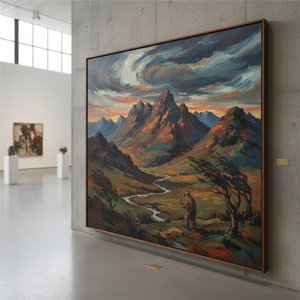 Evan Walters: A Study in Contemporary Landscape Painting & Emotional ResonanceExplore the captivating world of Evan Walters, a Welsh artist renowned for his evocative landscapes & social commentary. Discover his Impre…
 The Energetic Canvas: Exploring Dynamic Composition in Art History & Contemporary PracticeExplore the history of dynamic composition in art, from Renaissance chiaroscuro to modern asymmetry. Learn how masterful artists used balan…