Skift til printsalg
 Vis mere







































 For kunstværker eller reproduktioner, der er større end 105 cm (ca. 41 tommer) på en hvilken som helst side, vil rammen blive leveret som et adskilt sæt. Denne metode sikrer sikker levering og forhindrer skader under transport.


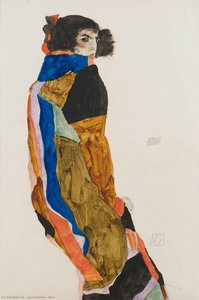
A Window into Adolescent Anguish: Egon Schiele’s ‘Boy with Hand to Face’
Egon Schiele's 1910 watercolor, *Boy with Hand to Face*, is more than just a portrait; it’s a visceral exploration of inner turmoil and the complexities of adolescence. Measuring 43 x 33 cm, this deceptively simple work encapsulates the raw emotionality that defines Schiele’s contribution to Expressionism. The painting doesn't merely *show* us a boy; it invites us to *feel* with him.Decoding the Gesture and Form
The composition is strikingly direct. A young male figure, rendered in muted browns and creams punctuated by stark white lines, dominates the frame. His hand pressed against his face isn’t a gesture of shyness, but one of profound introspection – or perhaps even despair. The pose suggests a withdrawal from the world, a turning inward to confront uncomfortable truths. Schiele deliberately distorts proportions; the body is elongated and angular, contributing to an overall sense of unease. This isn't about anatomical accuracy, it’s about conveying psychological state.Schiele’s Expressionistic Technique
Schiele masterfully employs watercolor to achieve a delicate yet unsettling effect. The washes are layered, creating subtle variations in tone and texture that heighten the emotional impact. His signature use of bold, often jagged lines – particularly the white outlines – doesn't define form so much as *contain* it, suggesting fragility and isolation. This technique is characteristic of his Expressionist style, prioritizing subjective experience over objective representation. The roughness of the brushwork adds to the immediacy and authenticity of the piece.Historical Context: Vienna 1910
Created in a period of significant social and artistic upheaval, *Boy with Hand to Face* reflects the anxieties of early 20th-century Vienna. Schiele was part of a generation grappling with changing societal norms, psychological exploration (influenced by Freud), and a growing sense of alienation. His work challenged traditional academic painting, embracing subjectivity and emotional intensity. He rejected the idealized beauty of earlier eras in favor of a more honest – and often unsettling – portrayal of the human condition.Symbolism and Emotional Resonance
The symbolism within the piece is potent yet open to interpretation. The obscured face invites projection; we are left to imagine the source of the boy’s distress. The stark white lines can be seen as barriers, representing emotional detachment or a sense of being trapped. Vulnerability, sadness*, and *isolation* are palpable emotions radiating from the canvas. Schiele doesn't offer answers; he presents us with a question – a poignant meditation on the human experience.Schiele’s Legacy & Collecting Today
Egon Schiele’s influence extends far beyond his tragically short life (1890-1918). His unflinching exploration of psychological themes paved the way for future generations of artists. Today, original Schiele paintings reside in major museums like the Österreichische Galerie Belvedere and the Leopold Museum in Vienna. For those seeking to bring a piece of this artistic legacy into their homes or design projects, high-quality reproductions offer an accessible alternative.Explore More by Egon Schiele:
- Seated Male Nude, Right Hand Outstretched – A study in vulnerability and the human form.
- Standing Male Nude – Demonstrating Schiele’s bold and unconventional approach to portraiture.
- Poldi Lodzinsky – A compelling example of Schiele’s portrait work.
Spørgsmål og svar
Hvor lys eller mørk fremstår "Boy with Hand to Face" af Egon Schiele?
Overordnet set er "Boy with Hand to Face" registreret som lysende. Den oplevede lysstyrke beskriver, hvor lyst eller mørkt værket fremstår.
Hvornår og med hvilke materialer blev "Boy with Hand to Face" skabt?
"Boy with Hand to Face" af Egon Schiele er udført i Akryl på lærred og er fra 1910.
Hvilken fase i Egon Schieles karriere svarer datoen 1910 for "Boy with Hand to Face" til?
Dateringen fra 1910 placerer "Boy with Hand to Face" i Early Period af Egon Schiele's udvikling.







 Se i rummet
 Del som kort
 Del
Del
 Detaljer
 Guide
Guide

 Download
 Lignende værker
 Røntgenundersøgelse
 Diasshow
 Q&A
Q&A Statistikker