Expressionism · 1893
Storm (Edvard Munch, 1893)
Edvard Munch (1863–1944) har skabt Storm. Det er fra 1893. Det tilhører Expressionism-bevægelsen. Den er udført i Oil On Canvas.
- 1893
- Oil On Canvas

 Se i rummet

 Håndmalet oliemalerie
 Del som kort
 Del
 Guide


 Download
 Lignende værker
 Røntgenundersøgelse
 Diasshow
 Spørgsmål og svar

 Statistikker
Storm: det vigtigste
- Titel
- Storm
- Kunstner
- Edvard Munch (1863–1944)
- Kunstner født i
- Ådalsbruk, Norge
- Dato
- 1893
- Medium
- Oil On Canvas
- Bevægelse
- Expressionism
- Motiv
- storm, anxiety, darkness, landscape, emotion, turmoil
Hvad forestiller Storm?
A Tempestuous Soul: Edvard Munch’s “The Storm”
Edvard Munch's "The Storm," painted in 1893, isn’t merely a depiction of a raging tempest; it’s a visceral embodiment of inner turmoil—a profound exploration of anxiety and the fragility of human existence. This iconic work, currently residing within the esteemed collection of the Museum of Modern Art (MoMA) in New York City, stands as a cornerstone of Expressionism, a movement that sought to capture not just external reality but the raw, unfiltered emotions simmering beneath the surface. Munch, already grappling with personal tragedies including the early deaths of his mother and sister, channeled these profound experiences into a visual language characterized by bold color, distorted forms, and an unsettling sense of unease—elements powerfully realized in “The Storm.” The painting’s power resides not just in its dramatic subject matter but in its ability to evoke a deeply felt emotional response within the viewer, mirroring the artist's own turbulent inner world.
Visualizing Inner Chaos: Style and Technique
Munch’s technique is deliberately unsettling. The composition immediately plunges the viewer into a scene of chaotic energy. Thick, swirling brushstrokes dominate the canvas, conveying the relentless force of the wind and rain. These aren't delicate lines; they are aggressive marks, imbued with an almost frantic quality. The color palette contributes significantly to this sense of unease. Muted tones—primarily deep blues, grays, and ochres—create a somber atmosphere, punctuated by jarring flashes of intense yellow in the clouds and the distant light. This contrast isn’t merely aesthetic; it represents the struggle between darkness and hope, despair and perhaps a fleeting glimpse of resilience. The figure in the foreground, rendered with simplified forms and a slightly elongated face, seems to be caught within this maelstrom, her posture suggesting both vulnerability and a desperate attempt to maintain composure. Note how Munch uses perspective—the receding road and distant house create a sense of isolation and emphasize the overwhelming power of nature.
Symbolism and Psychological Depth
“The Storm” is rich in symbolic meaning, deeply rooted in Munch’s personal experiences and his exploration of psychological themes. The storm itself represents not just meteorological conditions but also the internal storms raging within the human psyche—fear, grief, anxiety, and a sense of impending doom. The woman standing on the road has been interpreted as representing humanity confronting these forces, perhaps even succumbing to them. Some scholars connect her posture and gaze to depictions of women awaiting news from loved ones lost at sea – a poignant reflection of Munch’s own anxieties about loss and mortality. The distant house, barely visible through the storm clouds, symbolizes a fragile sense of security, threatened by the overwhelming power of nature. The overall composition can be viewed as an allegory for the human condition—a constant struggle against forces beyond our control.
A Legacy of Emotional Intensity
Edvard Munch’s “The Storm” remains a profoundly moving and influential work of art, solidifying his place as a pioneer of Expressionism. Its enduring appeal lies in its ability to tap into universal emotions—fear, anxiety, and the awareness of our own mortality. Reproductions of this masterpiece offer an opportunity to experience the raw emotional power of Munch’s vision firsthand. Whether displayed in a grand salon or a more intimate setting, “The Storm” continues to resonate with viewers, reminding us of the complexities of the human spirit and the enduring beauty—and terror—of the natural world. For those seeking a high-quality reproduction, OriginalUniqueArt.com offers meticulously crafted hand-painted versions that faithfully capture the essence of this iconic artwork. Further exploration into Munch’s life and artistic journey can be found on platforms like Edvard Munch on OriginalUniqueArt.com and through resources such as Smarthistory and the Metropolitan Museum of Art.
Storm i høj opløsning

Public domain: kunstneren døde i 1944.
Flere størrelser, beskæringer og kildehenvisning →Edvard Munch, Storm (1893). Public domain
En digital ekspert kontrollerer farverne i forhold til det originale maleri og retoucherer filen, så den er tro mod kunstnerens penselstrøg.
Køb billedet i høj opløsningSpørgsmål om Storm
Hvor mættet er farvepaletten i "Storm"?
Farverne i "Storm" af Edvard Munch har en Balanced Soft mætning. Mætning beskriver, hvor livlige eller dæmpede farverne er.
Hvad anbefales en reproduktion af "Storm" af Edvard Munch til?
Den foreslåede anvendelse af "Storm" af Edvard Munch er Statement, men den kan også tjene andre formål.
Hvordan beskrives stemningen i "Storm" af Edvard Munch?
Den overordnede stemning i "Storm" af Edvard Munch er Dramatic. Stemningen beskriver værkets generelle atmosfære.
Hvordan beskrives farvepaletten i "Storm" af Edvard Munch?
Farvepaletten i "Storm" af Edvard Munch beskrives som Earthy. Det er en kortfattet beskrivelse af værkets farver.
Er "Storm" typisk for det, som Edvard Munch normalt skabte?
"Storm" skildrer storm, anxiety, darkness, landscape, emotion, turmoil, night, mens Edvard Munchs registrerede temaer er german expressionism, psychological angst, personal trauma, emotional intensity, symbolic landscape, inner turmoil, monet’s color, van gogh's brush. En sammenligning af de to viser, hvordan værket relaterer sig til kunstnerens sædvanlige motiver.
Hvilken fase i Edvard Munchs karriere svarer datoen 1893 for "Storm" til?
"Storm", skabt i 1893, tilhører Late Period af Edvard Munch's karriere.
Hvilken placering passer bedst til formatet på "Storm" af Edvard Munch?
Med sin Landscape form foreslås en reproduktion af "Storm" til et Living Room.
Hvordan passer "Storm" ind i Edvard Munchs temaer og stil?
I Edvard Munchs samlede værk placerer "Storm" sig i Expressionism-stilen, sammen med temaerne omkring german expressionism, psychological angst, personal trauma, emotional intensity, symbolic landscape, inner turmoil, monet’s color, van gogh's brush.
Hvilket rum komplementerer farverne i "Storm" af Edvard Munch?
De Earthy farver i "Storm" af Edvard Munch matcher det anbefalede rum: et Living Room.
Om kunstneren, Edvard Munch

1863–1944, Norge
Edvard Munch
Livet og identiteten bag Edvard Munch Edvard Munch var en norsk maler, hvis liv var dybt vævet sammen med landskaberne og den tunge atmosfære i hans hjemland. Han blev født den 12. december 1863, og han brugte størstedelen af sin eksistens på at navigere i den menneskelige psykes kompleksitet gennem pensel og grafiske værktøjer. Hans værker føltes ofte som en direkte forlængelse af hans egne indre kampe, hvor han transformerede private følelser til noget synligt og fælles.
Også af Edvard Munch
 Skrik1893
 Vampyr nasjonalgalleri oslo
 Pubertet1914
 Angst 21894

Essays om Storm
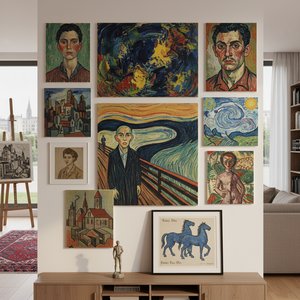 Top 10 Ekspressionistiske Mesterværker: Kunst der Rører Sjælen – OriginalUniqueArt.dkOplev de 10 mest ikoniske ekspressionistiske malerier! Fra Munchs Skrig til Kandinskys abstraktion – dyk ned i kunstens sjæl og intensitet.…
 Echoes of Anxiety: The 25 Most Iconic Masterpieces by Edvard MunchJourney through the raw emotion of Expressionism with our curated guide to Edvard Munch's top 25 masterpieces. Explore the stories behind h…
 Unveiling the Masterpieces: Top 25 Must-See Artworks at the Munch Museum in OsloExplore 25 iconic Edvard Munch masterpieces from Oslo's Munch Museum. Discover timeless Expressionist art on OriginalUniqueArt.com.