Skift til printsalg
 Vis mere







































 For kunstværker eller reproduktioner, der er større end 105 cm (ca. 41 tommer) på en hvilken som helst side, vil rammen blive leveret som et adskilt sæt. Denne metode sikrer sikker levering og forhindrer skader under transport.


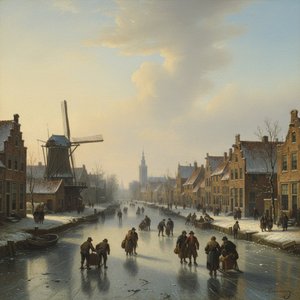
A Serene Dutch Landscape: "River Sun" by Charles Henri Joseph Leickert
This captivating artwork, titled "River Sun," presents a quintessential Dutch landscape scene rendered with remarkable detail and tranquility. The painting depicts a riverbank bustling with activity – a windmill stands proudly against the horizon, boats gently navigate the water, and a small town nestles in the distance. Characteristic of the Dutch Golden Age tradition, Leickert’s work emphasizes realistic depiction of everyday life intertwined with the natural beauty of the countryside.
Style and Technique: A Blend of Realism and Romanticism
Charles Henri Joseph Leickert (1816-1907), a Belgian painter deeply influenced by Dutch masters, skillfully blends elements of Realism and Romanticism in "River Sun." The painting’s composition is carefully balanced, with the horizon line dividing the sky and land, creating a sense of harmony. The foreground features a muddy bank teeming with vegetation, leading the viewer's eye towards the central river and the distant town. Leickert masterfully employs horizontal lines to reflect the water and the flatness of the landscape, while vertical elements like the windmill and buildings add structural contrast. The shapes are predominantly organic – trees, clouds, boats – seamlessly integrated with geometric forms such as the windmill blades and building structures.
The technique is primarily oil painting, showcasing Leickert’s expertise in layering and blending pigments mixed with linseed oil onto canvas. This meticulous approach creates a soft, layered texture that evokes a sense of atmosphere and depth. The diffused, natural lighting casts gentle shadows and highlights the textures of the water and foliage, contributing to the overall realism of the scene.
Historical Context and Influences
Leickert’s artistic journey began in The Hague under the tutelage of renowned landscape painters such as Bartholomus van Hove, Wijnand Nuijen, and Andreas Schelfhout. This foundational training instilled in him a deep appreciation for capturing the essence of winter landscapes, but his talent extended to depicting scenes like "River Sun," showcasing the vibrancy of summer along Dutch waterways. The painting reflects the broader artistic trends of the 19th century, particularly the Romantic movement’s focus on landscape and emotion, while remaining firmly rooted in the Realist tradition of meticulous observation and accurate representation.
Symbolism and Emotional Impact
"River Sun" is more than just a picturesque scene; it evokes a profound sense of tranquility, prosperity, and connection with nature. The windmill symbolizes industry and progress, while the boats represent trade and connectivity. The gentle river reflects the passage of time and the enduring beauty of the Dutch countryside. The overall effect is one of peaceful observation and appreciation for the natural world – an invitation to pause and reflect on the simple joys of life. Leickert’s skillful rendering creates a believable three-dimensional space, drawing the viewer into this idyllic scene and fostering a sense of calm and serenity.
Further Exploration
- Learn more about Charles Henri Joseph Leickert's life and work
- View "View on a village near to a river Sun" by Leickert
- Explore "Summer river view Sun" another work by the artist.
Spørgsmål og svar
Kan jeg se "river sun" som et diasshow i fuld skærm?
Se diaporamabillederne af "river sun" på værkets side Billedserie.
Hvordan relaterer stilen i "river sun" sig til kunstnerens samtid?
"river sun" af Charles Henri Joseph Leickert tilhører Realism-bevægelsen fra sin skabers det 19. århundrede-æra.
Fremstår farverne i "river sun" kraftige eller bløde?
Farverne i "river sun" af Charles Henri Joseph Leickert har en Monochromatic intensitet.
 Se i rummet
 Del som kort
 Del
Del
 Detaljer
 Guide
Guide

 Download
 Lignende værker
 Røntgenundersøgelse
 Diasshow
 Spørgsmål og svar
 Statistikker