
 Se i rummet
 Del som kort
 Del
Del
 Detaljer
 Guide
Guide

 Download
 Lignende værker
 Røntgenundersøgelse
 Diasshow
 Spørgsmål og svar
 Statistikker
Korinth med Akrokorinth

- 162.0 x 206.0 cm


 Vis mere
Giclée / Kunsttryk
Giclée- eller lærredstryk i museumskvalitet med hurtig produktion og fleksible muligheder for finish. ( Køb håndmalet maleri Skift til digitalt billede)




P118B Dkr10

P118H Dkr10

P118W Dkr10

P438Z Dkr10

P508JH Dkr12

P508YH Dkr12

P805H Dkr10

P805Z Dkr10

P919BZ Dkr10

P919G Dkr10

P919XJ Dkr10

P959ZH Dkr10

P968JZ Dkr12

W106C Dkr8

W218G Dkr10

W218JH Dkr8

W218Y Dkr10

W307PJ Dkr10

W316G Dkr10

W316PJ Dkr8

W316Y Dkr10

W398PJ Dkr8

W4111J Dkr10

W500HY Dkr15

W500JH Dkr15

W692G Dkr12

W849H Dkr8

W940BG Dkr15

W953PJ Dkr8




Vælg mellem vores forudindstillede størrelser, der matcher kunstværkets originale proportioner.

Indtast den bredde og højde, du har brug for, så det passer til din ramme eller din væg. Et print kan kun beskæres, aldrig gøres større end selve billedet, så en størrelse med et andet format vil medføre, at dele af motivet går tabt. Vi sender dig en digital mockup til godkendelse, før vi printer noget. Billedet vist på denne side viser ikke den faktiske beskæring — det er kun mockuppen, der gør.
Verdensomspændende levering () på 2 uger i stedet for de sædvanlige 4/5 uger. (7 november)

Gratis ekspresforsendelse til hele verden

Lærred af linned i høj kvalitet

Fuld transportforsikring

Garanti for refusion af told og importafgifter

Garanti for præcis farvegengivelse

100 dages returret ved fabrikationsfejl

100% fuld returret

Mængderabat ved flere køb
 Glasmulighed er kun tilgængelig i størrelser under 110 cm

Korinth med Akrokorinth
Giclée / Kunsttryk
Størrelse på reproduktion
-


Samlet pris
Dkr 540
Carl Rottmanns Betrag zum Landschaftsbild
Carl Anton Joseph Rottmann (11 januar 1797, i Handschuhsheim (i dag en del af Heidelberg) – 7 juli 1850, i München) var en tysk landskabsmaler og den mest kendte medlem af Rottmann familien af malere. Rottmann tilhørte kredsen af kunstnere omkring Kong Ludwig I af Bayern, som bestilte store landskabsmalerier eksklusivt fra ham. Han er bedst kendt for mytiske og heroiske landskaber. Landskabsmaler Karl Lindemann-Frommel var hans skole. Rottmann blev født i Handschuhsheim (Heidelberg) den 11 januar 1797. Der modtog han sine første tegneundervisning fra sin far, Friedrich Rottmann, som underviste Rottmanns tidlige karriere fokuserede på portrætter, hvor han producerede elegante og karakterfulde gengivelser af lokale patriciere og købmænd. Disse værker demonstrerede hans mesterskab i komposition og hans evne til at udtrykke personlighed gennem perspektiv og lys. Rottmanns stil var præget af romantikken, hvilket manifesterede sig i dramatiske farver og dynamiske komposotioner, hvor naturligt lys spillede en central rolle. Han søgte inspiration fra klassisk kunst og arkitektur, hvilket gjaldt både hans tekniske færdigheder og hans kunstneriske vision. Rottmanns arbejde var ikke blot teknisk præcist, men også følelsesmæssigt resonerende, hvilket afspejlede den romantiske ånds søgen efter skønhed og ærefrygt for naturen. Han blev en betydelig figur i kunsthistorien og hans værker fortsætter med at fascinere publikum over hele verden.- Teknik: Rottmann anvendte ofte encaustic teknikken, hvor varme smeltet voksfarver blev påført til et træpanel. Denne metode gav malerierne en unik tekstur og dybde samt mulighed for at skabe dramatiske effekter af lys og skygge.
- Tema: Rottmanns landskaber fokuserte ofte på majestætiske fjeldlandskaber og søområder, hvilket var populære motiver blandt romantiske kunstnere. Han forsøgte at fange essensen af naturens kraft og skønhed samt menneskets forhold til omgivelsen.
- Symbolik: Rottmanns værker indeholder ofte symboliske elementer, der henviser til religiøse og filosofiske ideer. Disse symboler kan være subtile eller åbenlyse og bidrager til kunstværkernes komplekse betydning.
Spørgsmål og svar
Hvad anbefales en reproduktion af "Korinth med Akrokorinth" af Carl Anton Joseph Rottmann til?
Det anbefales at bruge et tryk af "Korinth med Akrokorinth" til Accent.
Kan jeg se et røntgenbillede af "Korinth med Akrokorinth" af Carl Anton Joseph Rottmann?
Røntgenoptagelse-siden til "Korinth med Akrokorinth" af Carl Anton Joseph Rottmann er en interaktiv viewer, der lader dig glide gennem elleve optiske lag af værkets billede, herunder en visning i røntgenstil.
Hvad forestiller "Korinth med Akrokorinth" af Carl Anton Joseph Rottmann, og hvilken stemning formidler det?
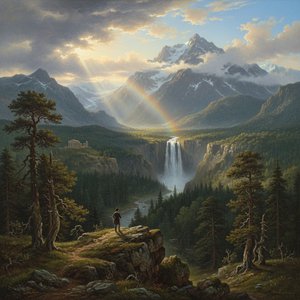
"Korinth med Akrokorinth" viser mountain landscape, desert scene, classical composition, dramatic light, mythical imagery, romantic era, landscape painting, og den indfangede stemning er Romantisk.
Kunstnerbiografi
The Visionary Landscapes of Carl Rottmann
Born in the tranquil setting of Handschuhsheim, Germany, in 1797, Carl Anton Joseph Rottmann emerged as a profound voice within the movement of German Romanticism. His life and artistry were deeply intertwined with the shifting landscapes of 19th-century Europe, reflecting a period where the sublime beauty of nature met the burgeoning spirit of national identity. Unlike many of his contemporaries who focused on the intimate or the domestic, Rottmann possessed an expansive vision, seeking to capture the monumental scale of the world through sweeping vistas and mythic atmospheres. His journey was one of constant movement, traveling through the rugged terrains of Greece, Italy, and the Bavarian Alps, each location leaving an indelible mark on his palette and his perception of the divine within the natural world.
The development of Rottmann’s style was a masterful evolution from classical precision to a more emotive, atmospheric approach. Influenced by the grand traditions of landscape painting, he moved beyond mere topographical accuracy to embrace the sublime—that specific Romantic quality of awe and terror inspired by the vastness of nature. His technique involved a sophisticated understanding of light and shadow, using them not just to define form, and shape, but to evoke a sense of historical weight and mythic presence. In his hands, a mountain range was never just stone and ice; it was a silent witness to antiquity, a stage for the legends of old. This ability to infuse physical geography with spiritual and historical narrative became the hallmark of his mature period.
A Legacy of Light and Myth
Rottmann’s achievements are most notably seen in his ability to bridge the gap between the tangible world and the realm of imagination. His works often serve as windows into a lost era, where the ruins of ancient civilizations seem to breathe under the soft glow of a Mediterranean sun or the misty shroud of a northern forest. Through his meticulous attention to the interplay of light upon textures—the roughness of weathered stone, the translucency of water, and the softness of clouds—he achieved a level of luminosity that captivated the art world of his time.
The historical significance of his oeuvre lies in its role as a cornerstone of Romantic landscape art. His contributions can be summarized through several key artistic pillars:
- The Synthesis of History and Nature: He pioneered a method of painting where the landscape itself acts as a vessel for historical memory, blending archaeological interest with poetic expression.
- Mastery of Atmospheric Perspective: His use of color temperature and clarity to create depth allowed viewers to feel immersed in the vastness of his depicted scenes.
- Cultural Documentation: Through his travels, he provided a visual record of the European landscapes that were central to the Romantic identity, particularly the Greek and Bavarian vistas.
Ultimately, the work of Carl Rottmann remains a testament to the power of the gaze to transform the ordinary into the extraordinary. He did not merely paint what he saw; he painted what he felt in the presence of greatness. His legacy continues to resonate with those who find beauty in the monumental and meaning in the silent, enduring features of our earth, ensuring his place as a vital figure in the tapestry of 19th-century European art.

Carl Anton Joseph Rottmann
1797 - 1850 , Germany
Kort om kunstneren
- Full Name: Joseph Wright of Derby
- Nationality: English
- Date Of Birth: 1797
- Date Of Death: 1850
- Place Of Birth: Handschuhsheim, Germany
- Notable Artworks:
- An Experiment on a Bird in the Air Pump
- The Slaughtered Horse
- A Man Defending His Cart
- Artistic Movement Or Style: Romanticism, Neoclassicism
- Artists Who Influenced This Artist:
- Janys Zedres
- Rembrandt
- Artists Or Movements Influenced By This Artist:
- Joshua Reynolds
- Romanticism
Relaterede artikler

Romantikkens Landskaber: Top 10 Malerier der Definerede En Æra | OriginalUniqueArt
Oplev romantikkens storhedstid! Dyk ned i top 10 landskabsmalerier af Caspar David Friedrich, Turner & Constable. Historiske fortællinger og museumskvalitets reproduktioner på OriginalUniqueArt.com – find din inspiration til væggen her!

The Sublime and the Picturesque: Exploring Emotion & Nature in Romantic Landscape Painting
Explore the emotional power of Romantic landscape painting! Discover the sublime & picturesque traditions, key artists like Friedrich & Cole, and find your perfect artwork at OriginalUniqueArt.
Evoking Nature's Sublime: A Comprehensive Exploration of 19th-Century Landscape Painting
Explore the captivating world of 19th-century landscape painting! Discover renowned artists like Friedrich & Monet, key movements, and find the perfect artwork to bring nature's serenity into your home. Expert insights at OriginalUniqueArt.

John Constables 25 Mesterværker: En Hyldest til Englands Landskabskunst | OriginalUniqueArt.com
Oplev John Constables 25 mest ikoniske værker! Fordyb dig i engelsk romantik, betagende landskaber og tidløs skønhed. Køb museumskvalitets reproduktioner af 'The Hay Wain' & mere på OriginalUniqueArt.com – inspiration til dit hjem.

Evocations of Place: A Historical Journey Through Landscape Art
Explore the rich history of landscape art with OriginalUniqueArt. Discover renowned artists, movements like Impressionism & Romanticism, and expert guidance for collecting timeless pieces. Find your perfect serene escape today!


