
 Se i rummet
 Send
Send Del
Del
 Detaljer
 Studieguide til kunstværker

 Download
 Lignende værker
 Røntgenundersøgelse
 Se diasshow
 Statistik
Fall of Simon Magus
 Oil On Canvas
- WallArt
 1461
1461 24.0 x 35.0 cm
 Royal Collection
 Læs mere
Håndlavet oliereproduktion
Håndmalet olie på lærred i din valgte størrelse og ramme, udført efter bestilling af vores kunstnere. ( Skift til printversion Skift til digitalt billede)




P118B Dkr10

P118H Dkr10

P118W Dkr10

P438Z Dkr10

P508JH Dkr12

P508YH Dkr12

P805H Dkr10

P805Z Dkr10

P919BZ Dkr10

P919G Dkr10

P919XJ Dkr10

P959ZH Dkr10

P968JZ Dkr12

W106C Dkr8

W218G Dkr10

W218JH Dkr8

W218Y Dkr10

W307PJ Dkr10

W316G Dkr10

W316PJ Dkr8

W316Y Dkr10

W398PJ Dkr8

W4111J Dkr10

W500HY Dkr15

W500JH Dkr15

W692G Dkr12

W849H Dkr8

W940BG Dkr15

W953PJ Dkr8




Vælg mellem vores forudindstillede størrelser, der matcher kunstværkets originale proportioner.

Indtast den bredde og højde, du har brug for, så det passer til din ramme eller din væg. Da dette er håndmalet, kan kunstneren ved en anden form på størrelsen male lidt mere rundt om billedet eller skære lidt væk — det er op til dig. Vi sender dig et digitalt mockup til godkendelse, før maleriet påbegyndes. Billedet, der vises på denne side, viser ikke det endelige resultat — det er kun mockuppet, der gør.
Efter bestilling vil OriginalUniqueArt.com team sende en e-mail til kunden for at indhente instruktioner og fremsende et udkast til gennemgang.
Levering i hele verden () på 3-4 uger i stedet for de standard 5 uger. (26 oktober). Ingen kompromiser med kvaliteten.

Gratis ekspresforsendelse til hele verden

Lærred af linned i høj kvalitet

Komplet transportforsikring

Garanti for refusion af told og importafgifter

Garanti for autentisk farvegengivelse

100 dages returret ved fabrikationsfejl

100% fuld returret

Mængderabat ved flere køb
 Glasmulighed er kun tilgængelig i størrelser under 110 cm

Fall of Simon Magus
Reproduktionsmateriale
Reproduktionsstørrelse
-


Samlet pris
Dkr 1968
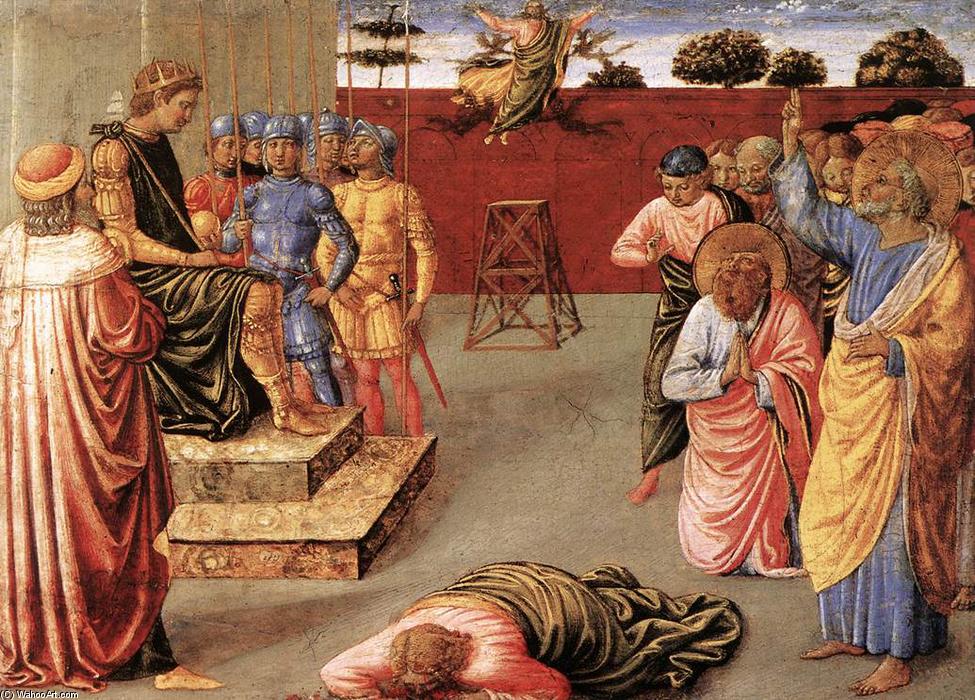
The Fall of Simon Magus: A Triumph of Venetian Gothic Style
Benozzo Gozzoli’s “Fall of Simon Magus,” painted in 1461-62, stands as a remarkable testament to the burgeoning artistic fervor of Renaissance Florence and its embrace of international stylistic influences. Commissioned for the altarpiece of Santa Maria della Purificazione e di San Zanobi—a confraternity dedicated to Saint Peter and Saint Paul—the panel embodies Gozzoli’s masterful command of Venetian Gothic, marking him as a pivotal figure in bridging the gap between medieval grandeur and humanist innovation.
- Subject Matter: The artwork recounts an episode from Jacobus de Voragine's *Golden Legend*, depicting Simon Magus’ audacious attempt to ascend to heaven by launching himself from a tower, fueled by ambition and defiance of divine authority. Peter, guided by Nero’s counsel, intervenes, commanding the demonic forces supporting Simon to release his grip on the earth.
- Style & Technique: Gozzoli employed tempera paint on poplar panel—a technique favored for its vibrancy and durability—resulting in a luminous surface adorned with intricate detail. The Venetian Gothic style is evident in the elongated figures, expressive drapery, and dramatic composition, reflecting the stylistic trends prevalent in Venice at the time.
- Historical Context: Painted during a period of intense artistic experimentation, “Fall of Simon Magus” aligns itself with the broader Renaissance preoccupation with moral allegory and biblical narratives. It speaks to themes of faith versus heresy, humility versus pride—concepts central to humanist thought.
Composition & Symbolism: A Dynamic Narrative
The painting’s dynamism is immediately striking. Gozzoli skillfully orchestrates a complex visual narrative, utilizing diagonal lines and overlapping planes to convey movement and tension. The central figure of Simon Magus dominates the composition, positioned precariously atop the tower—a symbol of ambition and earthly aspiration—while angels descend from above, representing divine intervention and judgment. Nero’s presence on the left underscores the imperial patronage that fueled artistic endeavors during this era.
- Color Palette: Gozzoli utilizes a rich color palette characterized by deep reds, blues, and golds—colors traditionally associated with royalty and piety—to heighten the emotional impact of the scene. The luminous hues contribute to the overall sense of grandeur and drama.
- Symbolic Imagery: Beyond its narrative content, “Fall of Simon Magus” incorporates symbolic imagery that reinforces its moral message. The tower represents ambition and pride, while the angels embody divine grace and redemption. The depiction of Simon’s lifeless body serves as a poignant reminder of earthly mortality.
Legacy & Influence
"Fall of Simon Magus" exemplifies Gozzoli's artistic genius and solidified his reputation as one of Florence’s foremost painters. Its influence extended beyond its immediate commission, inspiring subsequent artists to explore similar stylistic approaches and thematic concerns. Today, the panel resides in Hampton Court Palace, where it continues to captivate viewers with its masterful execution and enduring beauty—a timeless masterpiece that encapsulates the spirit of Renaissance art.
For more information on Benozzo Gozzoli and his works, visit Benozzo Gozzoli on Wikipedia. Handmade oil paintings reproductions of the Fall of Simon Magus can be found at OriginalUniqueArt.comSpørgsmål & svar
Hvad er målene på det originale værk "Fall of Simon Magus" af Benozzo Gozzoli?
"Fall of Simon Magus" måler 24 x 35 cm i sin oprindelige form. De originale dimensioner er en nyttig reference, når du skal vælge størrelsen på en reproduktion.
Hvilken følelse skaber farverne i "Fall of Simon Magus" af Benozzo Gozzoli?
Den Dark farvepalet i "Fall of Simon Magus" af Benozzo Gozzoli harmonerer med værkets Dramatic følelsesmæssige tone. Farven er en af de måder, et værk formidler følelser på.
Er farverne i "Fall of Simon Magus" af Benozzo Gozzoli mættede eller dæmpede?
Farverne i "Fall of Simon Magus" af Benozzo Gozzoli har en Clear Color Presence mætning. Mætning beskriver, hvor livlige eller dæmpede farverne er.
Om kunstneren
Early Life and Artistic Foundations
Benozzo Gozzoli, en fascinerende figur i den italienske renæssances kunst, blev født i Firenze omkring 1420. Hans barndom var præget af en familie med rødder i landdistrikterne, men han fandt sin vej til det pulserende kunstneriske liv i hjertet af Firenze. Selvom hans far var tøjmand, viste Benozzo tidligt et talent for håndværk og dekorativ kunst – sandsynligvis som guldsmed eller bronzebeskriver – før han fuldt ud dedikerede sig til maleriet. En vigtig milepæl i hans tidlige karriere var en samarbejdsaftale med den berømte billedhugger Lorenzo Ghiberti på det tredje bronzeport til Firenze's Baptisterium, et projekt der allerede demonstrerede hans evner og ambitioner. Denne tidlige erfaring, sammen med hans mentorforhold til Fra Angelico – en af de mest indflydelsesrige kunstnere i sin tid – lagde grundlaget for hans senere stil og teknikker. Fra Angelicos undervisning, især i den internationale gotiske stil, var afgørende for at forme Gozzolis unikke visuelle udtryk.The Medici Chapel and International Gothic Style
Gozzoli’s mest berømte værk er uden tvivl freskomaleden i Cappella dei Magi i Palazzo Medici-Riccardi i Firenze. Denne monumental skabelse, udført mellem 1459 og 1460 på bestilling af familien Medici, repræsenterer et vendepunkt i hans karriere og et perfekt eksempel på hans kunstneriske udvikling. Det er her, Gozzoli virkelig slår igennem med sin evne til at kombinere den internationale gotiske stil med tidlige renæssanceelementer. Scenen "Rejsen af de tre vise mænd" er ikke blot en historisk fortælling; det er et visuelt festfyrværk, der fyldes med detaljer, farver og en følelse af bevægelse og drama. Gozzoli udviser en bemærkelsesværdig dygtighed i at skildre menneskelige figurer med enestående realisme og psykologisk indsigt – et tydeligt tegn på hans uddannelse under Fra Angelico. Samtidig er det tydeligt, at han har studeret de seneste tendenser inden for kunstnerisk stil, især fra Domenico Veneziano og Filippo Lippi.Collaborations and Travels
Gozzoli var ikke blot en selvstændig kunstner; han var også en ivrig samarbejdspartner og deltog i prestigefyldte projekter over hele Italien. Hans arbejde med Lorenzo Ghiberti på Baptisteriet dannede grundlaget for hans karriere, og hans engagement under Fra Angelico i Vatikanet gav ham værdifuld erfaring og inspiration. Han tilbragte også betydelige perioder i Rom, hvor han assisterede Fra Angelico ved freskeverket i kapellet til pave Nicholas V, og senere arbejdede for pave Eugene IV i Santa Maria in Aracoeli. Hans rejser spredte hans kunstneriske indflydelse ud over Firenze og gav ham mulighed for at studere forskellige stilarter og teknikker. Hans arbejde i Pisa, hvor han malede en stor serie af fresker til Camposanto (kirkegården), er et bevis på hans evne til at tilpasse sig lokale traditioner og smag.Later Works and Legacy
I de senere år af sit liv fortsatte Gozzoli med at skabe værker i forskellige byer, herunder San Gimignano og Perugia. Hans seneste arbejde, en omfattende freskefortælling for det gamle Campo Santo i Pisa, er et imponerende eksempel på hans kunstneriske modenhed og evne til at kombinere historisk fortælling med dekorativ elegance. Benozzo Gozzoli døde i Pistoia i 1497, men hans arv lever videre gennem hans mange værker, der stadig betragtes som nogle af de mest fremtrædende eksempler på den internationale gotiske stil og tidlig renæssancekunst i Italien. Hans evne til at skabe levende, dynamiske billeder, der kombinerer detaljeret realisme med en følelse af æstetisk harmoni, har gjort ham til en elsket og beundret kunstner gennem århundreder.Key Dates
* **Born:** c. 1420, Florence, Italy * **Active in:** Florence, Umbria, Rome (1444-1497) * **Died:** 1497, Pistoia, Italy
Benozzo Gozzoli
1420 - 1497 , Italien
Hurtige fakta
- Artistic Movement Or Style: International Gotisk
- Artists Or Movements Influenced By This Artist: ['Renaissance']
- Artists Who Influenced This Artist:
- Fra Angelico
- Ghiberti
- Date Of Birth: 1420
- Date Of Death: 1497
- Full Name: Benozzo di Lese
- Nationality: Florentinsk
- Notable Artworks:
- Procession Magi
- St Francis
- Place Of Birth: Florenz, Italien
Relaterede artikler

Benozzo Gozzoli: Narrative Innovation & Secular Humanism in Early Renaissance Frescoes
Explore the innovative frescoes of Benozzo Gozzoli, a key Florentine Renaissance painter. Discover his unique blend of religious narrative, secular humanism & detailed portraiture in masterpieces like the Magi Chapel cycle.
Late Medieval Masterpieces: 10 Artworks That Defined an Era | OriginalUniqueArt
Journey through 10 defining Late Medieval masterpieces – from Giotto's frescoes to Jan van Eyck’s realism. Explore the stories, techniques & vibrant colors of Gothic art. Find museum-quality reproductions and elevate your home decor with OriginalUniqueArt.com! Discover all masterpieces on OriginalUniqueArt.com
High Medieval Art: 10 Masterpieces That Shaped an Era | OriginalUniqueArt
Journey through High Medieval Art! Explore 10 iconic masterpieces – from Giotto's frescoes to stunning Gothic cathedrals. Discover the stories behind these timeless paintings, sculptures & illuminated manuscripts. Find museum-quality art reproductions at OriginalUniqueArt.com.

Simon Vouet: A Baroque Master's Journey from Italian Influence to French Classicism
Explore the life & art of Simon Vouet, a pivotal French Baroque painter who introduced Italian styles to France. Discover his masterpieces and lasting influence on 17th-century art.

Divine Light & Golden Splendor: A Journey Through the Sacred Grandeur of High Medieval Art
Embark on a soulful journey through High Medieval art. Explore the divine light of Gothic cathedrals, Byzantine splendor, and sacred masterpieces that shaped Western history with our expert-led cultural reflections.


