Symbolist Painting · 1879
Spring Evening (Arnold Böcklin, 1879)
Arnold Böcklin (1827–1901) har skabt Spring Evening. Det er fra 1879. Det tilhører Symbolist Painting-bevægelsen. Den er udført i Oil On Panel. Det opbevares på Szépművészeti Múzeum i Budapest, Ungarn. Målene er 67 × 129 cm.
- 1879
- Oil On Panel
- 67 × 129 cm
- Szépművészeti Múzeum, Budapest

 Se i rummet

 Håndmalet oliemalerie
 Del som kort
 Del
 Faktablad


 Download
 Lignende værker
 Røntgenundersøgelse
 Diasshow
 Spørgsmål og svar

 Statistikker
Spring Evening kort fortalt
- Titel
- Spring Evening
- Kunstner
- Arnold Böcklin (1827–1901)
- Kunstner født i
- Basel, Schweiz
- Dato
- 1879
- Medium
- Oil On Panel
- Dimensioner
- 67 × 129 cm
- Hvor det kan ses
- Szépművészeti Múzeum, Budapest, Ungarn
- Bevægelse
- Symbolist Painting
- Motiv
- mythology, nymphs, pan, forest, evening, landscape
Hvad forestiller Spring Evening?
The Ethereal Embrace of Spring Evening
Arnold Böcklin’s “Spring Evening,” painted in 1879, isn't merely a depiction of a woodland scene; it’s an immersion into a realm of melancholic beauty and profound symbolism. Created during his time in Florence – a city that profoundly shaped his artistic vision – the painting captures a fleeting moment of enchantment, steeped in the atmosphere of late Romanticism and foreshadowing the rise of Symbolism. The canvas breathes with a quiet intensity, dominated by muted greens, blues, and browns, creating an almost dreamlike quality that immediately draws the viewer into its hushed world.
At the heart of the composition stands a woman, her posture suggesting both contemplation and vulnerability. Her hand gently resting on her head is a gesture simultaneously of yielding and quiet strength – she’s not passively observing but actively engaged with the scene unfolding before her. Beside her sits a man, seemingly lost in thought as he peruses a book, his presence offering a grounding element to the ethereal atmosphere. A bear, rendered with surprising tenderness, interacts playfully with both figures, blurring the lines between human and animal, nature and civilization. This carefully orchestrated tableau speaks of harmony, connection, and the delicate balance of the natural world.
A Symphony of Symbolism
Böcklin’s work is deeply rooted in mythology and folklore, drawing heavily on ancient Greek and Roman traditions. The central figure, often interpreted as Pan – the god of nature, shepherds, and wild music – plays his pipes, summoning a chorus of unseen nymphs from the surrounding forest. These dryads, with their flowing hair and graceful movements, represent the spirit of the woods, embodying both beauty and danger. The bear itself is a potent symbol, frequently associated with strength, wisdom, and primal instincts—a reminder of humanity’s connection to the earth.
The painting's muted palette contributes significantly to its symbolic weight. The cool blues and greens evoke a sense of melancholy and introspection, while the browns ground the scene in the tangible reality of the forest floor. The lighting is soft and diffused, creating an atmosphere of twilight—a liminal space between day and night, representing transition, mystery, and perhaps even mortality. Böcklin masterfully uses color not to simply depict a landscape but to convey complex emotions and ideas.
Technique and Artistic Influences
“Spring Evening” exemplifies Böcklin’s distinctive artistic style, characterized by meticulous detail, rich textures, and an almost obsessive attention to the natural world. He employed a technique of layering thin glazes of oil paint, building up color gradually to achieve remarkable depth and luminosity. The brushwork is subtle yet expressive, conveying both the smoothness of the forest floor and the intricate details of the foliage.
Böcklin’s artistic journey was profoundly influenced by his time in Düsseldorf, where he studied under Schirmer and became associated with the Düsseldorf School of Painting. However, it was in Florence that he truly developed his unique Symbolist vision, drawing inspiration from the city's rich cultural heritage and its connection to antiquity. The painting also reflects the influence of Romanticism, particularly the emphasis on emotion, imagination, and the sublime beauty of nature—themes central to the movement.
A Timeless Resonance
“Spring Evening” continues to resonate with viewers today because it taps into universal themes of longing, connection, and the search for meaning. Its evocative atmosphere and symbolic richness invite contemplation and offer a glimpse into the artist’s deeply personal vision. The painting's enduring appeal lies in its ability to transport us to another time and place—a world where myth and reality intertwine, and where the beauty of nature is inextricably linked to the mysteries of the human soul.
Hvilket museum udstiller Spring Evening?
Szépművészeti Múzeum
Budapest, Ungarn
Oprindelse og historie for Szépművészeti Múzeum Etableringen af Szépművészeti Múzeum blev formaliseret gennem Millennium-loven af 1896. Denne lovgivningsmæssige beslutning var et ønske om at skabe en dedikeret institution for de skønne kunstarter i hjertet af Budapest, Ungarn. Det valgte sted til dette formål var den lokation, som tidligere var besat af Rotunda-pavillonen, en struktur opført for at fremvise Feszty-körkép.


Højopløselige billeder af Spring Evening

Public domain: kunstneren døde i 1901.
Andre størrelser, beskæringer og kildehenvisning →Arnold Böcklin, Spring Evening (1879), Szépművészeti Múzeum. Public domain
Spørgsmål om Spring Evening besvaret
Hvor kan jeg se det originale værk "Spring Evening" af Arnold Böcklin?
Originalen af "Spring Evening" af Arnold Böcklin opbevares på Szépművészeti Múzeum, Budapest, Ungarn. En reproduktion gør det muligt at udstille værket i hjemmet.
I hvilket år blev "Spring Evening" af Arnold Böcklin skabt?
"Spring Evening" stammer fra 1879. Datoen placerer værket i Arnold Böcklin's karriere og dets tidsalder.
Hvilken teknik er "Spring Evening" udført med?
"Spring Evening" er udført i Oil On Panel.
Hvad er målene på det originale værk "Spring Evening"?
Det originale værk "Spring Evening" af Arnold Böcklin måler 67 x 129 cm.
Hvad forestiller "Spring Evening" af Arnold Böcklin?
Motiverne i "Spring Evening" er mythology, nymphs, pan, forest, evening, landscape, symbolism, böcklin.
Er billedet af "Spring Evening" af Arnold Böcklin frit tilgængeligt i det offentlige domæne?
Ophavsretsstatus for "Spring Evening" af Arnold Böcklin: værket er i det offentlige domæne – ophavsretten er udløbet. Dette afgør, om der frit må foretages reproduktioner af billedet.
Hvilken kunstner tilskrives "Spring Evening"?
"Spring Evening" tilskrives Arnold Böcklin.
Hvilken kunstretning tilhører "Spring Evening" af Arnold Böcklin?
Kunstretningen forbundet med "Spring Evening" af Arnold Böcklin er Symbolist Painting. Denne klassificering placerer værket blandt relaterede kunstnere og kunstværker.
Hvilken periode i Arnold Böcklins karriere tilhører "Spring Evening"?
"Spring Evening" repræsenterer Arnold Böcklins Late Period.
Om kunstneren, Arnold Böcklin
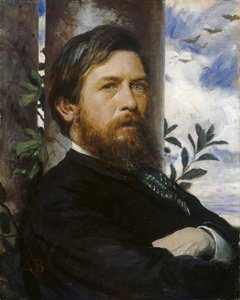
1827–1901, Schweiz
Arnold Böcklin
Øens skygge Basel, Schweiz, udgør udgangspunktet for et liv defineret af spændingen mellem det håndgribelige og det spektrale. Født den 16. oktober 1827 af Christian Frederick Böcklin og Ursula Lippe, bevægede den unge mand sig i sidste ende væk fra sin fars silkehandel mod Düsseldorf Akademiens strenge sale. Under Schirmers vejledning begyndte han at opsuge landskabets sprog, en færdighed der senere ville blive brugt til at kortlægge den menneskelige sjæls geografi.
Om Arnold Böcklin Bemærkelsesværdige værker af Arnold Böcklin
Også af Arnold Böcklin
 Dødens ø (Første version)1880
 Selvportræt med døden der spiller violin
 Kriget1896
 The Isle of the Dead (Version 2)1880

Essays om Spring Evening
 French artworks of the 1880sFrench Impressionist masterpieces by Claude Monet, Pierre-Auguste Renoir, and Georges Seurat. Find museum-quality reproductions on Original…
 Symphony of Sunlight: The Luminous Legacy of Pine Tree Landscapes in Art HistoryExplore the luminous history of pine landscapes through Sorolla and Shishkin. Discover the magic of forest art today.
 En Plein Air Serenity: Exploring the Luminous Beauty of Impressionist Garden ArtExplore the luminous history of Impressionist garden art through Monet and Van Gogh. Discover the magic of plein air painting today.