
 Se i fuld skala
 Del
Del Del
Del
 Detaljer

 Download
 Lignende værker
 Røntgenundersøgelse
 Diasshow
Self-Portrait
 Oil On Canvas
- WallArt
- Rococo
 1776
1776- Renaissance
 151.0 x 115.0 cm
 Staatliche Museen zu Berlin
 Se mere
Køb et højopløst, forbedret digitalt billede, der er langt bedre end online-forhåndsvisningen.
Hver fil er omhyggeligt forberedt af vores interne specialister ved hjælp af avancerede værktøjer og ekspertmæssig manuel retuschering. Vi sikrer, at hvert billede har enestående klarhed, præcis farvegengivelse og fine detaljer.
Den endelige fil leveres via e-mail inden for 72 timer og er optimeret til øjeblikkelig brug i professionelle, redaktionelle og trykte miljøer. Det er den samme kvalitet, som førende designstudier, forlag og gallerier har tillid til.
Digitalt billede
Download en højopløselig fil til personlig fremvisning, print og kreative projekter. ( Køb print Køb håndlavet maleri)
Inkluderet i alle ordrer på digitale billeder
Ekspert digital levering, garanteret
Når du vælger OriginalUniqueArt.com, får du ikke blot et billede – du modtager et professionelt optimeret digitalt kunstværk, skabt med præcision og sikret med en tilfredshedsgaranti. Her er alt, hvad din ordre automatisk indeholder:

Hurtig levering via e-mail
Din højkvalitets digitale billedfil vil blive sendt til din e-mail inden for 72 timer efter bestilling – klar til øjeblikkelig brug.

AI-optimeret digital fil
Dit kunstværk optimeres professionelt ved hjælp af avancerede AI-værktøjer og manuel redigering, hvilket sikrer maksimal detaljegrad, klarhed og farvenøjagtighed.

Gratis livslang genlevering
Har du ved en fejl slettet eller mistet din fil? Ingen bekymring – vi sender den igen til enhver tid, helt gratis.

Ingen importgebyrer – nogensinde
Nyd dit kunstværk med det samme uden told, afgifter eller leveringsgebyrer – digitale downloads er altid skattefrie.

Garanteret farvenøjagtighed
Vi sikrer, at dit digitale billede gengiver de originale farver så præcist som muligt ved hjælp af professionelle værktøjer og farvestyring.

60 dages tilfredshedsgaranti
Hvis du ikke er tilfreds med dit digitale billede, vil vi revidere det eller refundere 100% inden for 60 dage – uden spørgsmål.

100% Pengene tilbage-garanti
Ik tilfreds? Få fuld refusion inden for 60 dage efter modtagelse af din digitale fil – uden spørgsmål.

Mængderabat
Køb 3 billeder, spar 10% - Køb 5, spar 15% - Køb 10+, spar 20%. Ideelt til kreative projekter, gallerier og bureauer.
Beskrivelse af samlerobjektet
A Portrait of Introspection: Anna Dorothea Therbusch’s “Self-Portrait”
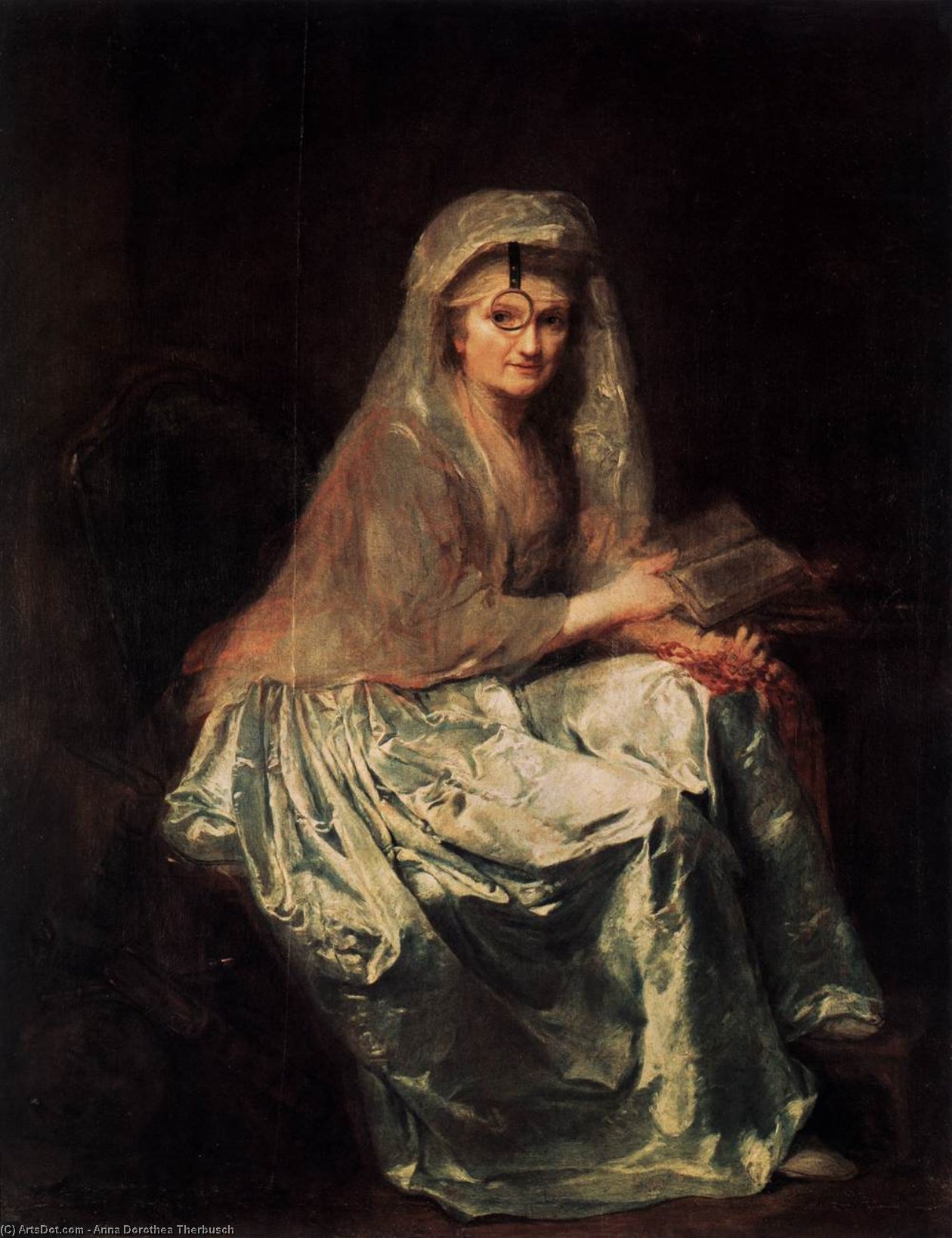
Anna Dorothea Therbusch's "Self-Portrait," painted in 1776, is more than just a likeness; it’s a profound meditation on the artist’s own identity and place within the world. This captivating work, housed at the Gemäldegalerie in Berlin, offers a rare glimpse into the mind of a woman who defied societal constraints to establish herself as a significant figure in 18th-century Rococo art. The painting immediately draws the viewer in with its intimate scale – a mere 151 x 115 cm – creating an immediate sense of closeness and invitation, as if we’ve been granted privileged access into the artist's private world.
The composition is deceptively simple yet remarkably layered. Therbusch presents herself seated before a partially obscured landscape, her gaze directed towards something just beyond our view. She wears a dark, flowing gown, its folds suggesting both elegance and a subtle melancholy. A delicate veil drapes across her head, partially concealing her face and adding an air of mystery to the portrait. The muted palette – dominated by browns, grays, and deep blues – contributes significantly to the painting’s contemplative mood. It's not a vibrant celebration of beauty, but rather a quiet exploration of inner experience.
The Rococo Soul: Style and Technique
“Self-Portrait” is a quintessential example of Therbusch’s mastery within the Rococo style. Characterized by its delicate brushwork, pastel colors, and emphasis on elegance and grace, Rococo art sought to evoke feelings of pleasure and refinement. However, unlike some of her contemporaries who embraced the frivolous aspects of the style, Therbusch imbues her self-portrait with a palpable sense of seriousness and introspection. Her technique is remarkably precise; observe the subtle gradations of tone in the fabric of her gown, or the delicate rendering of the veil’s folds. The artist skillfully employs chiaroscuro – the contrast between light and shadow – to sculpt the figure's form and create a sense of depth.
Therbusch was particularly adept at capturing subtle nuances of expression. Her slightly furrowed brow and downward gaze suggest a thoughtful, perhaps even melancholic, disposition. This is further reinforced by the inclusion of two chairs in the background – one behind her, seemingly occupied by an unseen figure, and another further back on the right, hinting at a past or a future yet to be realized. These elements subtly invite speculation about the artist’s inner life.
A Pioneer's Journey: Historical Context
Anna Dorothea Therbusch’s story is one of remarkable resilience and determination in a male-dominated art world. Born into a family with artistic roots – her father was a renowned Berlin portrait painter – she faced considerable obstacles as a female artist during the Enlightenment. Despite these challenges, she persevered, honing her skills and establishing herself as a respected figure in Prussia’s artistic circles. Her marriage to Ernst Friedrich Therbusch, an innkeeper, initially interrupted her career, but she quickly returned to painting, demonstrating her unwavering commitment to her craft.
Therbusch's journey is particularly significant because it highlights the struggles faced by women artists throughout history. She navigated a world where opportunities were limited and recognition was often elusive. Yet, through sheer talent and perseverance, she achieved considerable success, leaving behind a legacy of over 200 paintings – including this poignant self-portrait – that continue to captivate viewers today. Her work reflects the changing social landscape of her time, offering insights into the lives and experiences of women in 18th-century Europe.
Symbolism and Emotional Resonance
Beyond its technical merits, “Self-Portrait” is rich in symbolism. The veil, for instance, can be interpreted as a metaphor for introspection or perhaps even a sense of concealment – reflecting the societal pressures placed upon women during that era. The landscape beyond her gaze represents the unknown, inviting viewers to contemplate the artist’s hopes and dreams. The inclusion of the two chairs suggests themes of solitude, reflection, and perhaps a yearning for connection.
Ultimately, “Self-Portrait” is a deeply moving work that speaks to the universal human experience of self-discovery and introspection. It's not merely a portrait; it’s an intimate dialogue between artist and viewer, inviting us to contemplate our own identities and place in the world. The painting’s quiet intensity and subtle emotional depth make it a timeless masterpiece – a testament to Anna Dorothea Therbusch’s artistic genius and her remarkable journey as a pioneering female artist.
Kunstnerens biografi
Anna Dorothea Therbusch: A Pioneer of Female Artistic Expression
Anna Dorothea Therbusch (1721-1782) stands as a remarkable figure in the annals of Rococo art history—a woman artist who defied societal expectations and achieved considerable renown during the Enlightenment. Born into a family steeped in artistic tradition, her father, Georg Lisiewski, was himself a celebrated Berlin portrait painter, establishing a lineage dedicated to visual representation. This upbringing instilled in Anna Dorothea a profound appreciation for painting from an early age, fostering a talent that would blossom into one of Prussia’s most prolific and admired artists.- Early Life & Family: Anna Dorothea Lisiewski married Ernst Friedrich Therbusch, an innkeeper, forging a domestic life alongside her husband and raising five children. Despite the responsibilities of motherhood, she relentlessly pursued her artistic passions, demonstrating an unwavering commitment to her craft.
- Training & Artistic Development: Her father recognized her exceptional abilities and actively encouraged her artistic pursuits, providing her with invaluable instruction in painting techniques. Notably, her elder sister Anna Rosina was equally gifted, earning the moniker “Wunderkinder” – child prodigy – cementing their family’s reputation for artistic excellence.
A Rococo Visionary: Style and Technique
Therbusch's artistic style epitomized the elegance and refinement characteristic of Rococo art—a movement that prioritized ornamentation, pastel hues, and graceful asymmetry. Her canvases frequently depicted mythological scenes infused with allegorical symbolism, reflecting the intellectual currents of her time. She skillfully employed delicate brushstrokes and meticulous attention to detail, capturing ethereal beauty and conveying nuanced emotions through expressive poses and gestures. Her masterful handling of light and shadow contributed significantly to the atmospheric depth of her paintings, creating immersive experiences for viewers.- Notable Works: Among her impressive oeuvre are iconic pieces like “Diana mit Nymphen,” a breathtaking depiction of the goddess Diana surrounded by nymphs—a testament to Therbusch’s ability to convey grandeur and serenity through visual artistry.
Recognition & Patronage: Parisian Influence
Therbusch's artistic journey took an extraordinary turn when she relocated to Paris in 1765, seeking opportunities for advancement within the vibrant artistic landscape of the French capital. Recognizing her talent and advocating for female artists—a radical stance at the time—Denis Diderot, a prominent philosopher and art critic, championed Therbusch’s cause, even posing nude for her portrait. Her acceptance into the Académie royale de peinture et de sculpture marked a pivotal moment in her career, affording her access to influential mentors and fostering collaborations with fellow artists like Philippe Hackert. Despite facing financial hardships and navigating the complexities of Parisian society, Therbusch persevered, producing some of her most celebrated works during this period—particularly those imbued with the spirit of Diderot’s intellectual fervor.Legacy & Historical Significance
Anna Dorothea Therbusch's contribution to art history transcends mere stylistic innovation; she represents a courageous assertion of female autonomy within a patriarchal society. Her success as a painter challenged conventional notions of gender roles and paved the way for future generations of women artists. Today, her paintings reside in prestigious museums across Germany—including the Gemäldegalerie Berlin and Alte Nationalgalerie—serving as enduring reminders of Therbusch’s artistic brilliance and her unwavering determination to pursue her passion despite societal obstacles. She remains a symbol of perseverance, creativity, and the transformative power of artistic expression.
Anna Dorothea Therbusch
1721 - 1782 , Germany
Kort om kunstneren
- Artistic Movement Or Style: Rococo
- Artists Or Movements Influenced By This Artist: ['Denis Diderot']
- Artists Who Influenced This Artist: ['Georg Lisiewski']
- Date Of Birth: July 23, 1721
- Date Of Death: November 9, 1782
- Full Name: Anna Dorothea Therbusch
- Nationality: German
- Notable Artworks:
- Diana mit Nymphen
- Self-portrait
- Place Of Birth: Berlin, Germany

