

 Se i fuld skala
 Del
Del Del
Del
 Detaljer

 Download
 Lignende værker
 Røntgenundersøgelse
 Diasshow
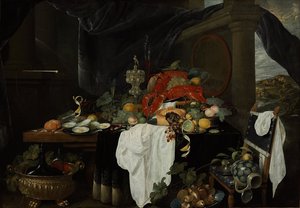
Banquet still life
 Se mere
Giclée / Kunsttryk
Giclée- eller lærredstryk i museumskvalitet med hurtig produktion og fleksible muligheder for finish. ( Køb håndlavet maleri Køb billede)




































Vælg mellem vores forudindstillede størrelser, der matcher kunstværkets originale proportioner.

Du kan indtaste dine egne mål for at passe til en specifik ramme eller et bestemt område. Hvis den valgte størrelse ikke stemmer overens med det originale billedes proportioner, vil vi enten beskære kunstværket eller udvide billedet med en spejlet eller ensfarvet kant. En digital mockup vil blive sendt til din godkendelse, før produktionen påbegyndes.
Bemærk venligst, at forhåndsvisningen på skærmen ikke afspejler den faktiske beskæring eller udvidelse. Kun mockuppen vil nøjagtigt vise den endelige komposition.
Selvom specialmål er tilgængelige, anbefaler vi at vælge et mål fra den foruddefinerede liste for at bevare de originale proportioner.
Verdensomspændende levering () på 2 uger i stedet for de sædvanlige 4/5 uger. (21 august)

Gratis ekspresforsendelse til hele verden

Lærred af linned i høj kvalitet

Fuld transportforsikring

Garanti for refusion af told og importafgifter

Garanti for præcis farvegengivelse

60 dages returret (kun ved fabrikationsfejl)

100% Tilfredshedsgaranti

Mængderabat tilgængelig
 Glasmulighed er kun tilgængelig i størrelser under 110 cm

Banquet still life
Giclée / Kunsttryk
Størrelse på reproduktion
-


Samlet pris
$ 81
Kunstnerens biografi
The Enigmatic Origins of a Flemish Master
Andries Benedetti remains a figure partially obscured by the mists of time, a talent whose brilliance flickered intensely before being lost to history. Born around 1615, his beginnings are shrouded in a beautiful ambiguity; while some whispers suggest a connection to Parma, Italy, his heart and his art were undeniably rooted in the vibrant, bustling atmosphere of Antwerp. As the son of Italian immigrants, Pietro Benedetti and Maria Torres, he was a product of the cosmopolitan tapestry that defined the Dutch Golden Age. This heritage likely gifted him with a unique perspective, blending the classical sensibilities of his ancestors with the burgeoning Flemish Baroque style.His early years in Antwerp were not merely spent in quiet observation but were marked by rigorous preparation within the prestigious Guild of Saint Luke. The records of 1636 reveal an artist emerging from the shadows, having served as an apprentice to the obscure yet skilled Vincent Cernevael II. This formative period was essential, providing him with the foundational tools to manipulate oil and light, setting the stage for a career that would eventually touch upon the very heights of pronkstillevens—those opulent, grand-scale still lifes that celebrated both earthly abundance and the fleeting nature of existence.
The Alchemy of Light and Lineage
To understand the technical prowess of Benedetti, one must look to the masters who shaped his hand. Beyond the foundational training under Cernevael, Benedetti had the extraordinary privilege of honing his craft in the studio of Jan Davidsz. de Heem, one of the most formidable names in Dutch still life painting. This lineage is evident in the way Benedetti approached the canvas, treating every surface with a reverence for texture and luminosity. He mastered the dramatic technique of chiaroscuro, using deep, velvety shadows to push his subjects forward into the light, creating a sense of three-dimensional weight that feels almost tactile.His brushwork was an exercise in precision and sensory delight. When observing his work, one does not merely see fruit; one experiences the dew on a petal or the subtle bruising on a ripening peach. This mastery is characterized by:
- The luminous rendering of organic textures, from the velvet skin of a pear to the translucent zest of a lemon.
- A sophisticated use of chiaroscuro to create depth and theatrical tension within the composition.
- The integration of symbolic elements, such as candles or skulls, which whispered of the vanitas tradition—a reminder of mortality amidst plenty.
A Symphony of Abundance and Decay
The true legacy of Andries Benedetti lies in his ability to capture the ephemeral. His paintings serve as a feast for the eyes, yet they are often tinged with a profound melancholy. In works such as “Still Life with Peaches, Pears, Lemons and Roses,” currently held in the Kunsthistorisches Museum Wien, we see the pinnacle of his ability to render the succulent and the delicate with breathtaking accuracy. He excelled at the pronkstilleven style, where overflowing platters of seafood, such as oysters and lobsters, sit alongside lush floral arrangements, creating a visual spectacle of wealth and natural beauty.Yet, beneath this layer of opulence, there is always a deeper narrative. The way a flower begins to wilt or the way light catches a dying ember suggests the inevitable passage of time. This tension between the magnificent and the mortal is what elevates his work from mere decoration to high art. Though his recorded presence in the annals of history fades after 1649, the enduring impact of his compositions continues to resonate, reminding us of a period when the canvas was a stage for the most exquisite dramas of the natural world.
andries benedetti
1615 - 1649 , Belgium
Kort om kunstneren
- Artistic Movement Or Style: Dutch Baroque
- Artists Or Movements Influenced By This Artist: ['Baroque Painting']
- Artists Who Influenced This Artist: ['Vincent Cernevael']
- Date Of Birth: ca. 1615
- Date Of Death: after 1649
- Full Name: Andries Benedetti
- Nationality: Flemish
- Notable Artworks: ['Floral Still Life']
- Place Of Birth: Parma(?), Belgium

