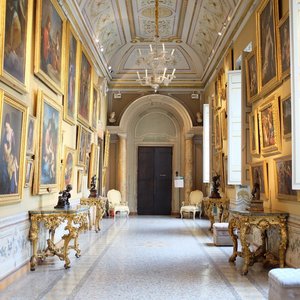
Portræt af Jacopo Zucchi

De 20 mest berømte Jacopo Zucchi-malerier, en galleriselektion

Opdateret oktober 2026 · rangeret efter vores popularitetsscore (søgninger, besøg og ordrer for hvert værk) · 21 værker af Jacopo Zucchi i vores katalog

Kort sagt

Af alle de originale værker, som Jacopo Zucchi efterlod, er det mest berømte Christ Cleansing the Temple (?) (1587), som er en del af samlingen på Kunsthistorisches Museum i Wien. Lige efter følger Minerva at the Forge of Vulcan (1578) og The Martyrdom of Saint Apollonia (1590). Vores katalog indeholder 21 værker af Jacopo Zucchi; galleriet har bevaret de 20 værker, som verden beundrer mest, hver vist med sin dato, sit museum og sin historie.

1542 – 1596, Florence Mannerism Flest værker: Galleria Borghese

Jacopo Zucchis top 10 malerier: galleriets udvalg

1
Christ Cleansing the Temple (?) (1587) af Jacopo Zucchi

Christ Cleansing the Temple (?)

1587 · Oil On Canvas · Kunsthistorisches Museum, Wien

The air in the temple is thick with the dust of commerce and the heat of sudden anger. A central figure moves through the crowd, his robes a sudden splash of rose-pink against the heavy, muted ochres of the sanctuary. He is a pillar of authority amidst a sea of agitated limbs and startled faces. The composition does not rest; it twists. Figures collide in a choreographed chaos, their bodies…

2
Minerva at the Forge of Vulcan (1578) af Jacopo Zucchi

Minerva at the Forge of Vulcan

1578 · Oil · Scottish National Gallery, Edinburgh

A heavy, amber light spills from a central cavern, casting long shadows across muscular limbs. In this subterranean workshop, the air feels thick with the scent of heated metal and woodsmoke. Minerva enters the frame, her presence marked by the cool, blue sheen of her ornate armor. She stands amidst the chaos of creation, a calm figure against the rhythmic violence of the blacksmiths' labor. The scene is crowded, a…

3
The Martyrdom of Saint Apollonia (1590) af Jacopo Zucchi

The Martyrdom of Saint Apollonia

1590 · Ink On Paper

The Martyrdom of Saint Apollonia is a work by the Florentine artist Jacopo Zucchi. Created about 1590, this piece offers an overview of a dramatic religious scene. The composition centers on the saint amidst a group of figures, some of whom hold knives, set against an outdoor backdrop featuring a building.

4
Allegory of the Creation (1585) af Jacopo Zucchi

Allegory of the Creation

1585 · Oil On Copper · Galleria Borghese, Rom

In this intricate work on copper, Jacopo Zucchi presents a complex vision of the cosmos, organized through the lens of Mannerist drama. The composition unfolds in layers, beginning with a celestial realm in the upper right where a divine figure sits amidst radiant light, holding a tablet inscribed with 'Alpha' and 'Omega'. Below this heavenly presence, the landscape stretches toward a distant horizon of mountains and a small, fortified town,…

5
The Miracle of the Snow (1580) af Jacopo Zucchi

The Miracle of the Snow

1580 · Oil On Canvas · Vatikanets Pinacoteca, Vatikanstaten

A grand procession of clergy and nobility moves through a meticulously detailed urban landscape, gathered before an elaborate architectural structure. Above the assembly, a radiant celestial light breaks through the heavens, signaling a moment of divine grace. The composition is densely populated, creating a sense of overwhelming scale and importance. Figures kneel and pray, some carrying liturgical objects or candles, their movements part of a collective, rhythmic surge toward the…

6
Holy family (1575) af Jacopo Zucchi

Holy family

1575 · Oil On Panel · Musée des Augustins, Toulouse

In this serene scene, the Holy Family gathers within a lush, verdant landscape. Jacopo Zucchi, a Florentine painter, captures a moment of quiet tenderness as the Virgin Mary sits cradling the Christ Child. To her side, Saint Joseph reaches out to interact with the infant, his presence grounding the divine group within the natural world. The figures rest amidst organic shapes and rugged rocky outcrops, while a winding river draws…

7
Portrait of a Woman (1600) af Jacopo Zucchi

Portrait of a Woman

1600 · Oil On Panel · Metropolitan Museum of Art, New York

This three-quarter length portrait depicts a young woman seated slightly off-center. She faces toward the viewer's left, though her gaze is directed toward the observer. The subject is positioned against a dark, olive-green background, seated upon a red velvet chair. Her attire consists of a silk satin gown in silvery-grey and deep charcoal tones, paired with a white lace collar. The garment features a sottana, or petticoat, with detachable sleeves.…

8
Immaculate Conception (1587) af Jacopo Zucchi

Immaculate Conception

1587 · Oil On Panel · Kunsthistorisches Museum, Wien

In this Mannerist oil painting, the Virgin Mary is positioned centrally in the upper half of the vertical composition, enveloped by a radiant golden mandorla of light. She is depicted in a moment of prayer, her figure characterized by the graceful, elongated proportions and fluid lines typical of the late Renaissance. Below her, the scene transitions from the celestial to the terrestrial, where several female figures gather, including one holding…

9
Portrait of a Lady (1570) af Jacopo Zucchi

Portrait of a Lady

1570 · Oil On Panel · Galleria Nazionale d'Arte Antica, Rom

The painting presents a woman positioned against a dark, indistinct background. She is depicted from the chest up, facing the viewer directly. Her attire consists of a blue dress paired with a white collar. A necklace rests upon her chest, and earrings are visible on her ears. The composition focuses the viewer's attention on the woman's face. The lighting creates a high contrast between the pale tones of her skin…

Jacopo Zucchi-udvalget fortsætter, fra 11 til 20

Motiverne, der fangede Jacopo Zucchis blik

De fire motiver, der optræder hyppigst i disse originaler, hver med sit fineste eksempel.

De museer, der udstiller Jacopo Zucchis originalværker

De 8 museer, der rummer flest af malerierne på denne side.

Museum By Værker af Jacopo Zucchi Malerier fra denne liste
Galleria Borghese, RomGalleria Borghese Rom 5 Allegory of the Creation, The Coral Fishers (detail), The Coral Fishers
Kunsthistorisches Museum, WienKunsthistorisches Museum Wien 2 Christ Cleansing the Temple (?), Immaculate Conception
Galleria Nazionale d'Arte Antica, RomGalleria Nazionale d'Arte Antica Rom 2 Portrait of a Lady, The Toilet of Bathsheba
Palazzo Ruspoli, RomePalazzo Ruspoli Rome 2 Jupiter, View of the Galleria
Scottish National Gallery, EdinburghScottish National Gallery Edinburgh 1 Minerva at the Forge of Vulcan
Vatikanets Pinacoteca, VatikanstatenVatikanets Pinacoteca Vatikanstaten 1 The Miracle of the Snow
Musée des Augustins, ToulouseMusée des Augustins Toulouse 1 Holy family
Metropolitan Museum of Art, New YorkMetropolitan Museum of Art New York 1 Portrait of a Woman

Jacopo Zucchi årti for årti: det originale værk, der definerer hvert enkelt

Værker per årti

Vælg et årti for at se det originale værk, der definerer det.

Samleres spørgsmål om Jacopo Zucchis malerier

Hvilket værk er Jacopo Zucchi mest kendt for?Vis svaret

Christ Cleansing the Temple (?) (1587), Kunsthistorisches Museum, Wien. Derefter følger Minerva at the Forge of Vulcan (1578) og The Martyrdom of Saint Apollonia (1590).

Hvor gammel var Jacopo Zucchi, da Christ Cleansing the Temple (?) blev skabt?Vis svaret

45 år gammel: Christ Cleansing the Temple (?) er fra 1587, og Jacopo Zucchi blev født i 1542.

Hvad er de ti mest berømte Jacopo Zucchi malerier?Vis svaret

Christ Cleansing the Temple (?), Minerva at the Forge of Vulcan, The Martyrdom of Saint Apollonia, Allegory of the Creation, The Miracle of the Snow, Holy family, Portrait of a Woman, Immaculate Conception, Portrait of a Lady og The Assembly of the Gods. Ranglisten ovenfor viser det enkelte værks årstal og museum.

Hvor mange malerier efterlod Jacopo Zucchi?Vis svaret

Vores katalog indeholder 21 værker af Jacopo Zucchi, dateret fra 1570 til 1590.

I hvilke museer udstilles Jacopo Zucchi's mesterværker?Vis svaret

Primært i Galleria Borghese (Rom), Kunsthistorisches Museum (Wien) og Galleria Nazionale d'Arte Antica (Rom). Museumslisten ovenfor viser dem alle.

I hvilke år malede Jacopo Zucchi sine mest berømte værker?Vis svaret

I 1580s: 10 af de 20 værker på denne side blev skabt dengang, herunder Christ Cleansing the Temple (?).

Hvad er de første og de sidste berømte originaler af Jacopo Zucchi?Vis svaret

På denne side er det tidligste Portrait of a Lady (1570) og det seneste The Martyrdom of Saint Apollonia (1590).

Hvilke motiver valgte Jacopo Zucchi oftest?Vis svaret

Woman (6), Man (5) og Jewelry (3), fordelt på de 20 værker på denne side.

Hvilken teknik brugte Jacopo Zucchi mest?Vis svaret

Oil On Panel, for 4 af de 20 værker på denne side.

Hvilken kunstretning tilhører Jacopo Zucchi?Vis svaret

Mannerism, baseret på originalerne på denne side.

Hvilke værker af Jacopo Zucchi udstilles på Galleria Borghese?Vis svaret

Allegory of the Creation, The Coral Fishers (detail) og The Coral Fishers: Galleria Borghese, Rom har 5 af værkerne på denne side.

Jacopo Zucchi: liv og værk

The Florentine Master of Mannerist Drama

Jacopo Zucchi stands as a pivotal figure in the evolution of the Florentine Baroque, embodying the stylistic complexities and dramatic grandeur characteristic of Mannerism. This was an era that famously rejected the idealized, harmonious beauty of the High Renaissance in favor of intellectual contemplation, expressive distortion, and a sense of restless energy. Born in Florence around 1542, Zucchi’s formative years were deeply rooted in the prestigious artistic traditions fostered by Giorgio Vasari. By joining Vasari’s studio as a young apprentice, Zucchi absorbed a meticulous approach to observation and a masterful command of technique that would serve as the bedrock of his later innovations.

This early apprenticeship instilled in him a profound understanding of disegno—the humanist concept of drawing as the essential foundation of all artistic creation. Under Vasari’s guidance, Zuc chi learned to balance rigorous anatomical accuracy with the deliberate, expressive manipulation of form. This tension between realism and artifice became the hallmark of his style, propelling him toward a vision marked by dynamic movement, unsettling perspectives, and an exploration of psychological depth that would define his prolific career.

Grandeur in Florence and Rome

Zucchi’s talent quickly earned him placement within some of the most prestigious decorative projects of the late 16th century. His involvement in the decoration of the Palazzo Vecchio, specifically within the Studiolo and the Salone dei Cinquecento, showcased his ability to execute ambitious, large-scale commissions. In these spaces, he blended classical ideals with Mannerist innovation, creating opulent frescoes that celebrated Florentine civic pride through masterful illusionistic painting techniques.

As his reputation expanded beyond the borders of Florence, Zucchi moved to Rome in the early 1570s, where he swiftly established himself as a sought-after master for the highest echelons of the clergy and nobility. His work for Cardinal Ferdinando de’ Medici's palazzo Firenze provided him with unparalleled access to artistic resources and high-profile patronage. It was during this Roman period that his collaborative spirit flourished; notably, he worked alongside his brother Francesco on the monumental fresco cycles adorning the apse and dome of Santo Spirito, leaving an indelible mark on the religious landscape of the city.

A Legacy of Symbolism and Technique

The breadth of Zucchi’s oeuvre reflects a remarkable ability to navigate diverse subject matters, from the deeply spiritual to the elegantly secular. His works often serve as windows into the complex allegories of the 16th century:

  • Religious Devotion: In pieces such as Allegory of the Creation, Zucchi captures profound moments of divine connection, utilizing dramatic lighting and celestial figures to evoke a sense of awe and religious fervor.
  • Allegorical Narrative: His masterpiece, Age of Silver, demonstrates his command over the Florentine Baroque style, weaving intricate details of justice and angelic presence into a complex tapestry of meaning.
  • Portraiture and Elegance: Beyond grand frescoes, Zucchi excelled in intimate portraiture. His Portrait of a Lady showcases his ability to use striking color palettes—such as deep blue tones—and meticulous detail in jewelry to convey the status and grace of his subjects.

Ultimately, the historical significance of Jacopo Zucchi lies in his role as a bridge between the structured traditions of the Renaissance and the emotive, theatrical intensity of the Baroque. Through his mastery of disegno and his embrace of Mannerist distortion, he helped shape a visual language that prioritized the emotional and intellectual impact of art, ensuring his place as one of the most influential painters of the late Italian Renaissance.