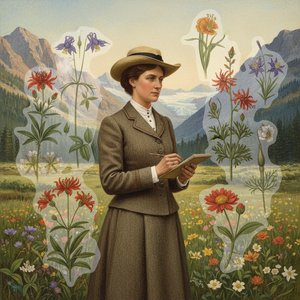
A Journey of Discovery and Botanical Wonder
Born into the refined atmosphere of London around 1848, Sarah Ann Porter’s life underwent a profound transformation when she crossed oceans to reach the rugged landscapes of New Zealand. Alongside her husband, Edward Featon, who served as the District Land Officer in Gisborne, Sarah transitioned from the familiar comforts of English society to the vibrant, untamed beauty of a colonial frontier. This relocation was more than a mere change of scenery; it was an awakening of the artistic spirit. As she settled into the life of a pioneer, her eyes were drawn to the extraordinary flora that flourished in her new home—a botanical world far removed from the manicured gardens of her youth.The Art Album: A Collaborative Masterpiece
The pinnacle of Featon’s creative life arrived in 1889 with the publication of The Art Album of New Zealand Flora. This was not merely a collection of drawings, but a monumental collaborative triumph between Sarah and Edward. While her husband provided the lively, descriptive text, Sarah breathed life into the pages through her meticulous watercolors. Together, they sought to dismantle the prevailing myth that New Zealand was a land devoid of floral splendor. Her work was characterized by:- Scientific Precision: A commitment to capturing the true essence and structure of native specimens.
- Artistic Elegance: The use of vibrant watercolors to reflect the lushness of the New Zealand landscape.
- Botanical Documentation: The recording of species such as the Pohutukawa, Karaka, and Clematis indivisa with an eye for detail that served both art and science.
Through this publication, Featon’s artistry was supported by the scientific community, drawing upon the knowledge of experts like William Colenso and Thomas Kirk to ensure her work stood as a reliable botanical record.
A Lasting Legacy in New Zealand Art
Sarah Ann Featon’s contribution extends far beyond the pages of a single album; she remains a foundational figure in the history of New Zealand botanical art. Her ability to blend the meticulous observation required by the Victorian aesthetic with a deep, emotional connection to her adopted homeland allowed her work to transcend simple illustration. Today, her exquisite renderings are preserved in prestigious institutions such as Te Papa Tongarewa, serving as a window into the natural heritage of a bygone era. Her life stands as a testament to the power of passion and the enduring impact of an artist who looked closely at the natural world and found beauty worth preserving for eternity.Otázky a odpovědi
Kde najdu díla umělce Sarah Ann Featon uspořádaná podle tématu?
Stránka Atlas témat umělce Sarah Ann Featon umožňuje prohlížet jeho díla podle jejich témat.
Jak najdu všechna díla umělce Sarah Ann Featon v určitém médiu?
Stránka Podle techniky seskupuje díla umělce Sarah Ann Featon podle použité techniky.
Existuje chronologický přehled tvorby umělce Sarah Ann Featon?
Kariéra umělce Sarah Ann Featon se na stránce Kronika umělce odvíjí období po období v podobě horizontální časové osy děl uspořádaných do kapitol podle tvůrčích etap.
Která umělecká díla umělce Sarah Ann Featon mají nejvyšší počet zhlédnutí?
Pro umělce Sarah Ann Featon je k dispozici stránka Statistiky, která zobrazuje statistiky o jeho dílech na tato webová stránka.