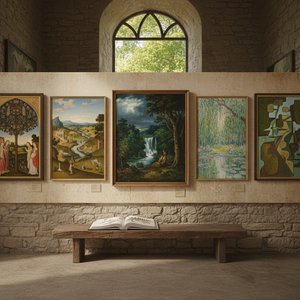
The Painter of Silent Landscapes: The Life of Richard Zimmermann
In the heart of nineteenth-century Germany, a period marked by profound shifts in both political boundaries and artistic sensibilities, Richard Augustus Zimmermann emerged as a master of the quiet, evocative landscape. Born in 1820 in Zittau, Zimmermann was part of an extraordinary artistic lineage; he was the son of the renowned impresario Karl Friedrich August Zimmermann, and his brothers—Albert, Max, and Robert—would all go on to carve their own names into the annals of art history. While his early training under his father suggested a path toward the grander, more structured world of history painting, Richard possessed an innate connection to the natural world that could not be suppressed. In 1838, he followed his father to Munich, and it was there, in defiance of traditional academic advice, that he chose to devote his soul to the study of landscape.
This decision proved to be a transformative moment for German genre painting. By turning away from the rigid narratives of historical epic, Zimmermann found a new language in the subtle textures of the earth and sky. His work became a celebrated exploration of atmosphere, where the fleeting light of a winter afternoon or the dense, brooding shadows of a forest could convey more emotion than any staged historical drama. He developed a particular mastery over winter landscapes, capturing the crystalline stillness of snow-covered fields and the skeletal beauty of frozen trees with a precision that felt both intimate and universal.
A Mastery of Atmosphere and Light
Zimmermann’s artistic evolution was characterized by an increasing ability to capture the ephemeral qualities of nature. His repertoire was diverse, ranging from sweeping mountain views and tranquil forest scenes to delicate village sketches and maritime pieces. As his career progressed, he began to draw inspiration from the classical traditions of landscape painting, notably adopting elements of the style of Berchem in his later period. This infusion of classical influence allowed him to imbue his compositions with a sense of timelessness, blending the rugged reality of German scenery with a refined, almost poetic sensibility.
The technical brilliance of his work lies in his ability to manipulate light to create depth and mood. Whether it was the shimmering reflection of light on a sea piece or the soft, diffused glow over a mountain range, Zimmermann’s brushwork served to ground the viewer in a specific moment of time. His landscapes were not merely topographical records but emotional journeys, inviting the observer to wander through forest glades and snow-swept valleys. This skill earned him widespread popularity, as his paintings offered a sense of peace and contemplative beauty to a public navigating an era of rapid industrial change.
Legacy and Final Years
Despite his successes in the vibrant art circles of Munich, Zimmermann’s life was marked by periods of quiet retreat. At one stage, he withdrew from the bustling German art centers to live in Prague, where he engaged in the meticulous work of a goldsmith—a profession that perhaps further refined his eye for detail and precision. This period of craftsmanship likely informed the delicate textures found in his later paintings, reinforcing the connection between the fine arts and the disciplined hand of the artisan.
Richard Zimmermann passed away in 1875 after a short illness, leaving behind a body of work that remains a testament to the enduring power of the natural landscape. His significance lies not only in his individual technical achievements but in his role as part of a family of painters who collectively shaped the German aesthetic of the nineteenth century. Through his dedication to the landscape genre, he helped elevate the depiction of nature from mere background scenery to a profound subject capable of expressing the deepest nuances of the human spirit.
Otázky a odpovědi
Je k dispozici 3D virtuální prohlídka děl umělce Richard Zimmermann?
Možná je i virtuální prohlídka: na stránce 3D galerie umělce Richard Zimmermann můžete obdivovat jeho díla v trojrozměrné galerii.
Kolik děl umělce Richard Zimmermann je možné si prohlédnout?
Na stránce Všechná umělecká díla si můžete prohlédnout 8 uměleckých děl děl autora Richard Zimmermann.
Pod jakými dalšími jmény nebo pseudony je Richard Zimmermann známý/á?
Richard Zimmermann je známý/á také pod jmény Richard Zimmerman, August Richard Zimmermann, August Richard Zimmerman, Richard, Zimmermann.