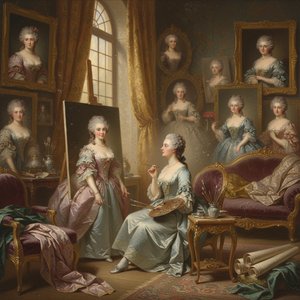
The Royal Glimpse
Paris, 1818. A gap in a door provides the only view of King Louis XVIII as he eats his lunch. Lizinca-Aimée-Zoé Rue, a young woman of eighteen, stands at a distance, her eyes fixed on the monarch's features. She does not intrude; she observes. This moment of quiet, calculated study results in a portrait that changes everything. The king is struck by her skill and her modest, witty presence. Suddenly, the student of Jean-Baptiste Jacques Augustin is no longer merely an artist seeking a living; she is a figure of interest within the Bourbon Restoration.
The success of this single encounter secures her place in the upper eltes of French society. She becomes a sought-after name among the Parisian aristocracy. Her talent for miniature painting, a medium less cumbersome than large-scale oils, allows her to move through the salons of the July Monarchy with ease. By the time she marries Charles François Brisseau de Mirbel in 1824, she has transitioned from a pupil copying masters to a court painter holding official status under Louis XVIII and Charles X.
Technique and Recognition
Her studio is a place of precision. Specializing in miniatures and watercolors, Lizinska de Mirbel relies on the technical discipline instilled by her early training. She focuses on the delicate rendering of faces, often finding her greatest success in the portraits of elderly men. Her work carries a specific clarity that wins the attention of the Paris Salon. The accolades arrive in waves:
- A second class medal at the 1822 Exposition.
- A first class gold medal at the Paris Salon of 1827.
- Continued recognition through subsequent exhibitions, including a second class medal in 1849.
The physical nature of her work—often executed on ivory—demands an intense focus on color and light. While she avoids the mess of larger canvases, the impact of her small-scale portraits is felt across the halls of power. Her subjects include the Duke of Orleans, Louise of Orleans, and the Duchess of Treviso. Even as political tides shift from the Bourbon Restoration to the July Monarchy, her position as a painter to the court remains intact under Louis-Philippe.
A Life in the Shadows of Power
Life for Lizinska de Mirbel is lived in the proximity of greatness and ceremony. Her early years in Cherbourg and later moves to Paris are marked by the shifting fortunes of her family, yet she carves out a professional identity that is entirely her own. She navigates the complexities of court life, maintaining a reputation as a sensible and modest woman even as she becomes a fixture of the era's social fabric.
Her death in August 1849 marks the end of an era for the French miniature. Her legacy remains held within the walls of major institutions, where her small, detailed captures of the nineteenth-century elite are preserved:
- The Louvre art museum.
- The Wallace Collection.
- Musée des arts décoratifs, Paris.
- Nationalmuseum, Sweden.
Otázky a odpovědi
Jak populární jsou umělecká díla umělce Lizinska de Mirbel?
Statistiky o dílech umělce Lizinska de Mirbel naleznete na jeho profilové stránce Statistiky.
V jakém historickém období působil/a Lizinska de Mirbel?
Lizinska de Mirbel působil v období 19th Century. Toto období historicky vymezuje uměleckou činnost tohoto autora.
Jaké barvy používal/a Lizinska de Mirbel nejčastěji?
Stránka Genom palety umělce Lizinska de Mirbel představuje barevný profil celkového díla tohoto tvůrce.
Kde najdu díla umělce Lizinska de Mirbel seskupená podle klíčových slov?
Chcete-li najít díla umělce Lizinska de Mirbel na konkrétní téma, navštivte jeho stránku Podle klíčových slov, kde jsou umělecká díla seskupena podle klíčových slov.