Early Life and Art Training
Born in Valencia on 4 January 1840, José Martí y Monsó was destined for a life defined by the study and preservation of Spanish art. His early years were marked by a move to Madrid, a transition that placed him at the center of the country's academic traditions. It was here that he began the formal discipline required of a professional painter, enrolling at the Real Academia de Bellas Artes de San Fernando. This institution provided the foundational structure for his developing technique and his eventual roles as a researcher and museum official.
His education was shaped by the guidance of established figures. Under the instruction of Luis Ferrant and Federico de Madrazo, he learned the technical rigors of his craft. Seeking to refine his skills beyond the classroom, he also sought out private lessons within the studios of Antonio Gómez Cros. These varied influences helped cultivate the precision that would later characterize his scholarly work and his deep understanding of Castilian art.
Artistic Recognition and Key Works
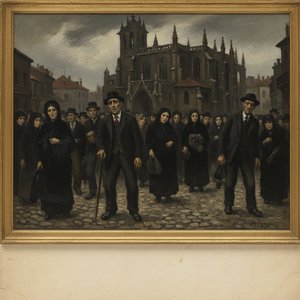
Following his formal training, Martí y Monsó became a consistent presence in the National Exhibition of Fine Arts, appearing there regularly after 1860. His ability to translate historical and social tension onto canvas was recognized early on. In 1864, he received an honorable mention for a painting depicting an episode from the Esquilache Riots, a work that captured a moment of significant civil unrest. This recognition marked the beginning of a period of increasing professional validation within the Spanish art scene.
His technical skill was further acknowledged in 1866, when he was awarded a third-class medal for his work The Grape Harvest. Beyond these formal accolades, his reputation was built upon a deep, scholarly understanding of regional traditions. He became a recognized authority on Castilian art, possessing a specialized knowledge of the history of Holy Week in Valladolid. This expertise allowed him to move beyond simple representation, grounding his perspective in the specific cultural and religious textures of the region.
Professional Career and Museum Leadership
After 1873, his professional life transitioned into the sphere of formal instruction and institutional stewardship. He assumed the directorship of the Escuela de Artes y Oficios de Valladolid, balancing his creative practice with the responsibilities of an educator. This period marked a shift from the solitary pursuit of painting toward a more public role in shaping the artistic landscape of the region.
His expertise in art history and preservation led to his appointment as the curator of the art collection at the Museo de Valladolid. By 1875, his administrative influence grew when he took over as Director of the Museo Provincial de Bellas Artes. He remained at the helm of this institution for the remainder of his life, providing a steady hand to the museum's operations until his death in 1912.
His standing within the academic community was formally recognized in 1900, when he was elected a member of the Real Academia de Bellas Artes de la Purísima Concepción. This appointment solidified his status as a central figure in the institutional life of Valladolid, bridging the gap between active practice and the preservation of Castilian art history.
Literary Contributions and Legacy
Beyond the canvas, Martí y Monsó sought to codify the visual history of the regions he studied. His pen was as active as his brush, particularly when documenting the treasures held within local institutions. In 1874, he produced the Catálogo provisional del Museo de Pintura y Escultura de Valladolid, a work that provided essential structure to the collections of the time. His scholarly interests later deepened into more expansive historical inquiries, resulting in the publication of Estudios histórico-artísticos relativos a Valladolid between 1898 and 1901.
His intellectual presence extended into the periodic literature of his era. He contributed to Castilla artística e histórica, a bulletin published by the Sociedad Castellana de Excursiones. Through these writings, he helped preserve the specific details of Castilian art and the traditions of Holy Week. His dedication to the cultural identity of Valladolid remained a constant throughout his life, a commitment that lasted until his death in the city on 14 December 1912.
The footprint he left in the urban landscape of Valladolid is marked by a plaza named in his honor. This tribute serves as a quiet recognition of a man who was as much a custodian of history as he was a creator of images. He remains a figure defined by his dual devotion to the practice of art and the rigorous preservation of its history.
Otázky a odpovědi
Mohu si u José Martí y Monsó prozkoumat používání barev napříč všemi jeho díly?
Použití barev v dílech umělce José Martí y Monsó uvedených na tato webová stránka můžete prozkoumat na stránce Genom palety tohoto umělce.
Kde najdu díla umělce José Martí y Monsó seskupená podle uměleckých směrů?
Díla umělce José Martí y Monsó si můžete prohlédnout rozdělená podle uměleckých směrů na jeho stránce Všechna umělecká hnutí.
Jak najdu díla umělce José Martí y Monsó na konkrétní téma?
Chcete-li najít díla umělce José Martí y Monsó na konkrétní téma, navštivte jeho stránku Podle klíčových slov, kde jsou umělecká díla seskupena podle klíčových slov.
Je k dispozici 3D virtuální prohlídka děl umělce José Martí y Monsó?
Díla umělce José Martí y Monsó si můžete prohlédnout v 3D galerii na jeho stránce 3D galerie.