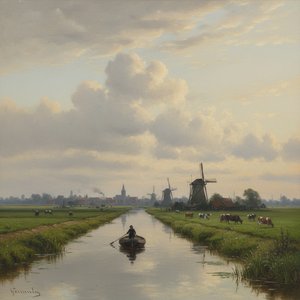
The Quiet Observer of the Amsterdam Waters
In the bustling heart of Amsterdam, where the canals meet the salt of the sea, Johannes de Blaauw spent his life watching the movement of the water. Born in 1712, he settled into the rhythm of the city, remaining there until his passing in 1776. His life was one of steady observation, a quiet existence spent capturing the shifting moods of the Dutch maritime landscape. He did not seek the grandiosity of the court, but rather the honest, churning reality of the ships and the tides that defined his home.
His hands were accustomed to the weight of oil and the texture of canvas. He sought to translate the physical sensation of the sea onto a flat surface, focusing on the way light interacts with the spray and the hull of a vessel. His work reflects a deep familiarity with the maritime life of the Netherlands, a world of wood, rope, and the unpredictable nature of the wind.
The Language of the Sea
The compositions of de Blaauw often centered on the tension between the vessel and the elements. He possessed a particular interest in the way a ship might sit in a calm sea or struggle against a rising swell. His technique allowed him to render the specificities of Dutch shipping, capturing the very essence of a vessel in motion. Through his brush, the viewer might encounter the following themes:
- The stillness of a marine scene during a calm period.
- The chaotic energy of ships navigating choppy seas off the coast.
- The interplay of light upon the surface of the water.
One can see his dedication to the craft in works like Marine Par Temps Calme, where the stillness is palpable. In other instances, he turned his attention to the more turbulent aspects of the coast, documenting the struggle of sailors against the waves. These paintings were not mere decorations but were studies of a way of life that was central to the identity of his city.
A Legacy in Oil and Canvas
Though he lived a life of focused industry, the value of his vision has been recognized through the passage of time. His works have surfaced in auctions, finding their way into the hands of collectors who sought the specific atmosphere of his maritime scenes. The market for his paintings has seen a range of results, from modest sums to significant amounts, reflecting the enduring interest in his depictions of the Dutch coast.
His historical significance lies in his ability to document the maritime character of the eighteenth century. He remains a painter of the sea, a man who understood that the water was never truly still, even when it appeared so. His paintings remain as records of a specific time and place, preserved in oil for those who wish to look back at the waters of Amsterdam.
Otázky a odpovědi
Odkud pochází Johannes de Blaauw?
Johannes de Blaauw se narodil(a) v Netherlands.
Jak je kariéra umělce Johannes de Blaauw rozdělena do období?
Kariéra umělce Johannes de Blaauw se na stránce Kronika umělce odvíjí období po období v podobě horizontální časové osy děl uspořádaných do kapitol podle tvůrčích etap.
Jaké nálady vyjadřují umělecká díla umělce Johannes de Blaauw?
Díla umělce Johannes de Blaauw si můžete prohlédnout podle nálady na jeho stránce Galerie nálad, kde jsou umělecká díla uspořádána podle jejich vyvolané nálady.
Kde najdu díla umělce Johannes de Blaauw seskupená podle uměleckých směrů?
Umělecká směry, ve kterých Johannes de Blaauw působil/a, si můžete prohlédnout na stránce Všechna umělecká hnutí, která seskupuje díla podle jednotlivých směrů.