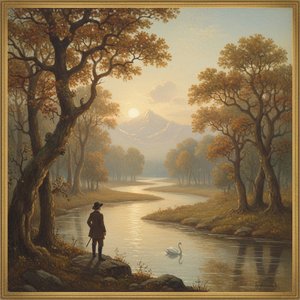
The Quiet Mastery of Hector Hanoteau
In the golden age of French landscape painting, few artists captured the serene, unadorned essence of the countryside with as much soulful precision as Hector Charles Auguste Octave Constance Hanoteau. Born in 1823 in Decize, Nièvre, Hanoteau emerged from the heart of France to become a vital voice in the movement toward sturdy realism. His journey through the prestigious halls of the École des Beaux-Arts, under the tutelage of Gignoux, instilled in him a profound respect for the natural world—a devotion that would define his entire oeuvre. Rather than seeking the dramatic or the theatrical, Hanoteau turned his gaze toward the quiet corners of the French landscape, finding profound beauty in the stillness of ponds, the movement of water, and the humble life of the rural terrain.
Hanoteau’s technique was a masterful marriage of disciplined realism and a sophisticated command of color. His brushwork, while grounded in the academic traditions of his training, possessed a vitality that breathed life into every leaf and ripple. He had an uncanny ability to manipulate light and tone to evoke a specific atmosphere, often leaning into a palette that felt both earthy and luminous. This skill allowed him to transcend mere topographical recording, instead inviting the viewer into a sensory experience of the French landscape. His works are characterized by a certain structural integrity, where every element of the composition feels anchored in a tangible, physical reality.
Legacy and Enduring Impressions
The significance of Hanoteau’s contribution to art history is cemented by the presence of his most celebrated masterpieces in some of the world's most esteemed institutions. His ability to capture the fleeting moments of nature—the way light dances upon a lily pad or how shadows settle over a village pond—has earned him a permanent place in the canon of French landscape painting. Some of his most iconic works include:
- The Village Pond: A quintessential example of his ability to blend tranquil scenery with masterful tonal control.
- The Frogs: A piece that showcases his keen eye for the small, often overlooked details of the natural ecosystem.
- The Water Lilies: A work that highlights his delicate handling of light and reflection, prefiguring some of the more impressionistic sensibilities of his era.
Throughout his career, Hanoteau received significant recognition from the French artistic establishment, most notably receiving a first-class medal at the Paris Exposition of 1889 and being honored with the cross of the Légion d'honneur in 1870. These accolades reflect not only his technical prowess but also his standing as a respected figure within the French art community. Today, his works reside prominently in the Musée d'Orsay, serving as a testament to a life spent observing the quiet majesty of the earth and translating that observation into timeless, evocative art.
Otázky a odpovědi
V jakém městě a z jaké země pochází Hector Hanoteau?
Hector Hanoteau se narodil(a) ve městě Decize v zemi France.
Kde najdu díla umělce Hector Hanoteau seskupená podle techniky?
Stránka Podle techniky seskupuje díla umělce Hector Hanoteau podle použité techniky.
Kde a v jakém roce se narodil/a Hector Hanoteau?
Hector Hanoteau se narodil(a) v roce 1823 ve městě Decize.