Early Life, Family and Training
George Lourens Kiers was born on 26 January 1838 in Amsterdam, Netherlands. He entered a household where art was the primary language. His father, Petrus Kiers, was a painter, and his mother, Elisabeth Alida Haanen, was also a painter. This lineage extended to his sister, Catharina Kiers, who pursued painting as well. Growing up in such an environment meant that the technicalities of the craft were part of his daily reality from the start.
His formal instruction came under the guidance of Johan Hendrik Louis Meijer. This training provided the foundation for a career defined by precision and a specific focus on maritime and river scenes. Kiers did not merely inherit a name; he inherited a professional standard. His development was shaped by this direct connection to established Dutch painting traditions through both blood and mentorship.
Residences and Periods of Activity
Kiers’s career was defined by a restless movement between the urban centers of the Netherlands and the more provincial landscapes of the north. He spent his formative years in Amsterdam, remaining there until 1856. This early period was interrupted by a brief stay in The Hague that lasted until 1857. After a single year back in Amsterdam in 1858, he returned to The Hague, where he remained until 1861. This pattern of shifting locations suggests an artist constantly seeking the specific light and subject matter required for his maritime and riverine studies.
The mid-1860s saw a significant shift toward Assen. He resided there in 1862, briefly moved back to The Hague during that same year, and then returned to Assen for a sustained period from 1863 to 1868. This era in Assen provided a different topographical context than the coastal or canal-heavy environments of his earlier years. Following this period of movement, Kiers finally settled in Amsterdam, where he remained for the rest of his life. His presence in the capital was consistent enough to allow him to exhibit his work in Amsterdam and The Hague from 1856 until 1903.
Artistic Style and Subject Matter
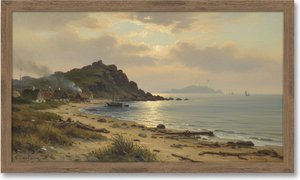
Kiers operated primarily as a marine painter, though his technical range extended to watercolor and etching. His focus remained fixed on the movement of water and the presence of vessels, specifically through sea and river views. He did not merely document ships; he placed them in specific, often dramatic, environmental contexts. This included the depiction of beach scenes and the turbulent energy of boats in stormy waters. His work often captures the tension between the vessel and the elements, such as in his depictions of fishing boats struggling against a storm.
There is a deliberate use of light and shadow in his compositions, particularly when he moved away from daylight scenes. He specialized in night scenes, frequently utilizing moonlight to define the silhouettes of ships. This interest in nocturnal lighting allowed him to explore more intense subjects, such as the visual impact of burning ships. By combining the maritime focus of his father with his own interest in night scenes, he created a specific niche for himself in Dutch maritime art, focusing on the interplay of light, fire, and water.
Key Works and Notable Paintings
Kiers’s output demonstrates a consistent focus on the mechanics of maritime life and the atmospheric tension of the sea. His ability to capture specific nautical events is evident in works like A stranded barque ship, painted about 1858. This period of his career shows a clear command over the depiction of vessels in distress. He often merged the technical precision of a draftsperson with the dramatic requirements of marine painting, particularly when dealing with light and shadow.
The artist frequently returned to the interplay between light and disaster. In Brandend schip, an oil on canvas from 1868, he explores the visual impact of fire against the dark maritime environment. This interest in nocturnal or high-contrast scenes was a direct continuation of his father's influence, yet Kiers applied it specifically to the movement of ships. His compositions often centered on the struggle of vessels against the elements, whether through the chaos of a storm or the stillness of a moonlit harbor.
His range extended beyond large-scale canvases to more intimate studies on different supports. Notable examples include:
- Het uitvaren van de vissersvloot, an oil on painter's board
- A Steam Sailing Ship before the Maasbruggen in Rotterdam
- Gezicht op de vaart te Assen
These works, alongside his various watercolors and etchings, confirm his status as a specialist in river and sea views. He did not merely paint scenery; he documented the functional reality of Dutch waterways, from the bustling activity of fishing fleets to the industrial presence of steamships.
Where to See the Works Today
The physical presence of Kiers's output remains anchored in several significant Dutch institutions. The Frans Halsmuseum in Haarlem maintains a collection that includes his maritime and landscape studies. Similarly, the Drents Museum in Assen holds works that reflect his connection to the northern regions of the Netherlands. These locations provide the most direct way to observe his handling of light and water in a controlled, professional setting.
In Amsterdam, the Het Scheepvaartmuseum holds two of his works, reinforcing his historical connection to the city's maritime identity. His professional standing during his lifetime was further cemented by his membership in Arti et Amicitiae, an influential institution in Amsterdam. While many of his pieces exist in private hands or smaller collections, these public museums remain the primary repositories for his surviving oil paintings and watercolors.
Otázky a odpovědi
Existuje přehled všech témat, která George Lourens Kiers maloval/a?
Stránka Atlas témat umělce George Lourens Kiers umožňuje prohlížet jeho díla podle jejich témat.
Jak se umění umělce George Lourens Kiers v čase vyvíjelo?
Chronologický přehled tvorby umělce George Lourens Kiers naleznete na jeho stránce Kronika umělce, kde jsou díla uspořádána podle jejich vzniku v jednotlivých kapitolách.
V jakém městě a z jaké země pochází George Lourens Kiers?
George Lourens Kiers se narodil(a) ve městě Amsterdam v zemi Netherlands.
V jakém historickém období působil/a George Lourens Kiers?
George Lourens Kiers působil v období 19th Century. Toto období historicky vymezuje uměleckou činnost tohoto autora.