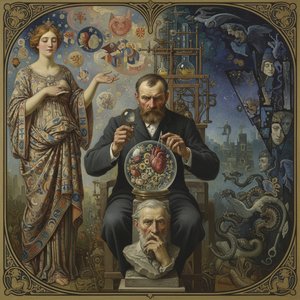
The Wandering Brush: The Life and Legacy of Carl Frithjof Smith
Born in the vibrant atmosphere of Christiania, Norway, in 1859, Carl Frithjof Smith was an artist whose creative spirit refused to be confined by national borders. Though his roots were firmly planted in Norwegian soil, his artistic journey led him across Europe, eventually finding a permanent home within the rich cultural tapestry of Germany. His early years were marked by a practical discipline; before the world knew him as a master of the brush, he labored as a draftsman in the mechanical workshops of Trondheim. This foundational period of precision and technical rigor would later manifest in the meticulous detail and structural integrity of his paintings, providing a unique backbone to his more fluid, emotive compositions.
The transition from draftsman to fine artist was a metamorphosis driven by passion rather than formal mandate. Despite facing early setbacks, such as the rejection of a state travel grant in 1880, Smith possessed an unyielding resolve. He sought out the prestigious Academy of Fine Arts in Munich, a move that would fundamentally reshape his artistic DNA. It was here, under the tutelage of the renowned genre painter Ludwig von Lützz, that Smith discovered the profound beauty of everyday life. Influenced by his mentor, he began to master the art of the genre scene—capturing the quiet, often overlooked moments of human existence with a sensitivity that resonated deeply with viewers.
A Master of Light and Human Connection
Smith’s oeuvre is characterized by a remarkable duality: the ability to execute grand, sweeping landscapes while maintaining an intimate focus on the human soul. His work as a portraitist allowed him to explore the psychological depths of his subjects, most notably seen in his evocative portrait of the legendary playwright Henrik Ibsen. Yet, it was in his genre paintings where he truly excelled at weaving narratives through light and shadow. He possessed an uncanny ability to transform a simple farm scene or a quiet church interior into a stage for silent drama, using texture and tone to evoke a sense of nostalgia and timelessness.
His technical prowess earned him significant acclaim on the international stage. The halls of the Berlin exhibitions and the prestigious Glaspalast in Munich bore witness to his rising stardom, as he was decorated with gold medals and silver honors. These accolades were not merely personal triumphs but reflections of a talent that bridged the gap between Northern European sensibilities and the academic traditions of Central Europe. His presence in the Deutscher Künstlerbund solidified his status among the elite of the German art scene, marking him as a pivotal figure in the late 19th-century artistic landscape.
The Professor and the Legacy
Beyond his individual canvases, Smith’s influence extended into the very foundations of art education. In 1890, he was appointed as a professor at the Grand-Ducal Saxon Art School in Weimar, a position he held with distinction until 1904. This period of his life was perhaps his most impactful, as he shaped the minds of the next generation of masters. Most notably, the legendary Max Beckmann emerged from his classroom, carrying forward the lessons of structure and observation that Smith had championed. Through his students, Smith’s artistic lineage continued to pulse through the veins of modern art.
Even after resigning from his academic post, Smith remained a fixture of Weimar's cultural life until his death in 1917. While his works were celebrated throughout Germany and Sweden, he maintained a quiet, intermittent connection to his Norwegian homeland. Today, we remember Carl Frithjof Smith not just as a painter of scenes, but as a bridge-builder—between the mechanical and the aesthetic, between Norway and Germany, and between the classical traditions of the past and the burgeoning modernism of the future.
Otázky a odpovědi
V jakém historickém období působil/a Carl Frithjof Smith?
Carl Frithjof Smith působil v období 19th Century. Toto období historicky vymezuje uměleckou činnost tohoto autora.
Existuje přehled všech témat, která Carl Frithjof Smith maloval/a?
Stránka Atlas témat mapuje díla umělce Carl Frithjof Smith podle tématu.
Existuje časová osa děl umělce Carl Frithjof Smith?
Díla umělce Carl Frithjof Smith můžete prohlédnout v chronologickém pořadí na stránce Chronologie děl.
Mohu si díla umělce Carl Frithjof Smith seřadit podle barvy?
Stránka Sestavení podle barev umělce Carl Frithjof Smith umožňuje prohlížet jeho díla uspořádaná podle barev.