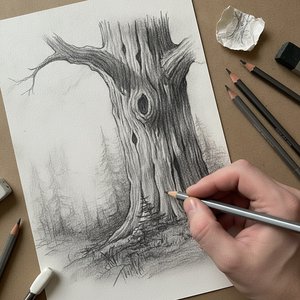
The Silent Language of Line: Mastering Hatching and Cross-Hatching for Depth and Texture
Master the art of hatching and cross-hatching with our expert guide. Explore the historical evolution from Renaissance masters like Dürer to modern techniques for creating profound depth, texture, and light in your drawings and printmaking.
Hatching (French: hachure) is an artistic technique used to create tonal or shading effects by drawing, painting, or scribing closely spaced parallel lines. When lines are placed at an angle to one another, it is called cross-hatching. Hatching is al...
Every profound masterpiece begins with a single, deliberate mark upon a void. Before the vibrant hues of oil paint command our attention in the grand halls of museums, there is the raw, intimate dialogue between an artist’s hand and a blank surface. This dialogue is often written in the silent language of the line. At its most fundamental level, hatching—or hachure, as it is known in French—serves as a rhythmic tool used to create tonal effects through closely spaced parallel lines. It is a technique that breathes life into two-dimensional surfaces, allowing a simple stroke to suggest a fleeting shadow or a structural boundary.
To understand hatching is to understand the physics of light. Shading, in its truest sense, refers to the depiction of depth perception by varying the level of darkness across a surface. In the hands of a master, hatching acts as a way to approximate the local behavior of light on an object's surface. By manipulating the quantity, thickness, and spacing of these lines, an artist can create the illusion of volume. Optically, brighter areas—those with less hatching—appear closer to the viewer, while darker, more densely hatched areas recede into the distance. It is a method of sculpting with nothing but ink or graphite, transforming a flat plane into a window of perceived depth.
From Medieval Origins to Renaissance Mastery: A Brief Art History of the Stroke
Albrecht Dürer’s ‘The Martyrdom of St John’ is a powerfully dramatic woodcut depicting the saint's brutal execution with intricate cross-hatching and intense detail. Explore this Northern Renaissance masterpiece and bring its timeless story into your...
The history of hatching is woven into the very fabric of Western art, originating in the Middle Ages and evolving significantly through the transformative eras of the Renaissance. While early medieval works relied heavily on outlines, the development of printmaking necessitated a more sophisticated way to denote shadow and form without the use of color. As artists moved from simple sketches toward complex engravings and woodcuts, they required a system that could communicate texture and light using only black ink on white paper.
The true zenith of this technique was reached during the Northern Renaissance, particularly through the works of masters like Albrecht Dürer. In his legendary woodcut, The Martyrdom of St John, one can witness the power of intricate cross-hatching to convey intense drama and anatomical detail. Dürer perfected the ability to use layered lines to create a sense of profound weight and atmosphere. Alongside him, pioneers such as Martin Schongauer utilized these linear methods to push the boundaries of what could be achieved in print media, turning the rigid medium of wood and metal into something that felt fluid, organic, and deeply emotive.
The Architecture of Light: Using Hatching to Construct Form and Volume
The Silent Language of Line: An Introduction to Hatching and Cross-Hatching Hatching Hatching (French: hachure) is an artistic technique used to create tonal or shading effects by drawing, painting, or scribing closely spaced parallel lines. When lin...
Hatching is far more than a mere decorative element; it is an architectural tool used to construct form. When an artist applies lines that follow or "wrap around" the contours of a subject, they are performing a feat of visual engineering. This technique, often referred to as contour hatching, allows the viewer to perceive the three-dimensional curvature of a limb, the roundness of a fruit, or the heavy folds of drapery. By varying the direction of the strokes to match the topography of the object, the artist guides the eye across the surface, creating a sense of structural integrity.
This process is akin to building a skeleton of light and shadow. A line can be as light as a whisper, suggesting the softest glow of dawn upon a cheek, or as heavy and assertive as a deep, architectural shadow beneath a stone ledge. Through the careful placement of these marks, the artist dictates where the light hits and where it fails to reach, effectively defining the very existence of the object within the composition. It is through this disciplined application of line that a two-dimensional drawing acquires its undeniable presence and weight.
Cross-Hatching and Complexity: Layering Lines for Depth and Texture
The Silent Language of Line: An Introduction to Hatching and Cross-Hatching Mastering the Hatching Technique: How Layered Lines Create Depth and Texture in Art The Silent Language of Line: An Introduction to Hatching and Cross-Hatching Hatching Hatch...
When the simplicity of parallel hatching meets the complexity of intersecting angles, we encounter the more sophisticated architecture of cross-hatching. This method does not merely decorate; it constructs layers of density that can simulate almost any texture known to man. By placing lines at opposing or perpendicular angles to one, the artist creates a mesh-like structure that traps darkness, allowing for much deeper tonal ranges than single-direction hatching could ever achieve.
This layering process is essential for creating contrast and movement. An area of shading placed next to another area with lines moving in a different direction creates a sharp boundary, defining edges and separating planes. This technique allows for the representation of diverse materials—from the coarse, rugged texture of weathered stone to the smooth, reflective surface of polished metal. For the student of art, mastering cross-hatching is about learning to manage this complexity, ensuring that the density of the marks serves the composition rather than obscuring it.
The Technical Vocabulary: Manipulating Line Weight, Density, and Direction
To master hatching is to learn a new vocabulary, where each stroke contributes to a larger, more meaningful narrative of form and light. The artist’s toolkit includes several critical variables: line weight, density, and direction. Line weight refers to the thickness of the individual mark; a heavy, bold line can suggest strength or deep shadow, while a fine, delicate line suggests subtlety and light. Density, on the other hand, is controlled by the proximity of the lines to one another. Increasing the frequency and closeness of these marks results in a darker, more opaque area.
Direction is perhaps the most vital element for maintaining the illusion of three-dimensionality. As previously noted, hatching lines should always follow the form they are meant to represent. If the direction is haphazard, the object will appear flat or distorted. However, when executed with precision, the direction of the stroke can create a sense of rhythm and flow, leading the viewer's eye through the composition in a choreographed dance. It is this technical discipline that separates a mere sketch from a masterful rendering of reality.
Beyond the Page: The Legacy of Hatching in Printmaking and Heraldry
Hatching (sometimes called hachure, from the French word) is a conventional system for monochrome denotation of heraldic armory, whereby the tinctures (colours) are represented by dots and lines. This technique is employed in cases where colours, for...
The influence of hatching extends far beyond the realm of fine art drawing, finding significant utility in the specialized fields of printmaking and heraldry. In the world of printmaking—encompassing intaglio processes like engraving and etching—hatching is a fundamental necessity. Because these methods rely on incised lines to hold ink, the artist must use hatching to create the illusion of color and tone where none physically exists in the matrix.
In the tradition of heraldry, hatching serves a highly functional purpose known as "hatching for tinctures." This is a conventional system used to represent specific colors in monochrome representations, such as on seals, coins, or engravings. For example, certain patterns of dots or lines are used to denote red, blue, or gold, allowing even a black-and-white image to communicate a full spectrum of heraldic meaning. From the ancient roots of textile decoration to the sophisticated systems developed during the Renaissance, the legacy of the hatched line remains an enduring testament to the power of the simple, deliberate mark.
At OriginalUniqueArt.com, we celebrate the profound techniques that define art history. Whether you are seeking to study the intricate linework of a Dürer woodcut or wish to bring the textured depth of a Renaissance masterpiece into your own home through a hand-painted oil reproduction, our collection offers unparalleled access to the world's most iconic works.
Unlock the secrets of graphite sketching with our expert guide for art students. Learn to master pencil grades, create realistic depth, and capture intricate textures through professional techniques designed to elevate your observational drawing skills.
Explore the profound artistry of graphite drawing. Discover professional techniques for mastering depth, texture, and detail through a lens of art history, from classical sketches to modern masterpieces. Elevate your understanding of the pencil medium with our expert guide.
Journey through history with 10 legendary drawings that redefined art. From Renaissance sketches to iconic charcoal works, explore the stories behind these timeless masterpieces. Find museum-quality reproductions and decor inspiration at OriginalUniqueArt.com. Discover all masterpieces online.
Elevate your artistic practice with our expert guide to drawing mediums and techniques. From graphite to charcoal, master the essential skills of line, shading, and form used by professional fine artists to create enduring masterpieces.
Elevate your artistic practice with this expert guide to mastering the line. Discover advanced techniques in graphite, charcoal, and contour drawing designed for art students seeking technical precision and expressive depth in their fine art studies.

 Hatching
 the Martyrdom Of St John,
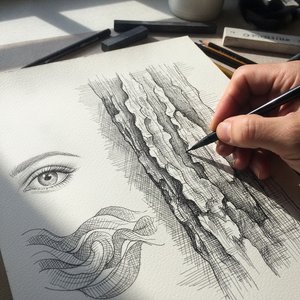 Mastering the Hatching Technique: How Layered Lines Create Depth and Texture in Art
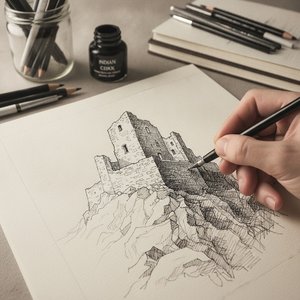 The Art of the Line: Mastering Hatching and Cross-Hatching to Create Depth and Dimension
 Hatching (heraldry)