Olejová malba
 Vše o díle Picking Cotton







































 U děl nebo reprodukcí, u nichž je jakákoliv strana větší než 105 cm (přibližně 41 palců), bude rám dodán jako sestava v rozloženém stavu. Tato metoda zajišťuje bezpečné doručení a chrání dílo před poškozením během přepravy.


Identification of the Artwork and Artist
The scene unfolds in "Picking Cotton," a work by the American artist William Aiken Walker. He captures a moment of labor within the fields, a subject that defines much of his artistic legacy. Walker was born in Charleston, South Carolina, in 1839, a place that remains deeply connected to his identity. He lived his life through the lens of genre painting, focusing his gaze on the everyday realities of the South.
Walker’s life eventually came to a close in Charleston, South Carolina, on January 3, 1921. Throughout his career, he became known for his ability to portray the lives of African Americans in the post-Reconstruction South. His brush captures the dignity of those working the land, turning a quiet moment of harvest into a window into a specific era of American history. The work exists as a visual record of the people and the agricultural rhythms that shaped the region.
Visual Composition and Subject Matter
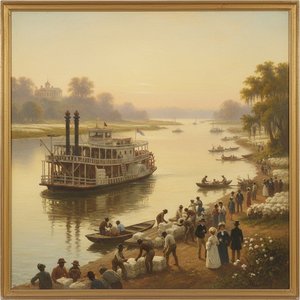
The scene unfolds across a wide expanse of the old west, where the heat of the day seems to hang over the sprawling fields. At least twelve people move through the landscape, their bodies bent toward the earth in a rhythm of constant motion. In the foreground, figures appear close enough to touch, their hands busy with the task of picking cotton, while others recede into the distance, becoming smaller silhouettes against the horizon. This layering of people creates a sense of immense, unending labor stretching toward the edge of the frame.
Horses are scattered throughout the composition, adding a sense of heavy, animal energy to the work. Some of these animals stand quietly nearby, while others strain against their harnesses. They pull carts and carriages that are piled high with heavy cotton bales, the weight of the harvest evident in the way the vehicles sit low to the ground. The movement of the people and the slow, steady pull of the horses create a landscape defined by purposeful, diligent activity. Every person in the field is occupied, tending to their specific task as they work together to bring in the crop.
Themes and Artistic Style
The scene unfolds as a genre painting, capturing a slice of everyday life through a lens of profound realism. Every figure in the field moves with a sense of purpose, their bodies engaged in the rhythmic, heavy labor of the harvest. There is a palpable atmosphere of hard work and dedication that hangs over the landscape, as people gather to tend to the crops. Horses pull heavy carts laden with cotton bales, their presence adding to the industrious energy of the field. The composition draws the eye across the expanse, following the movement of the workers from the immediate foreground into the distance.
Walker employs a realistic style to portray his subjects, focusing on the lived experiences of African Americans in the post-Reconstruction South. The painting does not shy away from the physical reality of the work; instead, it presents the scene with an empathetic clarity. One wonders at the quiet strength required to sustain such a pace under the sun. The depiction of the laborers and the surrounding environment provides a window into the social and economic realities of the era, documenting the grit and community spirit found within the agricultural landscape.
Related Works by William Aiken Walker
The artist's hand often returns to the rhythms of the Southern landscape and the labor that defines it. In Cotton Gin, Adams County, Mississippi, created about 1883, the focus shifts toward the machinery of the industry and the agricultural life surrounding it. This piece acts as a representative example of his genre scenes, capturing a specific moment of mechanical and human interaction. Nearby, the atmosphere changes in Noon Day Pause in the Cotton Field, where the heat and the stillness of the midday sun seem to settle over the workers.
Other scenes offer a glimpse into the more private, domestic realities of the era. Cabin Scene 1 brings a striking realism to the viewer, illustrating the specific living conditions of sharecroppers. It provides a quiet, unvarnished look at the spaces where these individuals reside. Meanwhile, Plantation Portrait, dated about 1885, offers another perspective on the social structures and the people who inhabited these vast Southern estates.
Otázky a odpovědi
Je dílo Picking Cotton ručně malované, nebo jde o tisk?
Ručně malováno: zkušený malíř přetvoří Picking Cotton v olejomalbu na lněném plátně.
Jakou velikost si mám vybrat pro Picking Cotton?
Velikosti se pohybují od 28.8 x 34.7 cm (Kč4367) až po 200.2 x 241.4 cm (Kč38689); v tabulce na této stránce jsou uvedeny jednotlivé varianty a jejich ceny.
Jak dlouho trvá doručení?
Doručení trvá 4 až 5 týdnů a zahrnuje bezplatnou expresní přepravu po celém světě; na této stránce je k dispozici i možnost urgentní výroby. Dílo můžete vrátit během 100 dnů s plným vrácením peniędzy, bez jakýchkoliv podmínek.
Jakou techniku použil/a William Aiken Walker pro dílo Picking Cotton?
Oil
 Náhled v interiéru

 Sdílet
 Sdílet
 Podrobnosti o díle
 Informační list pro studenty


 Stáhnout
 Podobné položky
 Rentgenové snímky
 Slideshow
 Otázky a odpovědi

 Statistiky