Přepnout na tisk
 Zobrazit více







































 U děl nebo reprodukcí, u nichž je jakákoliv strana větší než 105 cm (přibližně 41 palců), bude rám dodán jako sestava v rozloženém stavu. Tato metoda zajišťuje bezpečné doručení a chrání dílo před poškozením během přepravy.


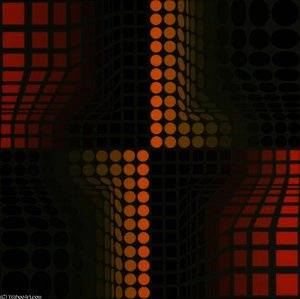
Vega-Wa-3: A Dance of Geometric Illusion
Victor Vasarely’s “Vega-Wa-3” isn't merely a painting; it’s an invitation to experience visual perception in a radically new way. Created in 1968, this striking artwork embodies the spirit of Op Art – Optical Art – a movement that sought to challenge our senses and explore the subconscious through controlled patterns of color and form. The image itself depicts a deceptively simple composition: concentric circles interwoven with smaller circles, forming an intricate checkerboard design against a predominantly white background punctuated by splashes of crimson red. This seemingly uncomplicated visual arrangement possesses a profound ability to generate an illusion of depth and movement, captivating viewers with its mesmerizing effect.The Genesis of Geometric Abstraction
Born in Pécs, Hungary (now Croatia), Victor Vasarely’s artistic vision was shaped by the intellectual currents of his time – particularly the Bauhaus influence. Rejecting representational art, Vasarely embraced geometric abstraction as a means to express fundamental principles governing visual experience. His meticulous approach involved constructing precise mathematical grids and applying systematic rules to generate repetitive patterns. This method wasn't simply about aesthetics; it was driven by a desire to understand how our eyes perceive space and color, mirroring the burgeoning interest in psychology and neuroscience of the era. The Bauhaus school instilled in him a belief that art should serve functionality and communicate ideas effectively – principles that would permeate his entire oeuvre.Decoding the Visual Language: Op Art’s Illusionistic Technique
The technique employed in “Vega-Wa-3” exemplifies the core tenets of Op Art. Vasarely utilized a carefully calibrated chromatic scale, juxtaposing complementary colors—red and white—to heighten visual stimulation. However, it's not merely color that creates this illusion; rather, the repetition of circles at varying scales generates rhythmic movement across the canvas. This subtle oscillation plays upon our retinal receptors, tricking the eye into perceiving depth where none exists. Vasarely’s meticulous calculations ensured that the patterns shifted slightly as viewers moved their gaze—a deliberate tactic designed to heighten perceptual awareness and provoke a visceral response.Symbolism Beyond Surface Appearance
While seemingly devoid of narrative content, “Vega-Wa-3” carries symbolic weight rooted in Vasarely's philosophical explorations. He viewed geometric abstraction as a pathway to transcendence – a way to escape the constraints of language and logic and access a realm of pure visual sensation. The circles themselves represent unity and wholeness, mirroring concepts found in Eastern philosophies and reflecting Vasarely’s fascination with spirituality. Furthermore, the checkerboard pattern symbolizes order and stability amidst apparent chaos—a visual metaphor for navigating life's complexities with composure and clarity.A Legacy of Bold Vision
“Vega-Wa-3” stands as a testament to Victor Vasarely’s groundbreaking contribution to modern art. Its enduring appeal lies in its ability to provoke contemplation and inspire wonder – qualities that resonate deeply within the viewer. Today, reproductions of this iconic piece continue to captivate collectors and interior designers alike, offering a glimpse into the revolutionary aesthetic principles of Op Art and demonstrating the transformative power of geometric abstraction. It remains an unforgettable exploration of visual perception and a celebration of artistic innovation.Otázky a odpovědi
Co zachycuje dílo "Vega-Wa-3"?
Témata obsažená v díle „Vega-Wa-3“ od Victor Vasarely zahrnují geometric abstraction, circular patterns, optical illusion, color vibration, minimalist design, visual perception, retro futurism. Tato témata společně shrnují obsah celého uměleckého díla.
Jaké je místo díla „Vega-Wa-3“ mezi opakovanými tématy umělce Victor Vasarely?
„Vega-Wa-3“ zachycuje geometric abstraction, circular patterns, optical illusion, color vibration, minimalist design, visual perception, retro futurism, zatímco v díle umělce Victor Vasarely se setkáváme s tématy jako bauhaus influence, geometric forms, visual depth illusion style, democratic art vision expressed, exploring perception boundaries. Porovnání těchto dvou aspektů odhaluje, jak toto dílo navazuje na obvyklá témata tohoto autora.
V jakém věku vytvořil/a Victor Vasarely dílo „Vega-Wa-3"?
Victor Vasarely bylo 62 let, když v roce 1968 vytvořilo dílo „Vega-Wa-3“. Věk je vypočítán z roku narození umělce, 1906.
 Náhled v interiéru
 Sdílet
 Sdílet
 Podrobnosti o díle
 Průvodce

 Stáhnout
 Podobné položky
 Rentgenové snímky
 Slideshow
 Q&A
Q&A Statistiky