Cubism
Interior (Stuart Davis)
Interior je dílo autora Stuart Davis (1892–1964). Patří k hnutí Cubism.

 Náhled v interiéru

 Ručně malovaná olejná reprodukce
 Sdílet
 Sdílet
 Průvodce


 Stáhnout
 Podobné položky
 Rentgenové snímky
 Slideshow
 Otázky a odpovědi

 Statistiky
Interior: the essentials
- Název
- Interior
- Autor
- Stuart Davis (1892–1964)
- Narozen(a) v roce
- Filadelfie, Spojené státy americké
- Pohyb
- Cubism
- Motiv
- abstract, geometric, modernism, composition, lines, forms
Looking at Interior
A Dynamic Vision of Modernity: Exploring Stuart Davis’s “Interior”
Stuart Davis's “Interior” is a captivating example of American Modernism, pulsating with energy and reflecting the artist’s unique response to the burgeoning urban landscape and the rhythms of jazz. Created sometime during his prolific career (1892-1964), this work embodies Davis’s commitment to developing a distinctly American visual language, moving beyond European influences towards a bold, independent style.
Deconstructing Space: Style & Technique
- The artwork is immediately striking for its geometric abstraction. Davis employs fragmented forms and flattened perspectives – hallmarks of both Cubism and Constructivism – but infuses them with a uniquely American sensibility.
- A vibrant palette dominates, anchored by the stark contrast between the white background, bold reds, blues, and greys, and punctuated by energetic black lines. The orange border further intensifies this visual impact.
- Davis’s technique is evident in the visible brushstrokes and layering of paint, creating a subtle texture that adds depth despite the overall flattened composition. This suggests an active process of building up form and color on the canvas, likely using oil paints as his primary medium.
- The arrangement isn't simply random; it’s carefully orchestrated into distinct zones – a tower-like structure in blue-grey, a dynamic red section with a vertical ‘sail’ or flag element, and a central area of interwoven geometric shapes. This zoning creates a sense of controlled chaos.
Echoes of Jazz & the Machine Age: Context & Symbolism
Davis was deeply influenced by jazz music, which he saw as embodying the spirit of modern America – improvisational, energetic, and uniquely its own. While “Interior” isn’t a direct representation of musical notes, the dynamic interplay of shapes and colors evokes the same sense of rhythm and syncopation found in jazz compositions.
- The architectural elements, particularly the stylized tower, could be interpreted as representing aspiration or the burgeoning skyscrapers of American cities. Davis frequently engaged with urban themes throughout his career.
- The ‘sail’ or flag-like form introduces a sense of movement and direction, perhaps symbolizing progress or the forward momentum of modern life.
- His early exposure to the Armory Show in 1913 was pivotal. While his initial works reflected the Ashcan School style, he quickly absorbed and transformed European avant-garde ideas into something distinctly American.
Emotional Resonance & Lasting Impact
“Interior” is not a tranquil scene; it’s charged with energy and tension. The fragmented forms and bold colors create a sense of dynamism, while the lack of traditional perspective can be slightly unsettling. This emotional complexity reflects the anxieties and excitements of a rapidly changing world.
- The artwork invites viewers to actively engage with its abstract language, prompting individual interpretations and fostering a personal connection.
- As a pioneering figure in American Modernism, Stuart Davis paved the way for subsequent generations of artists. His work continues to inspire those seeking to break free from convention and explore new forms of visual expression.
Interior in high resolution
Chráněno autorským právem: obrázek je uveden pouze pro ilustrační účely.
More sizes, crops & citation →Stuart Davis, Interior.
Questions about Interior
Je dílo „Interior“ od Stuart Davis spíše světlé, nebo tmavé?
„Interior“ má celkovou jasnost brilliant a jeho luminanci je Bright Balance.
Jak lze vysvětlit situaci s autorskými právy u díla „Interior“ od Stuart Davis?
Dílo „Interior“ od Stuart Davis spadá do volného užívání (stále chráněno autorským právem). Autorské právo vyprší po určité době od úmrtí umělce, ke kterému došlo v roce 1964.
Kde si mohu prohlédnout náhled díla "Interior"?
Chcete-li si prohlédnout náhled reprodukce díla „Interior“ od Stuart Davis, otevřete stránku Náhled v prostoru tohoto díla.
Existuje k dílu „Interior“ od Stuart Davis informační list pro studenty?
Stránka Průvodce pro studenty díla „Interior“ od Stuart Davis nabízí tištěný dvoulistový informační list: samotné umělecké dílo s identifikační tabulkou, časovou osu situující dílo do období života umělce, další díla daného autora, naměřenou barevnou paletu a citace ve čtyřech stylech připravené pro okamžité zkopírování.
Pod jakými dalšími jmény je Stuart Davis známý/á?
Mezi další jména, pod kterými je znám(a) Stuart Davis, tvůrce díla „Interior“, patří i Davis, Edward Stuart Davis.
Jak světlý je celkově obraz "Interior"?
Vnímaná jasnost díla „Interior“ od Stuart Davis je brilliant. Lze jej přizpůsobit osvětlení daného prostoru.
Působí barvy díla "Interior" výrazně, nebo jemně?
„Interior“ od Stuart Davis má Vivid barevnou intenzitu.
Jakou převládající barvu v sobě nese dílo „Interior“ od Stuart Davis?
Dominantní odstín díla „Interior“ od Stuart Davis je Amber to Saffron. Tento odstín tvoří základní tón celé palety.
About the artist, Stuart Davis
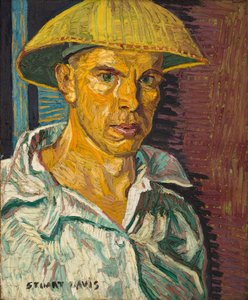
1892–1964, Spojené státy americké
Stuart Davis
Stuart Davis: A Pioneer of American Modernism Stuart Davis, born December 7, 1892, in Philadelphia, Pennsylvania, was a formative voice within the burgeoning landscape of American Modernism. Surrounded by an artistic lineage – his father served as art editor for the Philadelphia Press and his mother practiced sculpture – he possessed an innate predisposition towards visual expression from infancy. This early exposure profoundly shaped his artistic sensibilities and propelled him toward a career dedicated to redefining artistic boundaries. Davis’s formal education commenced at the Robert Henri School of Art in New York City between 1909 and 1912, where he benefited immensely from the mentorship of Robert Henri himself.
Also by Stuart Davis
 Odol
 Lucky Strike1924
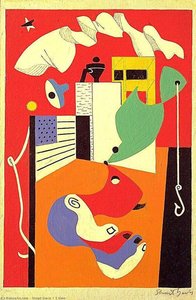 T View1951
 Blue Café1928
Essays around Interior
 Stuart Davis: Modernist Abstraction & the Vibrant Spirit of the Jazz AgeExplore the vibrant world of Stuart Davis, a pioneer of American Modernism. Discover his jazz-inspired paintings, signature style & investm…
 The Geometry of Elegance: Elevating Modern Villa Interiors with Cubist-Inspired ArtDiscover how Cubist-inspired art elevates modern villa interiors. Explore the intersection of geometric precision and luxury design through…
 Steel & Soul: The Rhythmic Geometry and Industrial Resonance of the Machine AgeExplore the rhythmic geometry of Fernand Leger and the Machine Age. Discover the power of industrial art today.