Přepnout na tisk
 Zobrazit více







































 U děl nebo reprodukcí, u nichž je jakákoliv strana větší než 105 cm (přibližně 41 palců), bude rám dodán jako sestava v rozloženém stavu. Tato metoda zajišťuje bezpečné doručení a chrání dílo před poškozením během přepravy.


A Bold Declaration in Red and White: Decoding Lichtenstein’s ‘Half Face with Collar’
Roy Lichtenstein's 1963 work, *Half Face with Collar*, is more than just a portrait; it’s a potent distillation of the burgeoning Pop Art movement. The painting immediately commands attention with its striking simplicity – a man’s face, cropped at an intriguing angle, dominated by the crisp lines of a white collar and tie against a field of vibrant red. This isn't a subtle study of character, but rather a bold statement about representation itself, borrowing directly from the visual language of mass media. Lichtenstein doesn’t aim to replicate reality; he replicates *the appearance* of reproduction – specifically, the look of commercial printing. The image feels instantly familiar, like something plucked from an advertisement or a comic strip, yet elevated to the status of fine art. This deliberate blurring of boundaries was central to Lichtenstein's project: questioning the hierarchy between “high” and “low” culture, and challenging traditional notions of artistic skill.- Subject Matter: The painting depicts a male face presented in profile, emphasizing the contours of his features with meticulous detail despite the stylized aesthetic.
- Style: Lichtenstein’s signature Pop Art style is characterized by flatness, bold outlines, and a deliberate rejection of illusionistic depth.
- Technique: The artwork utilizes oil paint combined with Magna dispersion paint—a technique borrowed from commercial printing—to achieve its distinctive textured surface.
The Mechanics of Impact: Ben-Day Dots and Artistic Process
To understand *Half Face with Collar*, one must consider Lichtenstein’s signature technique – the use of Ben-Day dots. Originally a mechanical process used in commercial printing to create varying shades of color, Lichtenstein adopted these dots as an integral part of his aesthetic. They aren't merely decorative; they are fundamental to the painting’s impact, mimicking the imperfections and artificiality of mass production. The red background isn’t a flat expanse of color but a carefully constructed field of these tiny dots, creating a visual texture that vibrates with energy. He didn’t simply copy comic book panels; he painstakingly recreated the *process* by which they were made, using stencils and applying paint in layers to achieve the desired effect. This meticulous approach belies the seemingly effortless quality of his work. The stark contrast between the white collar and tie and the red background reinforces the painting's conceptual core—a commentary on how images are disseminated and perceived.- Ben-Day Dots: Lichtenstein meticulously applied Ben-Day dots to create a textured surface that mimics the printing process, emphasizing the artificiality of reproduction.
- Stencil Technique: The artist employed stencils to apply paint in layers, mirroring the methods used by commercial printers and highlighting his deliberate artistic process.
Otázky a odpovědi
Jaké nastavení tisku se doporučuje pro „Polovina obličeje s límcem“ od Roy Lichtenstein?
Pro tisknutí díla „Polovina obličeje s límcem“ od Roy Lichtenstein se doporučuje velikost Velký formát v orientaci Čtverec.
Co zachycuje dílo „Polovina obličeje s límcem“ od Roy Lichtenstein a jakou náladu vyvolává?
„Polovina obličeje s límcem“ od Roy Lichtenstein zachycuje face, collar, red, white, dots, pop art, lichtenstein v Výrazné náladě. Předmět a atmosféra dohromady definují toto dílo.
Pod jakými dalšími jmény nebo pseudony je Roy Lichtenstein známý/á?
Roy Lichtenstein se vystupuje även pod alternativními jmény Roy Fox Lichtenstein.
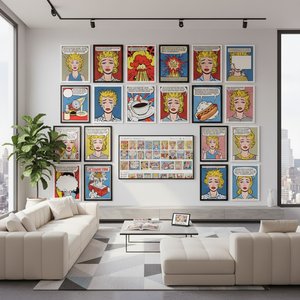
 Náhled v interiéru
 Sdílet
 Sdílet
 Podrobnosti o díle
 Průvodce

 Stáhnout
 Podobné položky
 Rentgenové snímky
 Slideshow
 Q&A
Q&A Statistiky