
 Náhled v interiéru
 Sdílet
 Sdílet
 Podrobnosti o díle
 Průvodce

 Stáhnout
 Podobné položky
 Rentgenové snímky
 Slideshow
 Otázky a odpovědi
 Statistiky
Market Scene

- 59.0 x 122.0 cm


 Zobrazit více
Giclée / Umělecký tisk
Giclée nebo plátěný tisk muzeální kvality s rychlou výrobou a širokou nabídkou povrchových úprav. ( Koupit ručně malovaný obraz Přepnout na digitální obraz)




P118B Kč10

P118H Kč10

P118W Kč10

P438Z Kč10

P508JH Kč12

P508YH Kč12

P805H Kč10

P805Z Kč10

P919BZ Kč10

P919G Kč10

P919XJ Kč10

P959ZH Kč10

P968JZ Kč12

W106C Kč8

W218G Kč10

W218JH Kč8

W218Y Kč10

W307PJ Kč10

W316G Kč10

W316PJ Kč8

W316Y Kč10

W398PJ Kč8

W4111J Kč10

W500HY Kč15

W500JH Kč15

W692G Kč12

W849H Kč8

W940BG Kč15

W953PJ Kč8




Vyberte si z našich přednastavených velikostí, které odpovídají původním proporcím díla.

Zadejte šířku a výšku, které potřebujete pro váš rám nebo stěnu. Tisk lze pouze oříznout, nikdy však nelze zvětšit obraz nad jeho původní rozměr, proto při výběru jiného formátu dochází ke ztrátě části obrazu. Před samotným tiskem vám zašleme digitální náhled k schválení. Obraz zobrazený na této stránce nenabízí skutečný výřez — ten uvidíte pouze v náhledu.
Celosvětové doručení () do 2 týdnů namísto standardních 4/5 týdnů. (4 listopad)

Zdarma celosvětová expresní doprava

Vysoce kvalitní lněné plátno

Kompletní pojištění přepravy

Záruka vrácení celního poplatku

Záruka věrného barevného souladu

100dení lhůta pro vrácení zboží (pouze při vadách výroby)

100% záruka vrácení peněz

Sleva při více objednávkách
 Skleněná varianta je dostupná pouze u rozměrů menších než 110 cm

Market Scene
Giclée / Umělecký tisk
Rozměry reprodukce
-


Celková cena za vybrané možnosti reprodukcí
Kč 1756
The Genesis of a Monumental Genre Scene
Pieter Aertsen’s “Market Scene,” painted in 1550, isn't merely a depiction of a bustling marketplace; it’s a meticulously constructed microcosm of 16th-century Dutch life. Aertsen, often hailed as the architect of domestic narrative within painting, deliberately elevated the everyday – the sights, sounds, and social interactions of a common market – to an unprecedented level of artistic significance. This wasn't simply about recording a scene; it was about crafting a complex tableau brimming with symbolic resonance, inviting viewers into a world both familiar and subtly profound. His work predates Bruegel’s monumental genre scenes, establishing a crucial precedent for future generations of artists exploring the richness of ordinary existence.
Aertsen's genius lies in his ability to seamlessly blend elements from various registers – still life, religious allegory, and realistic portraiture – into a single, unified composition. The painting’s genesis can be traced back to Renaissance ideals, particularly the concept of *peinture de sujet*, championed by artists like Peiraikos, which advocated for the elevation of seemingly mundane subjects to the level of high art. Aertsen embraced this philosophy wholeheartedly, transforming a commonplace market scene into a carefully orchestrated narrative brimming with layers of meaning.
A Symphony of Detail: Technique and Composition
The painting’s impact is immediately arresting – a vibrant explosion of color and activity contained within a remarkably detailed composition. Aertsen masterfully employs the techniques characteristic of Flemish Mannerism, utilizing bold outlines to define figures and objects with striking clarity. The use of oil paint allows for an astonishing level of realism, capturing the textures of fabrics, the gleam of produce, and the subtle nuances of human expression. The scene unfolds across a carefully designed space, drawing the eye through a complex network of stalls, tables, and pathways. Notice how Aertsen uses perspective to create a sense of depth, guiding the viewer’s gaze from the foreground figures to the distant buildings.
Central to the composition is the large table laden with an abundance of fruits and vegetables – a still life element that anchors the scene and provides a focal point. However, it's not simply a collection of objects; each item carries symbolic weight. The variety of produce represents prosperity and fertility, while its arrangement suggests a carefully considered display intended to attract customers. The background features a small, almost obscured religious scene – an “Ecce Homo” fragment referencing the biblical account of Pilate’s pronouncement of Jesus as innocent – subtly interwoven into the everyday drama.
Symbolism and Social Commentary
Beyond its visual appeal, "Market Scene" offers a fascinating glimpse into 16th-century Dutch society. The bustling marketplace was not just a place for commerce; it was a vital social hub where people from all walks of life gathered to exchange news, gossip, and goods. Aertsen captures this dynamic atmosphere with remarkable accuracy, depicting a diverse array of characters – merchants, shoppers, laborers, children – each engaged in their own activities. The inclusion of figures like the cook, offering food and drink, hints at the importance of hospitality and communal sustenance.
The painting also subtly critiques societal values. The presence of a figure indulging in oysters and mussels—a symbol of lust—serves as a reminder of the potential for excess and moral decay within the seemingly prosperous marketplace. Aertsen’s work, therefore, transcends mere representation; it becomes a subtle commentary on the complexities of human nature and the challenges of maintaining moderation amidst abundance.
A Legacy in Reproduction
Today, Pieter Aertsen's "Market Scene" stands as a testament to his artistic vision and enduring legacy. High-quality reproductions, such as those offered at OriginalUniqueArt.com, allow art enthusiasts to experience the richness and detail of this remarkable painting firsthand. Owning a reproduction is not merely acquiring an image; it’s gaining access to a window into a bygone era – a vibrant snapshot of 16th-century Dutch life imbued with layers of symbolism and artistic brilliance.
Otázky a odpovědi
Patří dílo „Market Scene“ mezi nejpopulárnější práce autora Pieter Aertsen?
Dílo „Market Scene“ od Pieter Aertsen má úroveň popularity Recognized. Tato klasifikace odráží, jak široce je toto dílo známé.
Jaká barevná paleta je použita v díle „Market Scene“ od Pieter Aertsen?
Paleta díla „Market Scene“ od Pieter Aertsen je popsána jako Earthy. Jde o stručný popis barevného zpracování tohoto díla.
Kolik lidí si prohlíží „Market Scene"?
Pro dílo „Market Scene“ je k dispozici stránka Statistiky. Zobrazuje měsíční počet návštěv tohoto díla i dalších děl daného umělce s rozpadem podle zemí a jazyků.
Biografie umělce
Pieter Aertsen: The Architect of Domestic Narrative
Pieter Aertsen, a name often whispered in the halls of art history, stands as a pivotal figure bridging the gap between Northern Mannerism and the burgeoning realism of the Dutch Golden Age. Born in Amsterdam around 1508 and tragically dying in the same city in 1575, Aertsen’s legacy isn't defined by grand religious commissions or heroic portraits, but rather by his revolutionary approach to genre painting – a deliberate elevation of everyday life, imbued with layers of symbolism and narrative depth. He wasn’t merely depicting scenes; he was constructing miniature worlds, inviting viewers into a complex tapestry of human experience.
Aertsen's early training under Allaert Claesz provided him with a solid foundation in traditional Flemish techniques. However, it was his relocation to Antwerp, the vibrant heart of artistic innovation during the mid-16th century, that truly shaped his distinctive style. Antwerp’s bustling atmosphere, its diverse population, and its position as a crossroads of European trade fostered an environment ripe for experimentation – a stark contrast to the more rigidly defined religious conventions of the time. Here, he joined the esteemed Guild of Saint Luke, earning the moniker “Langhe Peter,” or Tall Peter, reflecting his imposing stature, a detail often incorporated into his portraits.
The Invention of Monumental Genre
Aertsen’s most significant contribution to art lies in his pioneering work – the creation of what is now recognized as monumental genre scenes. Unlike earlier depictions of domestic life that were relegated to smaller, secondary spaces within religious compositions, Aertsen placed everyday activities – market scenes, butcher shops, still lifes – squarely at the forefront of his canvases. This wasn’t simply a shift in subject matter; it represented a fundamental change in artistic priorities. He deliberately blurred the lines between different genres – still life, landscape, and narrative – creating complex compositions that demanded active engagement from the viewer.
His most famous example, the *Butcher's Shop with the Flight into Egypt* (1551), exemplifies this revolutionary approach. The scene is dominated by a meticulously rendered butcher’s stall overflowing with meat, vegetables, and tools – an astonishingly detailed still life that immediately grabs the viewer’s attention. Yet, subtly interwoven within this seemingly mundane setting are elements of biblical narrative: the Holy Family fleeing into Egypt, depicted in miniature on a small panel above the counter. This layering of realities – the tangible world of commerce juxtaposed with the spiritual realm of faith – became a hallmark of Aertsen's work and profoundly influenced generations of artists to come.
Symbolism and the Language of Objects
Aertsen’s scenes are not merely visually arresting; they are rich in symbolic meaning. Each object, each gesture, carries weight and contributes to a larger narrative or moral commentary. The arrangement of items within a still life, for instance, could represent earthly pleasures versus spiritual rewards, wealth versus poverty, or even the fleeting nature of time. The *Butcher’s Shop* is particularly laden with symbolism: the abundance of food represents worldly prosperity, while the presence of oysters and mussels – associated with lust – serves as a cautionary tale.
Furthermore, Aertsen drew inspiration from earlier artists like Joachim Patinir, who had pioneered the use of landscape elements within religious scenes to create atmospheric depth and visual interest. Aertsen adopted this technique, integrating miniature landscapes – a church window, a pastoral scene – into his genre compositions, further expanding the scope of his narratives and inviting viewers to contemplate multiple realities simultaneously.
Influences and Artistic Development
Initially trained in the traditional Flemish style under Allaert Claesz, Aertsen’s work underwent a significant transformation during his time in Antwerp. He absorbed the influences of artists like Jan van der Straet, known for his dynamic compositions and attention to detail, as well as Joachim Patinir, whose use of landscape created atmospheric depth. Aertsen skillfully combined these elements with his own innovative approach, creating a unique visual language that distinguished him from his contemporaries.
His early works demonstrate a clear adherence to Flemish conventions, but gradually he began to prioritize the foreground and imbue everyday scenes with symbolic weight. This shift is particularly evident in *The Butcher’s Shop*, where the still life elements are not merely decorative but integral to the narrative. Aertsen's later paintings continued to evolve, incorporating more complex compositions and a greater emphasis on psychological realism.
Legacy and Historical Significance
Pieter Aertsen’s influence on subsequent generations of artists is undeniable. His innovative approach to genre painting paved the way for the rise of Dutch still life as a distinct artistic genre, influencing figures like Jan Sanders van Hemessen and, crucially, his son, Pieter Pietersz the Elder. Aertsen's emphasis on realistic detail, combined with his masterful use of symbolism and narrative layering, set a precedent for later artists who sought to capture the complexities of everyday life.
Even more remarkably, Aertsen’s work anticipated developments in Italian painting. The Renaissance humanist Hadrianus Junius (Adriaen de Jonghe) compared Aertsen to Peiraikos, an ancient Greek painter celebrated for his ability to depict ordinary subjects with extraordinary realism and symbolic depth. This comparison underscored Aertsen's pioneering role in challenging traditional artistic conventions and elevating the status of genre painting.
Despite the destruction of many of his works during the iconoclasm of the Beeldenstorm (the Protestant Reformation’s icon-smashing movement) in Amsterdam, Aertsen’s legacy endures. His paintings continue to fascinate art historians and viewers alike, offering a glimpse into a world where the mundane becomes profound and everyday life is transformed into a rich tapestry of meaning.

Pieter Aertsen
1508 - 1575 , Nizozemsko
Rychlé informace o umělci
- Artistic Movement Or Style: Severní manýrismus
- Artists Or Movements Influenced By This Artist: ['Joachim Patinir']
- Artists Who Influenced This Artist: ['Allaert Claesz']
- Date Of Birth: 1508, Amsterdam
- Date Of Death: 1575, Amsterdam
- Full Name: Pieter Aertsen
- Nationality: Holandský
- Notable Artworks:
- Butcher's Shop
- Tržnice
- Place Of Birth: Amsterdam, Nizozemsko
Související články

Mastering Light & Shadow: A Journey Through the Dutch Golden Age's Luminous Legacy
Embark on a cultural journey through the Dutch Golden Age. Explore the masterful interplay of light and shadow in 17th-century masterpieces, from Rembrandt to Vermeer, and discover how this era of profound realism continues to inspire fine art collectors today.
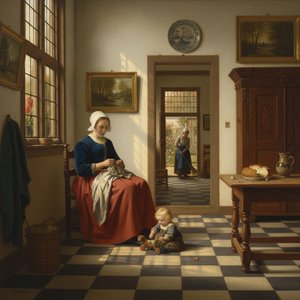
Pieter de Hooch: Illuminating Dutch Domestic Life & Golden Age Charm
Explore the captivating world of Pieter de Hooch, a master of Dutch Golden Age painting. Discover his innovative use of light, intimate domestic scenes, and lasting influence on art history. Learn more at OriginalUniqueArt.

The Enduring Legacy of Oil on Canvas: Technique, History & Aesthetic Impact
Explore the rich history & techniques of oil painting – from Renaissance masters to Impressionism. Discover pigments, layering methods, and why this timeless medium endures. Expert insights for artists & art enthusiasts.

Oil on Canvas: A Historical & Technical Exploration of a Timeless Artistic Medium
Explore the rich history & enduring techniques of oil painting on canvas. Discover the science behind its longevity, conservation practices, and contemporary relevance. Expert insights for art enthusiasts.

Golden Light & Dutch Skies: The Timeless Magic of Dutch Golden Age Landscapes
Discover the breathtaking beauty of Dutch Golden Age landscapes. Explore the mastery of light, chiaroscuro, and 17th-century realism through an expert art history lens, celebrating the enduring legacy of the Dutch Masters for discerning collectors and art lovers.

