Velikost textu

() ·

Obraz vytvořený ručně přímo pro vás

The Lightning

Ručně malovaná olejová reprodukce

Rukou malované olejné plátno v libovolném rozměru i s rámem, vyrobené našimi umělci na zakázku. ( Přepnout na tisk Přepnout na digitální obraz)

Popis sbírného předmětu

Experience 'The Lightning' by Pierre Alexandre Antigna (1848). A poignant portrait of a family amidst a storm, capturing urban realism and the compassion of a French Romantic artist. Hand-painted reproduction available.

Biografie umělce

French painter Pierre Alexandre Antigna (1817-1878) captured urban poverty & realism in his works, evolving from religious scenes to naturalist depictions. Explore his compassionate art.

od ·

Kapitola 1

Jak velká by měla být?

Posunout pro změnu velikosti; obrázek vlevo zobrazuje rám v jeho skutečné šířce. Zachovávají se původní proporce.

Standardní velikost
na zakázku
CM
INCH

Vyberte si z našich přednastavených velikostí, které odpovídají původním proporcím díla.

šířka
výška

Zadejte šířku a výšku, které potřebujete pro váš rám nebo stěnu. Protože se jedná o ruční malbu, při výběru jiného formátu může umělec kolem obrazu domalovat o něco více, nebo jej mírně oříznout — rozhodnete si vy. Před zahájením malby vám zašleme digitální náhled ke schválení. Obraz zobrazený na této stránce neodpovídá skutečnému výsledku — pouze digitální náhled jej zobrazuje.

Kapitola 2

Jak má být doručeno?

Vyberte si okraje plátna

Vyberte si rámeček

Corner sample of the WhiteWrap canvas edge finish, stretched on masivní dřevo bars
Bílé okraje Kč1
Corner sample of the BlurSideWrap canvas edge finish, stretched on masivní dřevo bars
Rozostřené okraje Kč1
Corner sample of the ExtendedWrap canvas edge finish, stretched on masivní dřevo bars
Prodloužené okraje Kč1
Corner sample of the P118B picture frame: tvarovaný polystyren, 5 cm wide and 3 cm thick
P118B Kč10
Corner sample of the P118H picture frame: tvarovaný polystyren, 5 cm wide and 3 cm thick
P118H Kč10
Corner sample of the P118W picture frame: tvarovaný polystyren, 5 cm wide and 3 cm thick
P118W Kč10
Corner sample of the P438Z picture frame: tvarovaný polystyren, 5.5 cm wide and 3.5 cm thick
P438Z Kč10
Corner sample of the P508JH picture frame: tvarovaný polystyren, 7 cm wide and 3.5 cm thick
P508JH Kč12
Corner sample of the P508YH picture frame: tvarovaný polystyren, 7 cm wide and 3.5 cm thick
P508YH Kč12
Corner sample of the P805H picture frame: tvarovaný polystyren, 5 cm wide and 3.5 cm thick
P805H Kč10
Corner sample of the P805Z picture frame: tvarovaný polystyren, 5 cm wide and 3.5 cm thick
P805Z Kč10
Corner sample of the P919BZ picture frame: tvarovaný polystyren, 7 cm wide and 3.5 cm thick
P919BZ Kč10
Corner sample of the P919G picture frame: tvarovaný polystyren, 7 cm wide and 3.5 cm thick
P919G Kč10
Corner sample of the P919XJ picture frame: tvarovaný polystyren, 7 cm wide and 3.5 cm thick
P919XJ Kč10
Corner sample of the P959ZH picture frame: tvarovaný polystyren, 5 cm wide and 3 cm thick
P959ZH Kč10
Corner sample of the P968JZ picture frame: tvarovaný polystyren, 6 cm wide and 4 cm thick
P968JZ Kč12
Corner sample of the W106C picture frame: masivní dřevo, 5 cm wide and 3 cm thick
W106C Kč8
Corner sample of the W218G picture frame: masivní dřevo, 5 cm wide and 3 cm thick
W218G Kč10
Corner sample of the W218JH picture frame: masivní dřevo, 5 cm wide and 3 cm thick
W218JH Kč8
Corner sample of the W218Y picture frame: masivní dřevo, 5 cm wide and 3 cm thick
W218Y Kč10
Corner sample of the W307PJ picture frame: masivní dřevo, 6 cm wide and 3 cm thick
W307PJ Kč10
Corner sample of the W316G picture frame: masivní dřevo, 6 cm wide and 3 cm thick
W316G Kč10
Corner sample of the W316PJ picture frame: masivní dřevo, 6 cm wide and 3 cm thick
W316PJ Kč8
Corner sample of the W316Y picture frame: masivní dřevo, 6 cm wide and 3 cm thick
W316Y Kč10
Corner sample of the W398PJ picture frame: masivní dřevo, 5 cm wide and 3 cm thick
W398PJ Kč8
Corner sample of the W4111J picture frame: masivní dřevo, 6.5 cm wide and 3.5 cm thick
W4111J Kč10
Corner sample of the W500HY picture frame: masivní dřevo, 7 cm wide and 5 cm thick
W500HY Kč15
Corner sample of the W500JH picture frame: masivní dřevo, 7 cm wide and 5 cm thick
W500JH Kč15
Corner sample of the W692G picture frame: masivní dřevo, 8 cm wide and 4 cm thick
W692G Kč12
Corner sample of the W849H picture frame: masivní dřevo, 5 cm wide and 3 cm thick
W849H Kč8
Corner sample of the W940BG picture frame: masivní dřevo, 7.5 cm wide and 4.5 cm thick
W940BG Kč15
Corner sample of the W953PJ picture frame: masivní dřevo, 6 cm wide and 3.5 cm thick
W953PJ Kč8
Corner sample of the H24-GOLD picture frame: řezané dřevo s gessu, 10 cm wide and 6 cm thick
H24-GOLD Kč30
Corner sample of the H24-SILVER picture frame: řezané dřevo s gessu, 10 cm wide and 6 cm thick
H24-SILVER Kč30
Corner sample of the H36-GOLD picture frame: řezané dřevo s gessu, 15 cm wide and 6.5 cm thick
H36-GOLD Kč45
Corner sample of the H36-SILVER picture frame: řezané dřevo s gessu, 15 cm wide and 6.5 cm thick
H36-SILVER Kč45

Profil: . Celkové rozměry včetně rámu: .

Kapitola 3

Kdo jej maluje a mělo by se něco změnit?

Příklady možných změn: Nahrazení obličeje fotografií zákazníka; Přidání mazlíčka (např. výměna kočky za psa); Skrytá zpráva v pozadí; Změna krajiny nebo prvků v pozadí.
Po přijetí objednávky vám tým OriginalUniqueArt.com pošle e-mail s instrukcemi a poskytne náhled návrhu

Celosvětová doprava () za 3–4 týdny namísto standardních 5 týdnů. (5 listopad). Bez kompromisů v kvalitě.

Kapitola 4

Poslední úpravy

Štítek jako v muzeu?

Detaily ryté bronzové plakety

This elegant plaque features the artist's name and the title of the artwork, finely engraved for a timeless presentation.

It is made from bronze with a refined, elegant finish. The text is precisely laser-engraved for a sharp and permanent result. Measuring 9x2 cm, the plaque is compact yet easy to read. It's built to be durable and scratch-resistant, offering a professional, museum-quality look. Mounting is simple thanks to the included adhesive backing.

Detaily průhledné akrylové desky

The plaque includes essential engraved details such as the artist's name, the title of the artwork, the date it was created, the type of media used-like oil on canvas or watercolor-a brief description of the piece, and a QR code that links to the complete artwork information.

It is crafted from clear acrylic, offering a sleek, modern appearance. The text is UV-engraved in black to ensure strong visual contrast. With a size of 10x15 cm, it ensures optimal readability. It comes equipped with two metal hooks for secure wall mounting. The plaque is designed to be weather-resistant, making it suitable for various environments, and it includes interactive features that work seamlessly with smartphone scanning.

Detaily černé akrylové destičky

This elegant plaque includes engraved information such as the artist's name, the title of the artwork, the date it was created, the type of media used (like oil on canvas or watercolor), a short description of the artwork, and a QR code for quick access to more information.

The plaque itself is made from refined black acrylic with a premium finish. The text is laser-engraved in white for high contrast and readability. Its size is 10x15 cm, designed to be easy to read. It comes with two metal hooks for professional mounting. The design is sleek and fits any interior style. It is also weather-resistant and durable, with built-in digital integration for mobile compatibility.

Ochranný lak?

Kdy jej potřebujete?

Kapitola 5

Váš obraz přesně podle objednávky

The Lightning

Technika reprodukce

Rozměry reprodukce

-

Vybraní mistři umění

Vyšší míra detailu, jemnosti a delší doba výroby

-

Možnosti rámování reprodukcí

-

-

U děl nebo reprodukcí, u nichž je jakákoliv strana větší než 105 cm (přibližně 41 palců), bude rám dodán jako sestava v rozloženém stavu. Tato metoda zajišťuje bezpečné doručení a chrání dílo před poškozením během přepravy.

Vyžaduje se odborná montáž – nejedná se o produkt pro svépomocnou realizaci (DIY).
Sestava musí být složena a plátno napnuto zkušeným profesionálním rámovačem s použitím dřevěného lepidla (není součástí balení), kleští na napínání plátna a svorek pro udržení pravých úhlů křížů během schnutí lepidla. Nesprávná montáž nebo nerovnoměrné napnutí plátna může způsobit trvalé poškození uměleckého díla, které není kryto naší zárukou.

  • Jsou zahrnuty všechny lišty z masivního dřeva, přesně na míru nařezané.

  • Sestavuje se pomocí součástí balení (šroubů), plus dřevěného lepidla na rohové spoje, které není součástí balení a musí jej zajistit váš rámovač.

  • Vyžaduje se profesionální nářadí, které není součástí sady: kleště na napínání plátna a svorky pro udržení kolmosti příček během schnutí lepidla.

Důležité:
Spoje v rozích vyžadují lepidlo na dřevo, tyčinky musí být přichyceny pomocí svorek, dokud lepidlo zcela neuschne, a pro napnutí plátna na sestavený rám je zapotřebí kleští na natahování plátna. Žádný z těchto náčiní není součástí sady. Před objednáním této velikosti prosím zajistěte zkušeného profesionálního rámovače.

Popisek díla

-

-

Ochranný lak

Lesklý lak (zvýrazňuje barvy, chrání před světlem a vlhkostí)

-

Přizpůsobit své umělecké dílo

Příklady možných úprav: nahrazení obličeje fotografií zákazníka; přidání domácího mazlíčka (např. výměna kočky za psa); vložení skrytého vzkazu do pozadí; změna krajiny nebo prvků v pozadí.

-

Prioritní doručení

Celosvětové doručení () za 3–4 týdny namísto standardních 5 týdnů. (5 listopad). Bez kompromisů v kvalitě.

-

Expresní doručení

Celosvětová doprava () do 5 týdnů. (12 listopad).

V ceně

Celková cena za vybrané možnosti reprodukcí

Kč 6504

Celková cena Kč 6504

Skleněná varianta je dostupná pouze u rozměrů menších než 110 cm

Součást každé objednávky

  • Zdarma celosvětová expresní doprava
  • Vysoce kvalitní lněné plátno
  • Kompletní pojištění přepravy
  • Záruka vrácení celního poplatku
  • Záruka věrného barevného souladu
  • 100dení lhůta pro vrácení zboží (pouze při vadách výroby)
  • 100% záruka vrácení peněz
  • Sleva při více objednávkách

A Moment Frozen in Storm – “The Lightning” by Pierre Alexandre Antigna

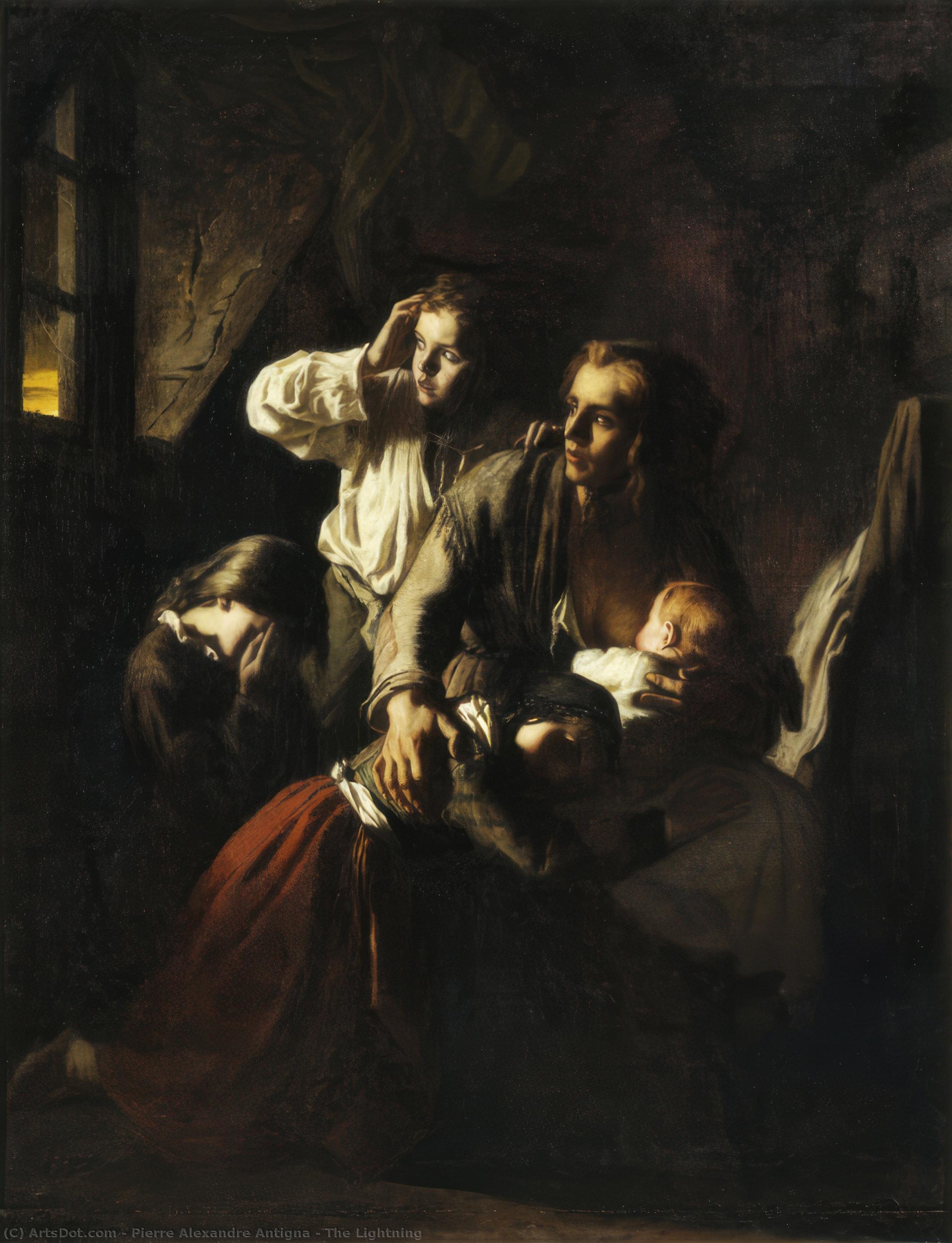
“The Lightning,” painted in 1848 by the French artist Pierre Alexandre Antigna, is more than just a depiction of a family huddled together during an electrical storm; it’s a poignant meditation on vulnerability, familial love, and the raw power of nature. Antigna, a key figure in Parisian Realism, masterfully captures a fleeting moment of intense emotion within a dimly lit interior, drawing the viewer into a scene brimming with both immediate danger and profound tenderness. The painting immediately evokes a sense of urgency – the dark background, punctuated by the suggestion of rain-streaked windows, speaks to an external threat, while the central focus on the family’s embrace offers a powerful counterpoint.

Subject and Composition: A Study in Domesticity Under Duress

At the heart of the composition stands a man, identified as Pierre Alexandre Antigna himself, holding two infants close to his chest. His posture is one of unwavering protection, his gaze directed towards the children with an expression that blends concern and determination. Beside him, a young boy appears to be gazing out at the storm, perhaps contemplating its force or yearning for safety. The arrangement isn’t merely observational; Antigna deliberately places these figures within a confined space, emphasizing their dependence on one another and highlighting the vulnerability inherent in their situation. The limited palette – primarily dark browns, grays, and blues – reinforces this sense of confinement and impending darkness, while subtle highlights suggest the flickering light of an oil lamp, offering a fragile beacon of hope.

Technique and Style: The Nuances of Parisian Realism

Antigna’s style firmly aligns with the tenets of Parisian Realism, a movement that sought to depict life as it truly was – often unflatteringly – without resorting to romanticized ideals. He employs a meticulous attention to detail, evident in the textures of the clothing, the wrinkles on the man's face, and the delicate features of the infants. The brushwork is deliberately loose and expressive, particularly in rendering the shadows and suggesting the movement of the storm outside. Notably, Antigna’s use of light is crucial; it doesn’t illuminate the scene entirely but rather creates pockets of brightness that draw attention to key elements – the faces of the family members – while leaving much of the background shrouded in mystery. This technique enhances the dramatic effect and underscores the precariousness of their circumstances.

Symbolism and Historical Context: A Reflection of Urban Life

“The Lightning” was painted during a period of significant social upheaval in Paris, following the 1848 Revolution. The city was grappling with poverty, overcrowding, and political instability. Antigna’s choice to depict a family struggling against the elements resonated deeply with contemporary audiences, reflecting anxieties about urban life and the vulnerability of ordinary people. The storm itself can be interpreted as a metaphor for the turbulent times – a force beyond their control that threatens to overwhelm them. The act of holding the infants represents not just physical protection but also the preservation of hope and future generations amidst chaos. Drawing on research, it’s noted that Antigna lived in the impoverished Île Saint-Louis district, giving him firsthand experience with the hardships faced by many Parisians.

Emotional Impact and Legacy: A Timeless Portrait of Human Connection

Despite its somber subject matter, “The Lightning” possesses a remarkable emotional resonance. The painting’s power lies in its ability to evoke empathy for the family depicted – their vulnerability, their love, and their unwavering commitment to one another. It's a testament to the enduring strength of the human spirit in the face of adversity. Reproductions of this powerful work continue to captivate viewers today, offering a poignant reminder of our shared humanity and the importance of connection amidst uncertainty. The painting’s legacy resides not only in its artistic merit but also in its ability to spark reflection on social issues and the enduring value of family bonds.

Otázky a odpovědi

Jak se v díle "The Lightning" propojují kontrast a harmonie?

V díle "The Lightning" se Serene kontrast snoubí s Strong Color Unity harmonií.

Jaká barevná paleta je u díla "The Lightning" použita?

Paleta díla „The Lightning“ od Pierre Alexandre Antigna je popsána jako Earthy. Jde o stručný popis barevného zpracování tohoto díla.

Jak "The Lightning" vyvažuje světlo a stín?

Zaznamenané hodnoty pro dílo „The Lightning“ od Pierre Alexandre Antigna jsou: jas deep_shadow, luminance Dark.

Více informací o tomto obrazu

Náhled v interiéru Náhled v AR Přepnout na tisk Přepnout na digitální obraz Sdílet
Podrobnosti o díle Průvodce Přidat do oblíbených Stáhnout Podobné položky Rentgenové snímky Slideshow Otázky a odpovědi Statistiky

V číslech

  • 1848rok vytvoření
  • 29k výběru rámečků
  • standardní velikosti, v jejich vlastních proportioních
  • 5týdnů na namalování a doručení
Pierre Alexandre Antigna

Pierre Alexandre Antigna

1817 - 1878, France

Rychlé informace o umělci Pierre Alexandre Antigna

  • Full Name: Pierre Alexandre Antigna
  • Nationality: French
  • Date Of Birth: 1817
  • Date Of Death: 1878
  • Place Of Birth: Orleans, France
  • Notable Artworks:
    • La halte forcée
    • Jeune Bretonne de Bénodet
    • ETUDE POUR UN MARCHAND D'IMAGES
  • Artistic Movement Or Style: Realism, Naturalism
  • Artists Who Influenced This Artist:
    • Paul Delaroche
    • Sebastien Norblin de la Gourdaigne

Biografie umělce

The Compassionate Eye of Pierre Alexandre Antigna

In the heart of nineteenth-century France, a period defined by profound social upheaval and shifting artistic paradigms, Jean Pierre Alexandre Antigna emerged as a painter of unparalleled empathy. Born in Orléans in 1817, his early artistic journey was rooted in the traditional landscapes of his youth, shaped under the watchful eye of the local painter François Salmon. However, the pull of Paris proved irresistible. Upon entering the prestigious École Nationale Supérieure des Beaux-Arts in 1837, Antigna found himself immersed in a world of academic rigor, studying under masters such as Sébastien Norblin de la Gourdaine and the renowned Paul Delaroche. These early years were marked by a focus on religious subjects and formal portraiture, adhering to the established stylistic conventions of the era.

Yet, the true metamorphosis of Antigna’s soul occurred not within the gilded halls of the academy, but in the shadowed, narrow streets of the Île Saint-Louis. Living amidst the impoverished quarters of Paris, the artist became a witness to the raw, unvarnated struggles of the urban poor. This profound exposure to human hardship acted as a catalyst, steering him away from idealized religious iconography toward a gritty, unflinching Realism. By the time the Revolution of 1848 swept through France, Antigna had fully embraced a style that sought to document the weight of existence. His canvases began to pulse with the heavy burdens and quiet resilience of those on the margins of society, rendered with a textured brushwork and an emotional depth that commanded the attention of the Parisian Salon.

A Journey Through Light and Naturalism

As his career progressed, Antigna’s artistic vision expanded beyond the urban confines of Paris. Driven by an insatiable curiosity about the human condition and the natural world, he embarked on extensive travels through the rugged landscapes of Brittany and the vibrant terrains of Spain. These journeys allowed him to blend his social consciousness with a burgeoning Naturalism. Around 1860, his work began to reflect a meticulous observation of nature, where the atmospheric qualities of the landscape became as much a subject as the people inhabiting them. Whether capturing the dramatic tension of a storm or the quiet dignity of a rural worker, his technique remained anchored in a sense of profound compassion.

His mastery was formally recognized by the French state when he was awarded the Legion of Honor in 1861, a milestone that solidified his standing among the significant figures of his generation. Even as his style evolved toward more naturalist depictions, the core of his work remained an exploration of vulnerability and strength. Notable works such as The Lightning demonstrate this duality, where a family huddled during an electrical storm serves as a poignant meditation on familial love amidst the terrifying power of nature. Through his use of light, shadow, and impasto textures, Antigna did more than merely paint scenes; he captured the very essence of survival.

Legacy of a Social Realist

The historical significance of Pierre Alexandre Antigna lies in his ability to bridge the gap between Romantic emotion and Realist truth. He did not merely observe poverty; he imbued it with a dignity that challenged the era's social hierarchies. His life, which concluded in Paris in 1878, left behind an oeuvre that serves as a vital visual record of nineteenth-century French life. His influence can be seen in the way he utilized the following elements to elevate his subjects:

  • Emotional Resonance: The ability to transform a scene of hardship into a universal study of human resilience.
  • Textural Depth: Using heavy, expressive brushstrokes to mirror the ruggedness of the lives he depicted.
  • Atmospheric Storytelling: Leveraging natural light and weather—such as in his depictions of storms—to reflect internal psychological states.
  • Social Witness: A commitment to documenting the marginalized, ensuring their presence was felt within the prestigious halls of the art world.

Today, Antigna is remembered not just as a painter of scenes, but as a compassionate voice of his era, an artist who looked into the darkness of urban struggle and found the enduring light of the human spirit.

Rychlé informace

  • Influences: French Romanticism
  • Notable elements: Storm scene, family
  • Artistic style: Romantic Realism
  • Artist: Pierre Antigna
  • Year: 1848
  • Movement: Realism

Artový kvíz

U každé otázky je pouze jedna správná odpověď.

Otázka 1:
What is the primary subject depicted in ‘The Lightning’?
Otázka 2:
According to the description, what is the overall atmosphere of ‘The Lightning’?
Otázka 3:
In what year was ‘The Lightning’ painted?
Otázka 4:
Who is the artist who created ‘The Lightning’?
Otázka 5:
What artistic movement is ‘The Lightning’ primarily associated with?