Abstract Expressionism
Head (Jackson Pollock)
Jackson Pollock (1912–1956) vytvořil dílo Head. Patří k hnutí Abstract Expressionism. Je vyrobeno z Acrylic On Canvas.
- Acrylic On Canvas

 Náhled v interiéru

 Ručně malovaná olejná reprodukce
 Sdílet
 Sdílet
 Informační list


 Stáhnout
 Podobné položky
 Rentgenové snímky
 Slideshow
 Otázky a odpovědi

 Statistiky
Head v kostce
- Název díla
- Head
- Autor
- Jackson Pollock (1912–1956)
- Rok narození umělce
- Cody, Spojené státy americké
- Technika
- Acrylic On Canvas
- Období
- Modern
- Motiv
- psychological, distortion, multiple eyes, chaos, surrealism, archetypal imagery
Co przedstawuje dílo Head?
A Visceral Exploration of the Human Condition
Jackson Pollock’s *Head*, a work shrouded in some mystery due to its lack of definitive dating and detailed documentation, presents a profoundly unsettling yet captivating vision. It is not a portrait in any traditional sense; rather, it's a fragmented, distorted exploration of the human form pushed to the very edge of recognition. The image assaults the viewer with a multiplicity of eyes and mouths, scattered across a seemingly chaotic surface. This isn’t an attempt at realistic representation but a raw, visceral expression of inner turmoil, anxiety, and perhaps even existential dread. The painting feels less like looking *at* a head and more like being immersed *within* a fractured psyche.Echoes of Surrealism and the Primal Self
To understand *Head*, one must consider Pollock’s artistic journey during its creation – likely in the late 1930s or early 1940s. He was deeply influenced by the Surrealist movement, which sought to unlock the power of the unconscious mind. However, Pollock wasn't simply mimicking Surrealism; he was forging his own path. The multiple eyes and mouths suggest a breakdown of boundaries – a loss of control over perception and expression. This resonates with Jungian psychology, an area Pollock actively explored through therapy during this period. His psychoanalyst encouraged him to express himself through art, leading to drawings that delved into archetypal imagery and the darker recesses of the human psyche. The work also reveals echoes of Picasso’s explorations of distorted figures, particularly his interpretations of mythological creatures like the Minotaur – a symbol of primal instincts and inner conflict. Pollock wasn't merely copying these influences; he was internalizing them and transforming them into something uniquely his own.The Genesis of a Revolutionary Technique
While *Head* doesn’t yet exhibit Pollock’s signature “drip” technique in its fully developed form, it foreshadows the radical innovations that would soon define his career. The layering of forms, the sense of movement and energy within the composition, hint at the all-over painting style he would later perfect. He was beginning to move away from traditional easel painting and explore more direct, physical ways of applying paint to canvas. This experimentation stemmed from a desire to bypass conscious control and tap into a more authentic, spontaneous form of expression. The very act of creating *Head* – the building up of layers, the distortion of form – can be seen as a precursor to his later action paintings, where the process itself became as important as the final product. It’s a crucial stepping stone in understanding how Pollock moved from representational work towards complete abstraction.A Powerful Statement for Modern Interiors
For those considering a reproduction of *Head*, it's essential to understand its emotional weight and visual impact. This is not a painting that will blend seamlessly into the background; it demands attention, provokes thought, and sparks conversation. Its dark, unsettling energy can be surprisingly effective in modern interiors, particularly those with minimalist or industrial aesthetics. The fragmented forms and bold composition create a striking focal point, adding depth and complexity to any space. *Head* is more than just an artwork; it’s a statement – a testament to the power of art to confront us with uncomfortable truths about ourselves and the world around us. It's a piece that will resonate with those who appreciate challenging, thought-provoking art and are unafraid to embrace the darker side of human experience.Vysokorozlišené fotografie díla Head
Jackson Pollock, Head. Veřejná doména
Odpovědi na otázky k dílu Head
Jakou technikou je vytvořeno dílo "Head"?
Technikou díla „Head“ od Jackson Pollock je Acrylic On Canvas. Reprodukce mají za cíl věrně zachytit vzhled této techniky.
Co zachycuje dílo „Head“ od Jackson Pollock?
„Head“ od Jackson Pollock zobrazuje: psychological, distortion, multiple eyes, chaos, surrealism, archetypal imagery, emotional intensity.
Lze obraz díla „Head“ od Jackson Pollock volně reprodukovat?
Co se týče autorských práv, dílo "Head" spadá do v rámci volného užití – autorská práva vypršela.
Kdo je autorem díla "Head"?
Autorem díla „Head“ je Jackson Pollock. Práce je v katalogu uvedena pod jménem Jackson Pollock.
K kterému uměleckému směru patří „Head“ od Jackson Pollock?
Umělecký směr, ke kterému patří dílo „Head“ od Jackson Pollock, je Abstract Expressionism. Tato klasifikace toto dílo umísťuje mezi související umělce a další umělecká díla.
Do které éry tvorby Jackson Pollock spadá dílo "Head"?
Dílo „Head“ pochází z období Mature Period v tvorbě umělce Jackson Pollock. Tato klasifikace dílo zasazuje do kontextu vývoje jeho tvůrčí dráhy.
Patří dílo „Head“ od Jackson Pollock do volného užití, a proč?
Dílo „Head“ od Jackson Pollock spadá do v rámci volného užití – autorská práva vypršela. Autorská práva se počítají od roku úmrtí autora; Jackson Pollock zemřel(a) v roce 1956.
Jakým způsobem se dílo „Head“ zapojuje do témat a stylu umělce Jackson Pollock?
Dílo „Head“ sdílí s ostatními pracemi umělce Jackson Pollock styl období Abstract Expressionism a opakující se témata: surrealist echoes, psychological depth, picasso’s distortion, jungian exploration, early technique foreshadowing.
Jaké je místo díla „Head“ mezi opakovanými tématy umělce Jackson Pollock?
„Head“ zachycuje psychological, distortion, multiple eyes, chaos, surrealism, archetypal imagery, emotional intensity, zatímco v díle umělce Jackson Pollock se setkáváme s tématy jako surrealist echoes, psychological depth, picasso’s distortion, jungian exploration, early technique foreshadowing. Porovnání těchto dvou aspektů odhaluje, jak toto dílo navazuje na obvyklá témata tohoto autora.
O umělci, Jackson Pollock

1912–1956, Spojené státy americké
Jackson Pollock
Early Life, Family and Training The story of Paul Jackson Pollock begins in the rugged landscape of Cody, Wyoming, where he was born on January 28, 1912. He was the youngest of five brothers, born to Stella May McClure and LeRoy Pollock. His father worked as a land surveyor, a profession that required constant movement across the vast American West. This nomadic existence meant that the young boy's early years were defined by frequent relocations, a restlessness that seemed to mirror the shifting horizons of his father's work.
O umělci Jackson Pollock Významná díla umělce Jackson Pollock
Také od autora Jackson Pollock
 Autunmový rytmus
 Číslo 1, 19491950
 Sjednocení
 Číslo 1A
Eseje k tématu Head
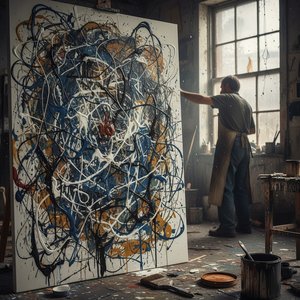 Paul Jackson Pollock: A Radical Departure – Exploring Abstract Expressionism's Pioneering Figure and His Enduring LegacyExplore the revolutionary art of Jackson Pollock & Abstract Expressionism. Discover his iconic drip paintings, lasting impact, and consider…
 Lucian Freud: A Psychological Portraiture of Post-War ExistenceExplore the profound psychological depth of Lucian Freud's portraits. Discover his unique realism, artistic evolution, and lasting influenc…
 Tři plátna, jeden příběh: Vliv volby na emocionální rezonanci umělecké interpretaceProzkoumejte hluboký vliv subjektivní interpretace na emocionální rezonanci uměleckých děl. Analýza klíčových konceptů a trendů 20. století…