Cubism
L (Juan Gris)
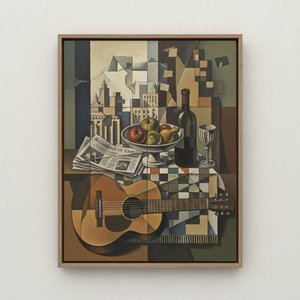
Juan Gris (1887–1927) vytvořil dílo L. Patří k hnutí Cubism. Je vyrobeno z Oil On Canvas. Nachází se v Biennale Internazionale dell'Antiquariato di Firenze v Florencie, Itálie.

 Náhled v interiéru

 Ručně malovaná olejná reprodukce
 Sdílet
 Sdílet
 Informační list


 Stáhnout
 Podobné položky
 Rentgenové snímky
 Slideshow
 Otázky a odpovědi

 Statistiky
L v kostce
- Název díla
- L
- Autor
- Juan Gris (1887–1927)
- Rok narození umělce
- Madrid, Španělsko
- Technika
- Oil On Canvas
- Kde jej vidět
- Biennale Internazionale dell'Antiquariato di Firenze, Florencie, Itálie
- Pohyb
- Cubism
- Období
- Modern
- Motiv
- guitar, music paper, man, geometric abstraction, monochrome, picasso influence
Co przedstawuje dílo L?
The Architect of Cubism: The Visionary World of Juan Gris
In the vibrant, avant-garde heart of early 20th-century Paris, a new visual language was being forged—one that dismantled the familiar to reveal a deeper, more structured truth. At the center of this revolution stood Juan Gris, a Spanish master whose analytical mind and poetic soul converged to create some of the most enduring icons of Synthetic Cubism. While contemporaries like Picasso and Braque often focused on the fragmentation of form, Gris brought a unique sense of mathematical precision and crystalline clarity to the movement. His work does not merely break objects apart; it reconstructs them into a harmonious symphony of geometric planes, where every line and shadow serves a deliberate, architectural purpose.
To encounter a piece like "Guitar & Music Paper" is to step into a world where reality is distilled into its most essential elements. The composition is a masterful dance of interlocking rectangles and cubes, creating a rhythmic interplay that guides the eye across the canvas. Gris utilized a sophisticated technique of layering textures and subtle gradations, allowing light to play across the surface as if through a prism. His palette, often characterized by earthy, muted tones, avoids the distraction of bright colors to focus instead on the profound relationship between shape and space. This deliberate restraint creates an atmosphere of contemplative stillness, inviting the viewer to linger within the complexity of the design.
A Symphony of Form and Symbolism
Beyond the technical brilliance lies a deep, symbolic resonance that continues to captivate collectors and decorators alike. The recurring motifs in Gris’s oeuvre—the guitar, the musical score, the newspaper—are not merely objects of study but symbols of the modern era's sensory richness. In "Guitar & Music Paper," the fusion of the instrument with the sheet music suggests a blurring of boundaries between the physical and the ephemeral, between sound and sight. The way the geometric shapes overlap creates an illusion of depth that feels both modern and timeless, making such works incredibly versatile for contemporary interior design.
For the discerning art lover or interior designer, a high-quality reproduction of a Juan Gris masterpiece offers more than just decoration; it provides a focal point of intellectual and aesthetic sophistication. The structured nature of his Cubist compositions lends itself beautifully to modern, minimalist, or mid-century modern environments, where the artwork can act as an anchor of stability and elegance. The emotional impact of his work is one of profound balance—a sense that even in a fragmented world, there is an underlying order and beauty waiting to be discovered. Owning a piece inspired by Gris is an invitation to celebrate the intersection of logic and lyricism, bringing a touch of Parisian avant-garde history into the sanctuary of the home.
Ve kterém muzeu se nachází L?
Biennale Internazionale dell'Antiquariato di Firenze
Florencie, Itálie
Nová podoba florentinské renesance: Ponořte se do světa BIAF Florencie dýchá uměním; není to jen město, které umění obsahuje, ale město, které uměním je , vžitým do samotných kamenů a doznívajícím v jeho palácích. V této atmosféře nesmrtelného krásy sídlí Biennale Internazionale dell'Antiquariato di Firenze (BIAること), událost, která přesahuje rámec běžného veletrhu antikvarátů a stává se pečlivě sestavovanou poutí do samotného srdce italské uměleckosti. Koná se v nádherném Palazzo Corsini, který je sám o sobě barokním mistrovstvím, a BIAF tak nenabízí pouze prohlídku, ale skutečné ponoření – šanci spojit se se staletími řemeslné dokonalosti a bohatým kulturním dědictvím Itálie.


Vysokorozlišené fotografie díla L

Juan Gris, L, Biennale Internazionale dell'Antiquariato di Firenze. Veřejná doména
Odpovědi na otázky k dílu L
Které muzeum uchovává originál díla "L"?
Dílo „L“ od Juan Gris je vystaveno v instituci Biennale Internazionale dell'Antiquariato di Firenze, Florencie, Itálie. Uvedené muzeum se vztahuje k originálu, nikoliv k reprodukcím.
Jakou technikou je vytvořeno dílo "L"?
Jaká témata se objevují v díle „L“ od Juan Gris?
Patří „L“ od Juan Gris do volného tisku?
Co se týče autorských práv, dílo "L" spadá do v rámci volného užití – autorská práva vypršela.
K kterému uměleckému směru patří „L“ od Juan Gris?
Do které období tvorby Juan Gris patří dílo „L“?
Proč má dílo „L“ právě takový autorský status?
O umělci, Juan Gris

1887–1927, Španělsko
Juan Gris
Raný život, rodina a vzdělání José Victoriano González-Pérez se narodil 23. března 1887 v Madridu ve Španělsku. Člověk, který se později proslavil pod jménem Juan Gris, vyrůstal v rozvětvené a rušné domácnosti jako třinácté z čtrnácti dětí. Jeho otec, Gregorio Gonzalez, byl úspěšný podnikatel, což rodině v jejích formativních letech v španělské metropoli poskytlo stabilní a bezpečné zázemí.
Také od autora Juan Gris
 Portrét Madame Josetty Gris1916
 Pears and grapes on a table1913
 Still Life před otevřeným oknem aka Place Ravignan1915
 Snídaně1915

Eseje k tématu L
 Spontaneity and Matter: Distinguishing CoBrA from Art InformelMaster the differences between CoBrA and Art Informel with our expert guide. Learn to identify these post-war movements today.
 Juan Gris: Cubist Deconstruction & Synthesis – A Comprehensive ExplorationExplore the revolutionary art of Juan Gris – a master of Cubism. Discover his unique approach to deconstruction, vibrant Synthetic Cubist w…
 Understanding the Difference Between Analytical and Synthetic CubismMaster the differences between Analytical and Synthetic Cubism with our expert guide. Learn to identify these iconic art movements now.