

 Zobrazit v interiéru
 Odeslat
 Sdílet
 Podrobnosti
 Průvodce

 Stáhnout obrázek
 Podobné kousky
 Rentgenové snímky
 Slideshow
 Statistiky
Pillars
 Oil On Canvas
- WallArt
- Constructivism
 1928
1928- Modern
 61.0 x 61.0 cm
 Přečíst si více
Umělecké dílo zobrazené na této stránce je chráněno autorským zákonem, což znamená, že nemůžeme legálně vytvářet ani prodávat jeho identickou reprodukci. Tato ochrana je vymáhána na základě mezinárodních dohod, jako například Berberská úmluva a národními zákony, včetně těch stanovených v Americký autorský zákon – Díl 17. Všechna práva vyhrazena.
Tato metoda je plně v souladu s autorským právem, protože nezahrnuje kopírování ani duplikování chráněného díla. Jde o kreativní reinterpretaci – nový obraz, který je inspirován originálem, ale není s ním identický.
Giclée / Umělecký tisk
Giclée nebo plátěný tisk muzeální kvality s rychlou výrobou a širokou nabídkou povrchových úprav. ( Objednat ručně malovanou reprodukci Přepnout na digitální verzi obrazu)




P118B Kč10

P118H Kč10

P118W Kč10

P438Z Kč10

P508JH Kč12

P508YH Kč12

P805H Kč10

P805Z Kč10

P919BZ Kč10

P919G Kč10

P919XJ Kč10

P959ZH Kč10

P968JZ Kč12

W106C Kč8

W218G Kč10

W218JH Kč8

W218Y Kč10

W307PJ Kč10

W316G Kč10

W316PJ Kč8

W316Y Kč10

W398PJ Kč8

W4111J Kč10

W500HY Kč15

W500JH Kč15

W692G Kč12

W849H Kč8

W940BG Kč15

W953PJ Kč8




Vyberte si z našich přednastavených velikostí, které odpovídají původním proporcím díla.

Zadejte šířku a výšku, které potřebujete pro váš rám nebo stěnu. Tisk lze pouze oříznout, nikdy však nelze zvětšit obraz nad jeho původní rozměr, proto při výběru jiného formátu dochází ke ztrátě části obrazu. Před samotným tiskem vám zašleme digitální náhled k schválení. Obraz zobrazený na této stránce nenabízí skutečný výřez — ten uvidíte pouze v náhledu.
Celosvětové doručení () do 2 týdnů namísto standardních 4/5 týdnů. (22 říjen)

Zdarma celosvětová expresní doprava

Vysoce kvalitní lněné plátno

Úplné pojištění přepravy

Záruka vrácení celního poplatku

Záruka věrného barevného shodu

100dení lhůta pro vrácení zboží (pouze při vadách výroby)

100% garance vrácení peněz

Sleva při více objednávkách
 Skleněná varianta je dostupná pouze u rozměrů menších než 110 cm

Pillars
Giclée / Umělecký tisk
Velikost reprodukce
-


Celková cena
Kč 1713
Josef Albers' Pillars: A Study in Order and Abstraction
Josef Albers’ "Pillars," created in 1928, is a striking example of early geometric abstraction that foreshadows the artist's later explorations of color theory. This artwork, measuring 61 x 61 cm, offers a compelling glimpse into Albers' artistic development during his time at the Bauhaus, a period marked by experimentation and a shift towards non-objective art.
Historical Context: The Bauhaus Influence
Albers’ journey as an artist was significantly shaped by his enrollment in the Bauhaus school in 1920. This progressive institution championed innovative educational ideas and fostered a climate of creative exploration. Initially studying painting at a traditional art school, Albers quickly gravitated towards the glass workshop within the Bauhaus, disregarding the prescribed wall painting class. It was here that he began creating "wall glass paintings"—assemblages of opaque glass—which served as precursors to his later color studies. “Pillars” reflects this early experimentation with form and material, demonstrating a move away from representational art towards pure abstraction.
Visual Analysis: Geometry, Color, and Composition
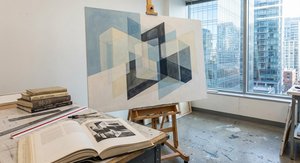
The artwork presents a meticulously structured composition characterized by vertical and horizontal lines arranged in a grid-like pattern. The color palette is restrained yet impactful, primarily featuring red, white, black, and grey tones with subtle variations. This deliberate choice of colors contributes to the overall sense of order and precision. The symmetrical arrangement emphasizes balance, while crisp, defined lines form rectangles and blocks that intersect, creating a complex visual texture. Notably, "Pillars" lacks traditional perspective or depth; it exists entirely on a flat, two-dimensional plane. The absence of recognizable objects or scenes reinforces the artwork’s purely abstract nature.
Style and Technique: Minimalism and Constructivism
“Pillars” aligns with both Minimalist and Constructivist aesthetics. Its emphasis on geometric forms, clean lines, and a limited color palette are hallmarks of Minimalism. Simultaneously, the structured grid and focus on construction evoke influences from Constructivism, an art movement that prioritized industrial materials and rational design principles. The technique employed appears to be precise painting, likely achieved through careful brushwork or potentially masking techniques to ensure sharp lines. The artwork is executed on canvas, as evidenced by the texture of the wooden backing.
Emotional Impact and Symbolism
While devoid of overt symbolism or emotional narrative, "Pillars" evokes a sense of order, precision, and intellectual rigor. Some viewers may perceive a slightly sterile or clinical aesthetic due to its geometric nature. However, the interplay of colors and forms creates a subtle visual rhythm that engages the viewer's perception. Ultimately, “Pillars” invites contemplation on the fundamental elements of art—line, shape, color—and their capacity to create compelling abstract compositions.
Otázky a odpovědi
Je pro dílo „Pillars“ k dispozici stažení?
Obraz díla „Pillars“ od Josef Albers si můžete stáhnout na stránce s k dispozici pro stažení Stáhnout: stažení digitálního obrazu ve vysokém rozlišení.
Kde mohu najít statistiky k dílu „Pillars“ od Josef Albers?
Stránka Statistiky díla „Pillars“ od Josef Albers zobrazuje statistiky veřejných návštěv: měsíční návštěvnost tohoto díla, srovnání s nejvíce prohlíženými díly daného umělce a původ jeho návštěvníků.
Z čeho je dílo "Pillars" vyrobeno a v jakém je stylu?
„Pillars“ od Josef Albers kombinuje techniku Oil On Canvas s uměleckým směrem Constructivism. Technika a směr popisují způsob vzniku a styl tohoto díla.
Biografie umělce
A Life Forged in Material: The Early Years and Bauhaus Formation
Josef Albers, born in Bottrop, Germany, in 1888, wasn’t destined for the world of art from the outset. His early life was deeply rooted in the practicalities of his father's contracting business – a world of carpentry, plumbing, and house-painting. This immersion in materials, in understanding how forms materialized through tangible means, would profoundly shape his artistic sensibility, laying the groundwork for an approach that prioritized direct experience and observation above all else. He wasn’t simply inheriting a trade; he was absorbing a fundamental respect for craftsmanship and the inherent qualities of each medium. Before dedicating himself fully to art, Albers spent five years as a schoolteacher in Bottrop and surrounding areas, honing his patience and pedagogical skills – attributes that would later prove invaluable in his role as an influential educator. His formal artistic training began in 1913 at the Königliche Kunstschule (Royal Art School) in Berlin, where he explored printmaking, painting, and crucially, stained glass. This early work, particularly his commission for “Rosa Mystica Ora Pro Nobis” in 1918 – a breathtaking stained-glass window – already hinted at his lifelong fascination with the transformative power of light and color, suggesting an abstract exploration that was yet to fully unfold. It wasn’t merely decorative; it was a deliberate investigation into how light *transformed* material, a theme that would become central to his artistic vision.The Bauhaus Crucible: Color as Subject
A watershed moment arrived in 1922 when Albers joined the faculty of the Bauhaus, the revolutionary school founded by Walter Gropius, seeking to unify all art and design disciplines. Initially assigned to the *Werklehre* (workshop practice) course – a foundational program designed to instill practical skills – he quickly immersed himself in the core principles of the Bauhaus: functionalism, geometric abstraction, and an unwavering focus on material exploration. This period proved transformative, fundamentally altering his artistic trajectory. Albers began a systematic investigation into color perception, moving decisively away from representational art towards increasingly abstract forms. He wasn’t interested in simply *what* colors were; he was driven by a desire to understand *how* they interacted, how they influenced each other, and how our eyes perceived them. The influence of fellow Bauhaus masters like Paul Klee and Wassily Kandinsky is readily apparent in his early work, yet Albers forged his own distinct path, prioritizing empirical observation over purely theoretical or metaphysical interpretations. He wasn’t seeking spiritual truths through color; instead, he meticulously documented its physical effects – a rigorous scientific approach that would become the defining characteristic of his artistic method. This focus on perception—on *how* we see—rather than what is *seen* set him apart and laid the foundation for his later explorations into the complexities of visual experience.Homage to the Square: A Laboratory of Perception
Following a period teaching at Black Mountain College in North Carolina – where he fostered a generation of American artists including Robert Rauschenberg and Cy Twombly – Albers embarked on what would become his most enduring and iconic series: “Homage to the Square” (1949-1967). This seemingly simple project, consisting of paintings featuring nested squares within squares, each iteration exploring subtle variations in color relationships, belies an incredibly complex and rigorous investigation into perceptual phenomena. It wasn’t intended as a celebration of geometry; rather, it was a meticulously designed laboratory for studying how our eyes perceive color – a process far more nuanced than intuitive understanding suggests. Albers painstakingly documented his experiments, revealing that colors aren't static entities but dynamic forces governing each other through internal logic, often misleading to the eye. A seemingly brighter square might appear to recede while a darker one advances, defying conventional expectations. This systematic approach culminated in his seminal book, *Interaction of Color* (1963), a foundational text still widely studied by artists and designers today. The book isn’t a treatise on color theory; it's a series of exercises designed to demonstrate how our perception of color is relative and contextual – a testament to Albers’ belief that seeing is not passive, but an active process of interpretation.Legacy and Enduring Influence
Josef Albers’s impact extends far beyond his paintings. His tenure as head of the design department at Yale University, from 1950 until his retirement in 1958, cemented his reputation as a profoundly influential teacher. He emphasized hands-on experimentation, critical observation, and relentless questioning of assumptions. Students weren't simply taught *what* to paint; they were taught *how* to see – to analyze, to deconstruct, and to understand the underlying principles governing visual experience. His pedagogical approach fostered independent thinking and encouraged students to develop their own unique artistic voices. *Interaction of Color* continues to be a cornerstone of art education, shaping how generations understand color relationships. Albers is now recognized as a key figure in the development of abstract art, particularly geometric abstraction and minimalist aesthetics. His “Homage to the Square” series remains iconic for its exploration of perceptual phenomena, demonstrating that even within seemingly simple forms, there exists an infinite complexity waiting to be discovered. He died on March 25, 1976, in New Haven, Connecticut, leaving behind a legacy that continues to inspire and challenge artists, designers, and educators alike – a testament to the power of observation, experimentation, and the enduring mystery of color.Notable Works
- Gray Instrumentation I Prospectus (1975): A minimalist monochrome painting exemplifying geometric balance and subtle tonal variations.
- Study for Homage to the Square – Beaming (Date Unknown): A classic example of Albers’s exploration of color interaction within nested squares, evoking a sense of calm and spatial depth.
- Rosa Mystica Ora Pro Nobis (1918): His early stained-glass commission, foreshadowing his lifelong fascination with light and color.

Josef Albers
1888 - 1976 , Německo
Rychlé informace
- Artistic Movement Or Style: Geometrická abstrakce
- Artists Or Movements Influenced By This Artist:
- Minimalismus
- Barvy
- Artists Who Influenced This Artist:
- Paul Klee
- Wassily Kandinsky
- Date Of Birth: 19. března 1888
- Date Of Death: 25. března 1976
- Full Name: Josef Albers
- Nationality: Německý-Americký
- Notable Artworks:
- Homage k čtverci
- Rosa Mystica
- Place Of Birth: Bottrop, Německo
Související články

Beyond Representation: Decoding the Language of Shape and Form in Geometric Abstraction
Master the complexities of Geometric Abstraction. Our expert guide explores the evolution from Cubist deconstruction to Bauhaus precision, decoding the power of shape and form. Perfect for art students seeking deep historical context and academic insight into modern masterpieces.
Beyond Form & Color: Geometric Abstraction's Enduring Legacy in Art History
Explore the captivating world of geometric abstraction! Discover its origins, key artists like Malevich & Mondrian, and why this movement remains highly valued by art collectors today. Expert insights at OriginalUniqueArt.

The Power of Less: A Definitive Guide to the Minimalism Movement and Geometric Abstraction
Explore the profound impact of Minimalism and Geometric Abstraction. From Mondrian to Malevich, discover how stripping art to its essential forms revolutionized modern aesthetics through our expert-led historical guide.

Neo-Abstract Art: The High-Impact Evolution of Modern Visual Energy and Geometric Sophistication
Discover the power of Neo-Abstract art. Explore how bold geometric forms and high-impact visual energy are redefining modern design. Learn to curate sophisticated, high-energy spaces with the latest trends in contemporary abstraction and structural color.

Geometrická abstrakce: 10 mistrovských děl, které změnily umění | OriginalUniqueArt.cz
Prozkoumejte 10 ikonických děl geometrické abstrakce od Mondriana, Maleviče a Kandinského. Objevte příběhy umělců, techniky a historii tohoto revolučního hnutí. Najděte inspiraci pro moderní dekorace a luxusní reprodukce obrazů na OriginalUniqueArt.com.