Olejová verze
 Vše o William Few







































 U děl nebo reprodukcí, u nichž je jakákoliv strana větší než 105 cm (přibližně 41 palců), bude rám dodán jako sestava v rozloženém stavu. Tato metoda zajišťuje bezpečné doručení a chrání dílo před poškozením během přepravy.


Identification of the Portrait of William Few
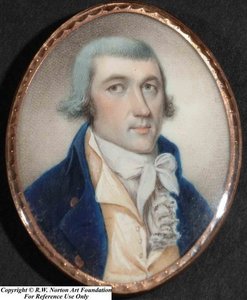
This miniature portrait of William Few was painted by John Ramage in 1787. The subject sits within a tight, oval frame, a quiet presence captured in the small scale of the work. Ramage, an artist who moved from the precision of Irish goldsmithing to the portraiture of a new nation, renders the man with a steady, composed gaze. The likeness is fixed in a moment of stillness, preserving the features of a man who occupied the center of a changing political landscape.
William Few was a lawyer and an American Founding Father whose life was shaped by the weight of significant signatures. He was a signer of the U.S. Constitution and later served as one of the first U.S. Senators from Georgia. His face, captured here by Ramage, belonged to a man who navigated the complexities of law and governance during the nation's formative years. The portrait remains a small, intimate window into the identity of a statesman.
The work exists as a precise record of a specific individual. Through the fine application of paint, Ramage captures the dignity of the subject. It is a study of a man who helped define the early American republic.
Visual Composition and Subject Details
The portrait is held within the tight embrace of an oval frame. This small scale focuses the eye entirely on the subject’s face and the quiet dignity of his posture. He is a man of the late 18th century, captured in a moment of stillness. A powdered wig sits upon his head, its texture rendered with fine, meticulous strokes that suggest a soft, white cloud against the skin. His gaze is steady, projecting a sense of composure and settled authority.
He wears a dark blue coat that anchors the composition. Beneath the heavy fabric, a white shirt emerges, accented by the delicate, intricate patterns of lace at the neck. The color palette remains restrained, built from a quiet arrangement of blues, whites, and grays. These tones define the contours of his features and the folds of his attire without the need for loud color. Light falls softly across the face, highlighting the man's presence through subtle shifts in shade.
The composition relies on the precision of line to define the subject. Every detail, from the lace to the hair, is shaped by controlled, deliberate movements of the brush. The arrangement is intimate, a miniature world contained within a small, curved boundary. It is a study of a gentleman in his formal finery, presented with a calm and steady grace.
Technical Details and Artistic Materials
The artist worked upon a small ivory board, a surface as smooth and pale as bone. Measuring 6 x 5 cm, this miniature format demands a quiet, disciplined hand. Oil paints provide the color, applied with a precision that mimics the fine grain of the material itself. Every stroke is a controlled movement, a deliberate placement of pigment intended to hold a likeness within a tiny, oval frame.
To build the skin and the soft textures of the wig, the artist employed the technique of miniature painting. This process relies on the meticulous layering of translucent glazes. Through these thin veils of color, light travels through the paint to reach the ivory beneath. Fine brushes carry the pigment in delicate, linear strokes, creating the subtle shifts in tone that define the face and the lace of the collar. The result is a surface of soft depth, achieved through the patient accumulation of light and shadow.
Related Works by John Ramage
The artist's hand moved through the quiet rooms of the emerging nation, capturing faces on small, ivory surfaces. In 1785, he rendered the likeness of Governor George Clinton. That same year, a red coat appeared in his portrait of John Maunsell. These small windows into the past rely on the same delicate, linear strokes used to define the features of William Few.
Time moved through his brush toward the center of American power. In 1789, he painted George Washington. The precision of his work continued into 1790 with the portrait of Theophylact Bache. Each miniature remains a small, contained world of light and shadow. The pigment settles into the grain of the ivory, holding a steady gaze.
Otázky a odpovědi
Je dílo William Few ručně malované, nebo jde o tisk?
Ručně malováno: zkušený malíř přetvoří William Few v olejomalbu na lněném plátně.
Jakou velikost si mám vybrat pro William Few?
Rozměry originálu jsou 6 x 5 cm. Velikosti se pohybují od 33.8 x 29.6 cm (Kč4332) až po 245.3 x 214.7 cm (Kč41479); v tabulce na této stránce jsou uvedeny jednotlivé varianty a jejich ceny.
Jak dlouho trvá doručení?
Doručení trvá 4 až 5 týdnů a zahrnuje bezplatnou expresní přepravu po celém světě; na této stránce je k dispozici i možnost urgentní výroby. Dílo můžete vrátit během 100 dnů s plným vrácením peniędzy, bez jakýchkoliv podmínek.
Kde se nachází originál díla William Few?
Originál se nachází ve sbírkách Metropolitan Museum of Art, New York.
Jakou techniku použil/a John Ramage pro dílo William Few?
Oil
 Náhled v interiéru

 Sdílet
 Sdílet
 Podrobnosti o díle
 Informační list


 Stáhnout
 Podobné položky
 Rentgenové snímky
 Slideshow
 Otázky a odpovědi

 Statistiky