Olejová verze
 Vše o John Maunsell







































 U děl nebo reprodukcí, u nichž je jakákoliv strana větší než 105 cm (přibližně 41 palců), bude rám dodán jako sestava v rozloženém stavu. Tato metoda zajišťuje bezpečné doručení a chrání dílo před poškozením během přepravy.


Identification of the Portrait of John Maunsell
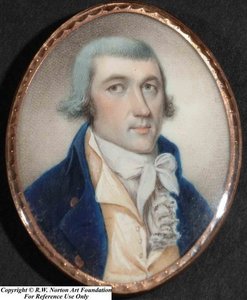
This miniature portrait by John Ramage depicts the British general John Maunsell. Executed in 1785, the work captures the likeness of the subject shortly after his return to New York State from a voluntary exile in Ireland during the revolution. Maunsell, who lived from 1724 to 1795, is presented in a formal manner that reflects his military standing.
Ramage, an Irish-born artist who became a prominent figure in the colonial American art scene, produced this piece during a period of significant political upheaval. The sitter's presence in the portrait is defined by his attire and the specific timing of the commission, which follows his relocation from Ireland to the American colonies.
Composition and Visual Elements
The subject is centered within an oval space, dominating the frame in a strict frontal view. This perspective offers no sense of depth beyond the immediate plane, focusing entirely on the sitter's likeness. He is presented in a red military-style coat layered over a white frilled shirt, establishing a formal silhouette against the background.
A circular copper frame encloses the portrait, featuring a delicate scrolled border. The color palette is restrained, dominated by reds, whites, and browns. These tones emphasize the sitter's attire and the formal dignity of the presentation.
Technique and Physical Materials
Executed in oil on panel, this miniature measures 4 x 3 cm. The artist employed fine brushes to achieve exceptional detail, utilizing meticulously controlled lines to define the subject's facial features and the folds of the red military-style coat. The precision of the brushwork allows for a clear rendering of the white frilled shirt and the textures of the sitter's attire.
The portrait is encased within a circular copper frame. This housing features a delicate scrolled border and includes a pin attached to the reverse for hanging. The composition is contained within this oval space, focusing the viewer's attention on the central figure.
Related Works by John Ramage
Ramage’s practice during the late eighteenth century focused heavily on the intimate scale of portrait miniatures. His ability to capture the likeness of the era's social and political elite is evident in several contemporary commissions. In 1785, he produced a portrait of Governor George Clinton, and by 1787, he had painted William Few. These works reflect the same technical precision used to render the features of prominent figures within the burgeoning American social landscape.
The artist’s reach extended to the highest levels of leadership during the early years of the new nation. In 1789, he received a commission to paint George Washington, becoming the first artist to portray the president while in office. This period of high-profile portraiture also included his work on Mrs. James Bleecker (Elizabeth Garland Bache) in 1788. Through these varied subjects, Ramage documented the faces of a changing society, from political leaders to private citizens.
Otázky a odpovědi
Je dílo John Maunsell ručně malované, nebo jde o tisk?
Ručně malováno: zkušený malíř přetvoří John Maunsell v olejomalbu na lněném plátně.
Jakou velikost si mám vybrat pro John Maunsell?
Rozměry originálu jsou 4 x 3 cm. Velikosti se pohybují od 37.3 x 26.8 cm (Kč4332) až po 248.7 x 178.3 cm (Kč35522); v tabulce na této stránce jsou uvedeny jednotlivé varianty a jejich ceny.
Jak dlouho trvá doručení?
Doručení trvá 4 až 5 týdnů a zahrnuje bezplatnou expresní přepravu po celém světě; na této stránce je k dispozici i možnost urgentní výroby. Dílo můžete vrátit během 100 dnů s plným vrácením peniędzy, bez jakýchkoliv podmínek.
Kde se nachází originál díla John Maunsell?
Originál se nachází ve sbírkách Metropolitan Museum of Art, New York.
Jakou techniku použil/a John Ramage pro dílo John Maunsell?
Oil On Panel
 Náhled v interiéru

 Sdílet
 Sdílet
 Podrobnosti o díle
 Informační list


 Stáhnout
 Podobné položky
 Rentgenové snímky
 Slideshow
 Otázky a odpovědi

 Statistiky