Menu
Text size

() ·

A painting made for you, by hand

Fruit Vendor

Ručně malovaná olejová reprodukce

Rukou malované olejné plátno v libovolném rozměru i s rámem, vyrobené našimi umělci na zakázku. ( Přepnout na tisk Přepnout na digitální obraz)

Popis sbírného předmětu

Jerome Myers (1867-1940): Výrazný americký malíř Ashcan School známý pro empatické obrazy NYC života – imigranti & urbanismus. Hlavní organizátor Armory Show 1913.

Biografie umělce

Jerome Myers (1867-1940): Významný představitel Ashcan School, známý pro empatické výtvarné díla zobrazující život v NYC a imigrantské komunity. Klíčový organizátor Armory Show roku 1913.

from ·

Chapter 1

How large should it be?

Slide to change the size; the picture on the left shows the frame at its real width. The proportions of the original are kept.

Standardní velikost
na zakázku
CM
INCH

Vyberte si z našich přednastavených velikostí, které odpovídají původním proporcím díla.

šířka
výška

Zadejte šířku a výšku, které potřebujete pro váš rám nebo stěnu. Protože se jedná o ruční malbu, při výběru jiného formátu může umělec kolem obrazu domalovat o něco více, nebo jej mírně oříznout — rozhodnete si vy. Před zahájením malby vám zašleme digitální náhled ke schválení. Obraz zobrazený na této stránce neodpovídá skutečnému výsledku — pouze digitální náhled jej zobrazuje.

Chapter 2

How should it arrive?

Choose the edges of the stretched canvas

Choose your frame

Corner sample of the WhiteWrap canvas edge finish, stretched on masivní dřevo bars
White Kč1
Corner sample of the BlurSideWrap canvas edge finish, stretched on masivní dřevo bars
Blurside Kč1
Corner sample of the ExtendedWrap canvas edge finish, stretched on masivní dřevo bars
Extended Kč1
Corner sample of the P118B picture frame: tvarovaný polystyren, 5 cm wide and 3 cm thick
P118B Kč10
Corner sample of the P118H picture frame: tvarovaný polystyren, 5 cm wide and 3 cm thick
P118H Kč10
Corner sample of the P118W picture frame: tvarovaný polystyren, 5 cm wide and 3 cm thick
P118W Kč10
Corner sample of the P438Z picture frame: tvarovaný polystyren, 5.5 cm wide and 3.5 cm thick
P438Z Kč10
Corner sample of the P508JH picture frame: tvarovaný polystyren, 7 cm wide and 3.5 cm thick
P508JH Kč12
Corner sample of the P508YH picture frame: tvarovaný polystyren, 7 cm wide and 3.5 cm thick
P508YH Kč12
Corner sample of the P805H picture frame: tvarovaný polystyren, 5 cm wide and 3.5 cm thick
P805H Kč10
Corner sample of the P805Z picture frame: tvarovaný polystyren, 5 cm wide and 3.5 cm thick
P805Z Kč10
Corner sample of the P919BZ picture frame: tvarovaný polystyren, 7 cm wide and 3.5 cm thick
P919BZ Kč10
Corner sample of the P919G picture frame: tvarovaný polystyren, 7 cm wide and 3.5 cm thick
P919G Kč10
Corner sample of the P919XJ picture frame: tvarovaný polystyren, 7 cm wide and 3.5 cm thick
P919XJ Kč10
Corner sample of the P959ZH picture frame: tvarovaný polystyren, 5 cm wide and 3 cm thick
P959ZH Kč10
Corner sample of the P968JZ picture frame: tvarovaný polystyren, 6 cm wide and 4 cm thick
P968JZ Kč12
Corner sample of the W106C picture frame: masivní dřevo, 5 cm wide and 3 cm thick
W106C Kč8
Corner sample of the W218G picture frame: masivní dřevo, 5 cm wide and 3 cm thick
W218G Kč10
Corner sample of the W218JH picture frame: masivní dřevo, 5 cm wide and 3 cm thick
W218JH Kč8
Corner sample of the W218Y picture frame: masivní dřevo, 5 cm wide and 3 cm thick
W218Y Kč10
Corner sample of the W307PJ picture frame: masivní dřevo, 6 cm wide and 3 cm thick
W307PJ Kč10
Corner sample of the W316G picture frame: masivní dřevo, 6 cm wide and 3 cm thick
W316G Kč10
Corner sample of the W316PJ picture frame: masivní dřevo, 6 cm wide and 3 cm thick
W316PJ Kč8
Corner sample of the W316Y picture frame: masivní dřevo, 6 cm wide and 3 cm thick
W316Y Kč10
Corner sample of the W398PJ picture frame: masivní dřevo, 5 cm wide and 3 cm thick
W398PJ Kč8
Corner sample of the W4111J picture frame: masivní dřevo, 6.5 cm wide and 3.5 cm thick
W4111J Kč10
Corner sample of the W500HY picture frame: masivní dřevo, 7 cm wide and 5 cm thick
W500HY Kč15
Corner sample of the W500JH picture frame: masivní dřevo, 7 cm wide and 5 cm thick
W500JH Kč15
Corner sample of the W692G picture frame: masivní dřevo, 8 cm wide and 4 cm thick
W692G Kč12
Corner sample of the W849H picture frame: masivní dřevo, 5 cm wide and 3 cm thick
W849H Kč8
Corner sample of the W940BG picture frame: masivní dřevo, 7.5 cm wide and 4.5 cm thick
W940BG Kč15
Corner sample of the W953PJ picture frame: masivní dřevo, 6 cm wide and 3.5 cm thick
W953PJ Kč8
Corner sample of the H24-GOLD picture frame: řezané dřevo s gessu, 10 cm wide and 6 cm thick
H24-GOLD Kč30
Corner sample of the H24-SILVER picture frame: řezané dřevo s gessu, 10 cm wide and 6 cm thick
H24-SILVER Kč30
Corner sample of the H36-GOLD picture frame: řezané dřevo s gessu, 15 cm wide and 6.5 cm thick
H36-GOLD Kč45
Corner sample of the H36-SILVER picture frame: řezané dřevo s gessu, 15 cm wide and 6.5 cm thick
H36-SILVER Kč45

Moulding: . Overall size with the frame: .

Chapter 3

Who paints it, and should anything change?

Examples of what can be changed: Replace face with customer photo; Add pet (e.g., replace cat with dog); Include hidden message in background; Change background landscape or elements.
After order, OriginalUniqueArt.com team will email client for instructions and provide a mockup preview

Celosvětová doprava () za 3–4 týdny namísto standardních 5 týdnů. (30 říjen). Bez kompromisů v kvalitě.

Chapter 4

The finishing touches

A nameplate, as in a museum?

Detaily ryté bronzové plakety

This elegant plaque features the artist's name and the title of the artwork, finely engraved for a timeless presentation.

It is made from bronze with a refined, elegant finish. The text is precisely laser-engraved for a sharp and permanent result. Measuring 9x2 cm, the plaque is compact yet easy to read. It's built to be durable and scratch-resistant, offering a professional, museum-quality look. Mounting is simple thanks to the included adhesive backing.

Detaily průhledné akrylové desky

The plaque includes essential engraved details such as the artist's name, the title of the artwork, the date it was created, the type of media used-like oil on canvas or watercolor-a brief description of the piece, and a QR code that links to the complete artwork information.

It is crafted from clear acrylic, offering a sleek, modern appearance. The text is UV-engraved in black to ensure strong visual contrast. With a size of 10x15 cm, it ensures optimal readability. It comes equipped with two metal hooks for secure wall mounting. The plaque is designed to be weather-resistant, making it suitable for various environments, and it includes interactive features that work seamlessly with smartphone scanning.

Detaily černé akrylové destičky

This elegant plaque includes engraved information such as the artist's name, the title of the artwork, the date it was created, the type of media used (like oil on canvas or watercolor), a short description of the artwork, and a QR code for quick access to more information.

The plaque itself is made from refined black acrylic with a premium finish. The text is laser-engraved in white for high contrast and readability. Its size is 10x15 cm, designed to be easy to read. It comes with two metal hooks for professional mounting. The design is sleek and fits any interior style. It is also weather-resistant and durable, with built-in digital integration for mobile compatibility.

A protective varnish?

When do you need it?

Chapter 5

Your painting, as you ordered it

Fruit Vendor

Technika reprodukce

Rozměry reprodukce

-

Vybraní mistři umění

Vyšší míra detailu, jemnosti a delší doba výroby

-

Možnosti rámování reprodukcí

-

-

U děl nebo reprodukcí, u nichž je jakákoliv strana větší než 105 cm (přibližně 41 palců), bude rám dodán jako sestava v rozloženém stavu. Tato metoda zajišťuje bezpečné doručení a chrání dílo před poškozením během přepravy.

Vyžaduje se odborná montáž – nejedná se o produkt pro svépomocnou realizaci (DIY).
Sestava musí být složena a plátno napnuto zkušeným profesionálním rámovačem s použitím dřevěného lepidla (není součástí balení), kleští na napínání plátna a svorek pro udržení pravých úhlů křížů během schnutí lepidla. Nesprávná montáž nebo nerovnoměrné napnutí plátna může způsobit trvalé poškození uměleckého díla, které není kryto naší zárukou.

  • Jsou zahrnuty všechny lišty z masivního dřeva, přesně na míru nařezané.

  • Sestavuje se pomocí součástí balení (šroubů), plus dřevěného lepidla na rohové spoje, které není součástí balení a musí jej zajistit váš rámovač.

  • Vyžaduje se profesionální nářadí, které není součástí sady: kleště na napínání plátna a svorky pro udržení kolmosti příček během schnutí lepidla.

Důležité:
Spoje v rozích vyžadují lepidlo na dřevo, tyčinky musí být přichyceny pomocí svorek, dokud lepidlo zcela neuschne, a pro napnutí plátna na sestavený rám je zapotřebí kleští na natahování plátna. Žádný z těchto náčiní není součástí sady. Před objednáním této velikosti prosím zajistěte zkušeného profesionálního rámovače.

Popisek díla

-

-

Ochranný lak

Lesklý lak (zvýrazňuje barvy, chrání před světlem a vlhkostí)

-

Přizpůsobit své umělecké dílo

Příklady možných úprav: nahrazení obličeje fotografií zákazníka; přidání domácího mazlíčka (např. výměna kočky za psa); vložení skrytého vzkazu do pozadí; změna krajiny nebo prvků v pozadí.

-

Prioritní doručení

Celosvětové doručení () za 3–4 týdny namísto standardních 5 týdnů. (30 říjen). Bez kompromisů v kvalitě.

-

Expresní doručení

Celosvětová doprava () do 5 týdnů. (6 listopad).

V ceně

Celková cena za vybrané možnosti reprodukcí

Kč 6464

Celková cena Kč 6464

Skleněná varianta je dostupná pouze u rozměrů menších než 110 cm

Included with every order

  • Zdarma celosvětová expresní doprava
  • Vysoce kvalitní lněné plátno
  • Kompletní pojištění přepravy
  • Záruka vrácení celního poplatku
  • Záruka věrného barevného souladu
  • 100dení lhůta pro vrácení zboží (pouze při vadách výroby)
  • 100% záruka vrácení peněz
  • Sleva při více objednávkách

Jerome Myers: A Visionary of Urban Realism

Jerome Myers (1867-1940) stands as a pivotal figure in American art history, particularly within the Ashcan School movement. Born in Petersburg, Virginia, his life’s journey—marked by itinerant experiences shaped by his father's absences—fueled an artistic sensibility deeply attuned to the struggles and resilience of marginalized communities. This formative upbringing instilled within him a profound empathy for the everyday realities of ordinary people, a perspective that would permeate his prolific output.

Myers’s artistic trajectory began with diverse pursuits – acting and scene painting honed his skills in visual storytelling and dramatic composition—providing invaluable groundwork for his formal training at Cooper Union followed by eight years at the Art Students League under George de Forest Brush. However, it was New York City itself that truly captivated him; specifically, the Lower East Side’s vibrant immigrant neighborhoods became the crucible of his artistic vision.

The Ashcan School and Its Aesthetic

Myers's commitment to portraying urban life with unflinching honesty aligns perfectly with the ethos of the Ashcan School. Rejecting idealized landscapes and academic conventions, these artists sought to capture the gritty textures and emotional complexities of American cities—particularly during the Progressive Era. Myers’s canvases eschewed romantic embellishment in favor of direct observation and meticulous detail, prioritizing capturing the palpable atmosphere of his surroundings.

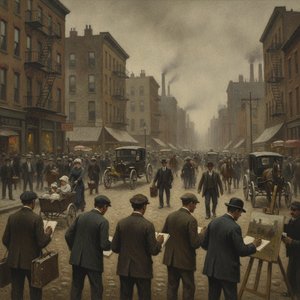
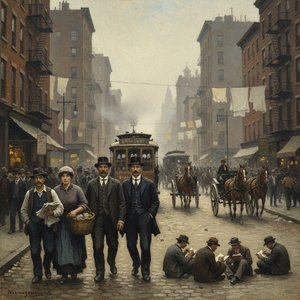
“Fruit Vendor,” painted circa 1920, exemplifies this stylistic approach. The monochrome palette—characteristic of Ashcan School artists—emphasizes form and texture, mirroring the starkness of urban life. Myers’s masterful technique utilizes broad brushstrokes to convey movement and dynamism, capturing the bustling energy of a busy marketplace.

The composition centers on a woman standing beside a fruit cart laden with apples – a deliberate choice reflecting Myers's fascination with immigrant communities and their daily struggles. Surrounding her are figures engaged in conversation and commerce, creating a tableau that speaks volumes about social interaction and economic hardship. The inclusion of a horse adds to the scene’s visual richness and reinforces its connection to the rural past juxtaposed against the burgeoning urban landscape.

Symbolism and Emotional Impact

Beyond mere depiction, “Fruit Vendor” carries symbolic weight. Myers's unwavering gaze at the human condition—particularly the dignity of labor and perseverance—resonates with humanist ideals prevalent during his time. The painting’s subdued tones evoke a sense of melancholy yet simultaneously convey hope – mirroring the spirit of resilience found within those navigating challenging circumstances.

Myers’s enduring legacy lies in his ability to transform observation into art, capturing not just what he saw but also what he felt. “Fruit Vendor,” like countless other works documenting the realities of American life, remains a testament to his artistic vision and its profound impact on the Ashcan School movement.

Otázky a odpovědi

Proč má dílo „Fruit Vendor“ právě takový autorský status?

Autorskoprávní status díla „Fruit Vendor“ – v rámci volného užití – autorská práva vypršela – vyplývá ze smrti umělce v roce 1940.

Obsahuje "Fruit Vendor" výrazné světlonápadové kontrasty?

„Fruit Vendor“ od Jerome Myers vykazuje Klidný kontrast mezi světlými a tmavými částmi.

Kde se doporučuje vystavit dílo „Fruit Vendor“ ve formátu Portrétní orientace?

Dílo v Portrétní orientace formátu, reprodukce díla „Fruit Vendor“, se doporučuje do Obývací pokoj.

More about this painting

Náhled v interiéru Náhled v AR Přepnout na tisk Přepnout na digitální obraz Sdílet
Podrobnosti o díle Průvodce Přidat do oblíbených Stáhnout Podobné položky Rentgenové snímky Slideshow Q&A Statistiky

In numbers

  • 1920the year it was painted
  • 29frames to choose from
  • standard sizes, in its own proportions
  • 5weeks to paint and deliver it
Jerome Myers

Jerome Myers

1867 - 1940, USA

Quick facts about Jerome Myers

  • Artistic Movement Or Style: Ashcan School
  • Artists Or Movements Influenced By This Artist: ['American Realism']
  • Artists Who Influenced This Artist: ['George de Forest Brush']
  • Date Of Birth: 1867
  • Date Of Death: 1940
  • Full Name: Jerome Myers
  • Nationality: Američan
  • Notable Artworks:
    • Recreation Pier
    • Street Shrine
    • Italian Procession
  • Place Of Birth: Petersburg, USA

Biografie umělce

A Life Etched in Urban Reality

Jerome Myers, born in Petersburg, Virginia, in 1867, was more than just a painter; he was a chronicler of the American urban experience at a pivotal moment in its history. His life story, marked by early hardship and constant relocation due to his father’s absences, deeply informed his artistic vision. This itinerant upbringing instilled within him an acute sensitivity to the struggles and resilience of those living on the margins – a theme that would become central to his oeuvre. His brother, Gustavus Myers, forged a path as a journalist and activist, further cementing a family commitment to social observation and reform. Before fully dedicating himself to art, Myers tasted life as an actor and scene painter, experiences which undoubtedly honed his understanding of visual storytelling and dramatic composition. This practical foundation served him well when he formally pursued artistic training at Cooper Union for a year, followed by eight years at the Art Students League under the tutelage of George de Forest Brush. However, it wasn’t the established art centers of Europe that truly captured Myers' imagination; rather, it was the teeming streets and vibrant life of New York City’s Lower East Side that became his enduring muse. A brief sojourn to Paris in 1896 paled in comparison to the raw energy and compelling narratives unfolding within his own city.

The Ashcan School and a Unique Artistic Voice

Myers emerged as a key figure associated with the Ashcan School, a group of artists who bravely turned their attention away from traditional academic subjects and towards the gritty realities of urban life. However, Myers wasn’t simply replicating what he saw; he was interpreting it through a deeply empathetic lens. He deliberately chose to depict the everyday lives of new immigrants – not as objects of pity or sociological study, but as individuals possessing inherent dignity and beauty. Over a thousand drawings, paintings, etchings, and watercolors bear witness to his dedication, documenting their routines, struggles, and moments of joy outside the confines of tenement walls. He famously articulated his artistic philosophy by stating that where others saw ugliness and degradation, he perceived “poetry and beauty.” This wasn’t mere romanticism; it was a profound belief in the inherent worth of every human experience, regardless of circumstance. His work stands apart within the Ashcan School not for its shock value – though it certainly challenged conventional artistic norms – but for its quiet compassion and unwavering focus on the humanity of his subjects. He wasn’t interested in grand narratives or sweeping statements; he was captivated by the small moments that revealed the essence of a life lived fully, even amidst hardship.

Early Influences and Artistic Training

Myers' formative years instilled within him a deep appreciation for observation and storytelling. His brother’s journalistic pursuits mirrored his own desire to engage with social issues—a conviction that would permeate his artistic endeavors. Before embarking on his formal artistic education, he gained invaluable experience as an actor and scene painter, mastering techniques of visual composition and dramatic expression. This practical grounding proved instrumental in shaping his approach to painting at Cooper Union and subsequently at the Art Students League under George de Forest Brush, where he honed his skills in capturing urban landscapes and human figures with remarkable realism. The influence of Brush’s teachings emphasized meticulous detail and a commitment to portraying subjects truthfully—values that would become hallmarks of Myers' distinctive style.

The Lower East Side: A Constant Inspiration

Myers’ artistic vision was irrevocably shaped by his residency in New York City’s Lower East Side, where he witnessed firsthand the challenges faced by immigrant communities. This environment fueled his desire to depict ordinary people with dignity and compassion—a mission that drove him to create countless images capturing scenes of daily life, religious processions, and festive celebrations. His paintings, particularly “Backyard” (1888), exemplify this commitment to portraying human experience with sensitivity and nuance. He sought not to glorify or sensationalize but rather to capture the quiet beauty found within everyday moments—a perspective that distinguishes his work from many of his contemporaries.

A Catalyst for Modernism: The Armory Show

Myers’ involvement in organizing the groundbreaking 1913 Armory Show marked a pivotal moment in American art history. This exhibition introduced European modernist movements – Cubism, Fauvism, and Expressionism – to an audience largely unfamiliar with these radical innovations. Myers recognized the importance of fostering dialogue between artistic traditions and championed the inclusion of avant-garde artists—demonstrating a willingness to embrace experimentation and challenge established aesthetic conventions. His contribution to this transformative event solidified his position as a pioneer of American modernism and foreshadowed the broader cultural shifts that would reshape the nation’s artistic landscape. ## Legacy and Continuing Relevance Jerome Myers' enduring legacy rests on his unwavering dedication to portraying human experience with empathy and honesty—values that continue to resonate powerfully today. His paintings serve as poignant reminders of the importance of recognizing beauty and dignity in all individuals, regardless of circumstance. He remains a cornerstone of Ashcan School realism and an artist whose vision inspires those who strive to capture the essence of life’s complexities with compassion and insight.

Rychlé informace

  • Notable elements or techniques: Detailed observation of urban life; expressive brushwork
  • Title: Fruit Vendor
  • Artistic style: Realism
  • Medium: Oil on Canvas
  • Influences: George de Forest Brush

Artový kvíz

U každé otázky je pouze jedna správná odpověď.

Otázka 1:
Jaký umělecký směr je Jerome Myers nejvíce spojen s obrazem "Fruit Vendor"?

Otázka 2:
Na co se obraz zaměřuje hlavně?
Otázka 3:
Kdo byl George de Forest Brush a jaký význam měl jeho vedení Jerome Myersa?
Otázka 4:
Podle Myersa co nejvíce inspirovalo jeho život ve městě?

Otázka 5:
Jaký byl význam Armory Show z roku 1913 pro Jerome Myersa?
Prozkoumejte umělecká díla uspořádaná podle témat, stylů a charakteristik.