Symbolist Expressionism · 1895
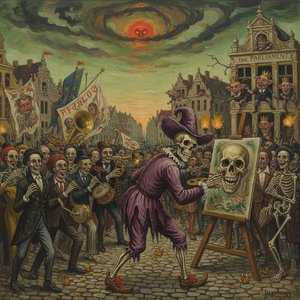
The Skeleton Painter (James Ensor, 1895)
James Ensor (1860–1949) vytvořil dílo The Skeleton Painter. Pochází z roku 1895. Patří k hnutí Symbolist Expressionism. Je vyrobeno z Acrylic On Canvas. Nachází se v Koninklijk Museum voor Schone Kunsten v Antverpy, Belgie.
- 1895
- Acrylic On Canvas
- Koninklijk Museum voor Schone Kunsten, Antverpy

 Náhled v interiéru

 Ručně malovaná olejná reprodukce
 Sdílet
 Sdílet
 Informační list


 Stáhnout
 Podobné položky
 Rentgenové snímky
 Slideshow
 Otázky a odpovědi

 Statistiky
The Skeleton Painter v kostce
- Název díla
- The Skeleton Painter
- Autor
- James Ensor (1860–1949)
- Rok narození umělce
- Ostende, Belgie
- Datum vytvoření
- 1895
- Technika
- Acrylic On Canvas
- Kde jej vidět
- Koninklijk Museum voor Schone Kunsten, Antverpy, Belgie
- Motiv
- skeleton, artist, death, masks, paintings, room
Co przedstawuje dílo The Skeleton Painter?
A Dance with Mortality: James Ensor’s “The Skeleton Painter”
James Ensor's "The Skeleton Painter," completed in 1895, is not merely a painting; it’s an unsettling plunge into the subconscious, a meticulously crafted tableau of morbidity and artistic obsession. The image, rendered with a distinctive and increasingly personal style, immediately confronts the viewer with a scene both bizarre and profoundly familiar – a room overflowing with art, dominated by a central figure: a skeleton diligently wielding a paintbrush. This isn’t a morbid spectacle intended to shock for shock's sake; rather, it’s a complex meditation on life, death, creativity, and the inescapable nature of artistic endeavor. Ensor, born in Ostend, Belgium, in 1860, cultivated an intensely individual vision, one deeply rooted in his upbringing amidst the vibrant chaos of a seaside resort town and fueled by a fascination with masks, disguise, and the theatricality of human experience.
The Artist’s Studio – A Realm of Shadows
The setting itself is crucial to understanding the painting's power. The room is crammed with canvases, each bearing witness to Ensor’s restless hand. A dining table, laden with objects—a clock, a partially consumed meal—suggests an interrupted life, a space where sustenance and creation intertwine. The presence of other skeletons, scattered amongst the chairs and leaning against walls, reinforces the pervasive theme of mortality. These aren't simply decorative elements; they are active participants in the scene, almost as if they’re observing or even contributing to the artist’s work. The inclusion of a cat, curled up near the left edge, adds an element of domesticity and perhaps a subtle critique – a creature of instinct and survival nestled within this world of intellectual pursuit.
Symbolism and Technique: A Palette of Unease
Ensor’s technique is immediately recognizable. He employed a thick, impasto application of paint, building up layers of color to create a tactile surface that seems almost sculptural. The palette is deliberately muted – browns, greys, ochres, and deep blues dominate—contributing to the painting's somber mood. The skeletal figure itself is rendered with remarkable detail, highlighting the fragility of bone while simultaneously conveying a sense of focused determination. Notice how Ensor uses strong diagonals – particularly in the arrangement of the chairs and paintings – to create a feeling of unease and instability. The use of color is not about beauty; it’s about evoking emotion, creating a visual atmosphere of melancholy and contemplation. His style evolved significantly throughout his career, moving away from academic influences towards a highly expressive, often unsettling, approach that anticipated the Symbolist movement.
Ensor's Exploration of Artistic Identity
"The Skeleton Painter" can be interpreted as an exploration of Ensor’s own artistic identity and his relationship to mortality. The skeleton artist represents not just death but also the inevitable end of creative endeavor, the fading of inspiration with time. It speaks to the paradox of the artist – someone who often seems detached from the everyday realities of life, yet is ultimately defined by their engagement with them. Ensor’s own struggles with artistic recognition and his rejection of traditional academic training likely fueled this preoccupation with themes of isolation and the ephemeral nature of existence. The painting isn't a celebration of art; it’s a questioning of its purpose and its ultimate significance in the face of oblivion. It invites us to consider what drives an artist to create, knowing that their work, like their own physical form, will eventually succumb to time.
OriginalUniqueArt offers exquisite, hand-painted reproductions of James Ensor’s “The Skeleton Painter,” allowing you to bring this haunting masterpiece into your home or office. Each reproduction is created with the same meticulous attention to detail and expressive technique as the original, capturing the painting's unique atmosphere and emotional depth. Explore our collection today and experience the unsettling beauty of Ensor’s vision.
Ve kterém muzeu se nachází The Skeleton Painter?
Koninklijk Museum voor Schone Kunsten
Antverpy, Belgie
Původy a dějiny muzea Koninklijk Museum voor Schone Kunsten byl založen v roce 1810. Jeho kořeny sahají hluboko do dějin, kdy jsou pevně spjaty s odkazem antverpského cechu svatého Lukáše, instituce, která působila od konce 14. století až do roku 1773.


Vysokorozlišené fotografie díla The Skeleton Painter

James Ensor, The Skeleton Painter (1895), Koninklijk Museum voor Schone Kunsten. Veřejná doména
Odpovědi na otázky k dílu The Skeleton Painter
Kde mohu vidět originál díla „The Skeleton Painter“ od James Ensor?
Originál díla „The Skeleton Painter“ si můžete prohlédnout v instituci Koninklijk Museum voor Schone Kunsten, Antverpy, Belgie.
V jakém roce bylo vytvořeno dílo „The Skeleton Painter“ od James Ensor?
Dílo "The Skeleton Painter" pochází z roku 1895. Toto datum situuje dílo do období tvůrčí činnosti James Ensor i do jeho dobové kontextu.
V jaké technice je vytvořeno dílo „The Skeleton Painter“ od James Ensor?
Technikou díla „The Skeleton Painter“ od James Ensor je Acrylic On Canvas. Reprodukce mají za cíl věrně zachytit vzhled této techniky.
Jaká témata se objevují v díle „The Skeleton Painter“ od James Ensor?
Témata obsažená v díle „The Skeleton Painter“ od James Ensor zahrnují skeleton, artist, death, masks, paintings, room, cat, decay. Tato témata společně shrnují obsah celého uměleckého díla.
Je dílo „The Skeleton Painter“ volné z autorských práv?
Co se týče autorských práv, dílo "The Skeleton Painter" spadá do v rámci volného užití – autorská práva vypršela.
K kterému umělci je dílo "The Skeleton Painter" připisováno?
Dílo "The Skeleton Painter" se připisuje autorovi James Ensor.
K jakému stylu patří „The Skeleton Painter“?
„The Skeleton Painter“ je dílo z období Symbolist Expressionism. Tento směr představuje uměleckou tradici, jejíž je dílo součástí.
Do které období tvorby James Ensor patří dílo „The Skeleton Painter“?
Dílo „The Skeleton Painter“ pochází z období Late Period v tvorbě umělce James Ensor. Tato klasifikace dílo zasazuje do kontextu vývoje jeho tvůrčí dráhy.
V jakém věku vytvořil/a James Ensor dílo „The Skeleton Painter"?
Při vzniku díla „The Skeleton Painter“ v roce 1895 bylo umělcům James Ensor (narozenému/é v 1860) 35 let.
O umělci, James Ensor

1860–1949, Belgie
James Ensor
Early Life, Family and Artistic Training James Ensor was born on April 13, 1860, in Ostend, Belgium. His identity was shaped by a specific cultural intersection: his father, James Frederic Ensor, was born in Brussels to English parents, while his mother, Maria Catherina Haegheman, was Belgian. This dual heritage provided a foundation for a perspective that often sat outside the narrow confines of local tradition. Growing up, the artist lived within the walls of a souvenir shop operated by his parents in Ostend.
Také od autora James Ensor
 Vjezdění Krista do Bruselu1888
 Autoportrét s maskami1899
 Koupelny v Ostendě
 Skelety se ohřívají1889

Eseje k tématu The Skeleton Painter
 Beauty in Mortality: Capturing the Soul of the Skull through the Luminous Lens of Impressionist ArtExplore the profound beauty of mortality through Impressionism. Discover how masters like Monet and Renoir transformed the Memento Mori tra…
 Psychologie hravé imaginace: Zkoumání humorných a fantastických obrazů jako katalyzátorů emoční pohody a sociálního spojeníProzkoumejte psychologii hravé imaginace a vliv umění na emoční pohodu. Odborný článek o surrealismu, grotesce a síle obrazů pro luxusní in…
 James Ensor's Grotesque Visions: Social Commentary & Artistic InnovationExplore the unsettling yet captivating world of James Ensor, a pioneer of Expressionism. Discover his satirical masterpieces, symbolic imag…