Menu
Text size

() ·

A painting made for you, by hand

Troubled Queen – Zmatená královna

Ručně malovaná olejová reprodukce

Rukou malované olejné plátno v libovolném rozměru i s rámem, vyrobené našimi umělci na zakázku. ( Přepnout na tisk Přepnout na digitální obraz)

Popis sbírného předmětu

Zkoumejte abstraktní výtvarné dílo Jacksona Polloka „Troubled Queen“ – dynamickou olejovou malbu plnou chaotické energie a vrstvených textur. Inspirace kubismem & surrealismem, vyjádření emocí & osobního projevu.

Biografie umělce

Paul Jackson Pollock (1912-1956) byl americký malíř, průkopník abstrakce a „drip“ techniky. Jeho dynamické, expresivní obrazové plochy, jako "Blue Poles", definovaly moderní umění a ovlivnily generace umělců. #Pollock #Abstraktníexpresionismus

from ·

Chapter 1

How large should it be?

Slide to change the size; the picture on the left shows the frame at its real width. The proportions of the original are kept.

Standardní velikost
na zakázku
CM
INCH

Vyberte si z našich přednastavených velikostí, které odpovídají původním proporcím díla.

šířka
výška

Zadejte šířku a výšku, které potřebujete pro váš rám nebo stěnu. Protože se jedná o ruční malbu, při výběru jiného formátu může umělec kolem obrazu domalovat o něco více, nebo jej mírně oříznout — rozhodnete si vy. Před zahájením malby vám zašleme digitální náhled ke schválení. Obraz zobrazený na této stránce neodpovídá skutečnému výsledku — pouze digitální náhled jej zobrazuje.

Chapter 2

How should it arrive?

Choose the edges of the stretched canvas

Choose your frame

Corner sample of the WhiteWrap canvas edge finish, stretched on masivní dřevo bars
White Kč1
Corner sample of the BlurSideWrap canvas edge finish, stretched on masivní dřevo bars
Blurside Kč1
Corner sample of the ExtendedWrap canvas edge finish, stretched on masivní dřevo bars
Extended Kč1
Corner sample of the P118B picture frame: tvarovaný polystyren, 5 cm wide and 3 cm thick
P118B Kč10
Corner sample of the P118H picture frame: tvarovaný polystyren, 5 cm wide and 3 cm thick
P118H Kč10
Corner sample of the P118W picture frame: tvarovaný polystyren, 5 cm wide and 3 cm thick
P118W Kč10
Corner sample of the P438Z picture frame: tvarovaný polystyren, 5.5 cm wide and 3.5 cm thick
P438Z Kč10
Corner sample of the P508JH picture frame: tvarovaný polystyren, 7 cm wide and 3.5 cm thick
P508JH Kč12
Corner sample of the P508YH picture frame: tvarovaný polystyren, 7 cm wide and 3.5 cm thick
P508YH Kč12
Corner sample of the P805H picture frame: tvarovaný polystyren, 5 cm wide and 3.5 cm thick
P805H Kč10
Corner sample of the P805Z picture frame: tvarovaný polystyren, 5 cm wide and 3.5 cm thick
P805Z Kč10
Corner sample of the P919BZ picture frame: tvarovaný polystyren, 7 cm wide and 3.5 cm thick
P919BZ Kč10
Corner sample of the P919G picture frame: tvarovaný polystyren, 7 cm wide and 3.5 cm thick
P919G Kč10
Corner sample of the P919XJ picture frame: tvarovaný polystyren, 7 cm wide and 3.5 cm thick
P919XJ Kč10
Corner sample of the P959ZH picture frame: tvarovaný polystyren, 5 cm wide and 3 cm thick
P959ZH Kč10
Corner sample of the P968JZ picture frame: tvarovaný polystyren, 6 cm wide and 4 cm thick
P968JZ Kč12
Corner sample of the W106C picture frame: masivní dřevo, 5 cm wide and 3 cm thick
W106C Kč8
Corner sample of the W218G picture frame: masivní dřevo, 5 cm wide and 3 cm thick
W218G Kč10
Corner sample of the W218JH picture frame: masivní dřevo, 5 cm wide and 3 cm thick
W218JH Kč8
Corner sample of the W218Y picture frame: masivní dřevo, 5 cm wide and 3 cm thick
W218Y Kč10
Corner sample of the W307PJ picture frame: masivní dřevo, 6 cm wide and 3 cm thick
W307PJ Kč10
Corner sample of the W316G picture frame: masivní dřevo, 6 cm wide and 3 cm thick
W316G Kč10
Corner sample of the W316PJ picture frame: masivní dřevo, 6 cm wide and 3 cm thick
W316PJ Kč8
Corner sample of the W316Y picture frame: masivní dřevo, 6 cm wide and 3 cm thick
W316Y Kč10
Corner sample of the W398PJ picture frame: masivní dřevo, 5 cm wide and 3 cm thick
W398PJ Kč8
Corner sample of the W4111J picture frame: masivní dřevo, 6.5 cm wide and 3.5 cm thick
W4111J Kč10
Corner sample of the W500HY picture frame: masivní dřevo, 7 cm wide and 5 cm thick
W500HY Kč15
Corner sample of the W500JH picture frame: masivní dřevo, 7 cm wide and 5 cm thick
W500JH Kč15
Corner sample of the W692G picture frame: masivní dřevo, 8 cm wide and 4 cm thick
W692G Kč12
Corner sample of the W849H picture frame: masivní dřevo, 5 cm wide and 3 cm thick
W849H Kč8
Corner sample of the W940BG picture frame: masivní dřevo, 7.5 cm wide and 4.5 cm thick
W940BG Kč15
Corner sample of the W953PJ picture frame: masivní dřevo, 6 cm wide and 3.5 cm thick
W953PJ Kč8
Corner sample of the H24-GOLD picture frame: řezané dřevo s gessu, 10 cm wide and 6 cm thick
H24-GOLD Kč30
Corner sample of the H24-SILVER picture frame: řezané dřevo s gessu, 10 cm wide and 6 cm thick
H24-SILVER Kč30
Corner sample of the H36-GOLD picture frame: řezané dřevo s gessu, 15 cm wide and 6.5 cm thick
H36-GOLD Kč45
Corner sample of the H36-SILVER picture frame: řezané dřevo s gessu, 15 cm wide and 6.5 cm thick
H36-SILVER Kč45

Moulding: . Overall size with the frame: .

Chapter 3

Who paints it, and should anything change?

Examples of what can be changed: Replace face with customer photo; Add pet (e.g., replace cat with dog); Include hidden message in background; Change background landscape or elements.
After order, OriginalUniqueArt.com team will email client for instructions and provide a mockup preview

Celosvětová doprava () za 3–4 týdny namísto standardních 5 týdnů. (30 říjen). Bez kompromisů v kvalitě.

Chapter 4

The finishing touches

A nameplate, as in a museum?

Detaily ryté bronzové plakety

This elegant plaque features the artist's name and the title of the artwork, finely engraved for a timeless presentation.

It is made from bronze with a refined, elegant finish. The text is precisely laser-engraved for a sharp and permanent result. Measuring 9x2 cm, the plaque is compact yet easy to read. It's built to be durable and scratch-resistant, offering a professional, museum-quality look. Mounting is simple thanks to the included adhesive backing.

Detaily průhledné akrylové desky

The plaque includes essential engraved details such as the artist's name, the title of the artwork, the date it was created, the type of media used-like oil on canvas or watercolor-a brief description of the piece, and a QR code that links to the complete artwork information.

It is crafted from clear acrylic, offering a sleek, modern appearance. The text is UV-engraved in black to ensure strong visual contrast. With a size of 10x15 cm, it ensures optimal readability. It comes equipped with two metal hooks for secure wall mounting. The plaque is designed to be weather-resistant, making it suitable for various environments, and it includes interactive features that work seamlessly with smartphone scanning.

Detaily černé akrylové destičky

This elegant plaque includes engraved information such as the artist's name, the title of the artwork, the date it was created, the type of media used (like oil on canvas or watercolor), a short description of the artwork, and a QR code for quick access to more information.

The plaque itself is made from refined black acrylic with a premium finish. The text is laser-engraved in white for high contrast and readability. Its size is 10x15 cm, designed to be easy to read. It comes with two metal hooks for professional mounting. The design is sleek and fits any interior style. It is also weather-resistant and durable, with built-in digital integration for mobile compatibility.

A protective varnish?

When do you need it?

Chapter 5

Your painting, as you ordered it

Troubled Queen – Zmatená královna

Technika reprodukce

Rozměry reprodukce

-

Vybraní mistři umění

Vyšší míra detailu, jemnosti a delší doba výroby

-

Možnosti rámování reprodukcí

-

-

U děl nebo reprodukcí, u nichž je jakákoliv strana větší než 105 cm (přibližně 41 palců), bude rám dodán jako sestava v rozloženém stavu. Tato metoda zajišťuje bezpečné doručení a chrání dílo před poškozením během přepravy.

Vyžaduje se odborná montáž – nejedná se o produkt pro svépomocnou realizaci (DIY).
Sestava musí být složena a plátno napnuto zkušeným profesionálním rámovačem s použitím dřevěného lepidla (není součástí balení), kleští na napínání plátna a svorek pro udržení pravých úhlů křížů během schnutí lepidla. Nesprávná montáž nebo nerovnoměrné napnutí plátna může způsobit trvalé poškození uměleckého díla, které není kryto naší zárukou.

  • Jsou zahrnuty všechny lišty z masivního dřeva, přesně na míru nařezané.

  • Sestavuje se pomocí součástí balení (šroubů), plus dřevěného lepidla na rohové spoje, které není součástí balení a musí jej zajistit váš rámovač.

  • Vyžaduje se profesionální nářadí, které není součástí sady: kleště na napínání plátna a svorky pro udržení kolmosti příček během schnutí lepidla.

Důležité:
Spoje v rozích vyžadují lepidlo na dřevo, tyčinky musí být přichyceny pomocí svorek, dokud lepidlo zcela neuschne, a pro napnutí plátna na sestavený rám je zapotřebí kleští na natahování plátna. Žádný z těchto náčiní není součástí sady. Před objednáním této velikosti prosím zajistěte zkušeného profesionálního rámovače.

Popisek díla

-

-

Ochranný lak

Lesklý lak (zvýrazňuje barvy, chrání před světlem a vlhkostí)

-

Přizpůsobit své umělecké dílo

Příklady možných úprav: nahrazení obličeje fotografií zákazníka; přidání domácího mazlíčka (např. výměna kočky za psa); vložení skrytého vzkazu do pozadí; změna krajiny nebo prvků v pozadí.

-

Prioritní doručení

Celosvětové doručení () za 3–4 týdny namísto standardních 5 týdnů. (30 říjen). Bez kompromisů v kvalitě.

-

Expresní doručení

Celosvětová doprava () do 5 týdnů. (6 listopad).

V ceně

Celková cena za vybrané možnosti reprodukcí

Kč 6516

Celková cena Kč 6516

Skleněná varianta je dostupná pouze u rozměrů menších než 110 cm

Included with every order

  • Zdarma celosvětová expresní doprava
  • Vysoce kvalitní lněné plátno
  • Kompletní pojištění přepravy
  • Záruka vrácení celního poplatku
  • Záruka věrného barevného souladu
  • 100dení lhůta pro vrácení zboží (pouze při vadách výroby)
  • 100% záruka vrácení peněz
  • Sleva při více objednávkách

A Realm of Inner Turmoil: Exploring Jackson Pollock’s Abstract Vision

Jackson Pollock's "Troubled Queen" stands as a testament to the tumultuous spirit of postwar American art and embodies the core principles of Abstract Expressionism. More than just pigment splashed onto canvas, it’s an invitation into a psychological landscape—a profound meditation on anxiety and instability rendered visible through its dynamic composition and revolutionary drip technique. The painting eschews recognizable imagery, prioritizing instead raw emotion and channeling the anxieties prevalent during WWII, reflecting Pollock's engagement with Jungian psychology and his desire to tap into universal human experience.

Style & Technique: Pioneering the Drip

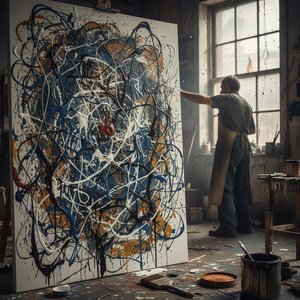
Pollock’s method—characterized by “all-over” painting and action painting—represented a radical departure from traditional artistic conventions. Unlike representational art focused on depicting external reality, Pollock sought to express internal feelings directly onto the canvas. He achieved this remarkable feat through his groundbreaking drip technique: instead of brushing paint onto the surface, he poured or splashed it from cans and sticks, allowing gravity and chance to dictate the flow of pigment. This process demanded complete physical engagement—Pollock would dance around the canvas while applying paint, creating a mesmerizing spectacle of movement and spontaneity. The resulting texture is incredibly rich and varied, ranging from thick impastoed layers to thinner washes, demonstrating Pollock’s mastery of material and his willingness to experiment with unconventional methods.

Color & Composition: An Earthy, Unsettling Harmony

The painting's color palette—dominated by deep greens, browns, yellows, and blues—contributes significantly to its unsettling mood. These earthy tones ground the composition but their chaotic arrangement prevents any sense of tranquility. The absence of strong highlights or shadows further enhances this murky atmosphere, drawing the viewer’s eye into the depths of swirling forms. Angular shapes like triangles and rectangles clash with more organic, vortex-like patterns—creating a visual tension that mirrors the emotional turmoil conveyed by the artwork. This deliberate imbalance underscores Pollock's rejection of conventional perspective and reinforces his commitment to conveying feeling rather than depicting a specific scene.

Historical Context: Post-War Anxiety & Abstract Expressionism

Pollock emerged as a pivotal figure within the burgeoning Abstract Expressionist movement following World War II, a period marked by widespread uncertainty and existential questioning. Artists like Pollock responded to these anxieties through intensely personal explorations of emotion and subconsciousness—rejecting rational thought in favor of intuitive expression. Influenced by Surrealist ideas and fueled by Jungian psychology, Pollock sought to access primal energies and communicate universal truths beyond the confines of language. His work stands as a powerful symbol of this era's preoccupation with psychological complexity and its desire for artistic innovation.

Symbolism & Emotional Impact: The Weight of a Crown

The evocative title, “Troubled Queen,” adds another layer of intrigue to the artwork’s narrative—though Pollock rarely assigned explicit meanings to his canvases. The queen figure symbolizes responsibility, power, and perhaps internal conflict—themes that resonate deeply within the painting's chaotic composition. The swirling lines and angular shapes evoke a sense of disorientation and unease, mirroring the psychological state conveyed by the piece. “Troubled Queen” serves as an unforgettable reminder of the enduring capacity of abstract art to communicate profound emotions without resorting to literal representation—a captivating exploration of inner turmoil presented in a masterful display of technique and color.
  • Style: Abstract Expressionism with Cubist influences
  • Artist: Jackson Pollock (1912-1956)
  • Medium: Oil on Canvas (presumed)

Photo Description: --Overall Impression-- The artwork presents a complex and chaotic abstract composition dominated by swirling lines, geometric shapes, and overlapping forms. It appears to be an oil painting with visible brushstrokes creating a textured surface. The subject matter is difficult to define in a traditional sense; it’s not representational but rather evokes a feeling of movement, energy, and perhaps disorientation. The perspective is flattened, lacking depth cues, contributing to the overall sense of instability. Lines are predominantly angular and jagged, intersecting and overlapping to create a dense network. Shapes range from sharp triangles and rectangles to organic, swirling forms resembling clouds or vortexes. The texture is heavily impastoed – thick application of paint creates a three-dimensional effect. Lighting seems diffuse, with no strong highlights or shadows, contributing to the painting’s somewhat murky atmosphere. The dynamism is palpable; it feels as though the painting is in constant motion, reflecting an internal struggle.

Otázky a odpovědi

Kdo vytvořil "Troubled Queen – Zmatená královna"?

Dílo "Troubled Queen – Zmatená královna" se připisuje autorovi Jackson Pollock.

Co zachycuje dílo „Troubled Queen – Zmatená královna“ od Jackson Pollock?

Motivy díla „Troubled Queen – Zmatená královna“ jsou abstract expressionism, drip painting, color palette, geometric shapes, emotional intensity, postwar anxiety, psychological turmoil.

Hangi tónem se "Troubled Queen – Zmatená královna" sklání?

Dílo „Troubled Queen – Zmatená královna“ od Jackson Pollock je protknuto Od okrové po sépiovou odstínem.

More about this painting

Náhled v interiéru Náhled v AR Přepnout na tisk Přepnout na digitální obraz Sdílet
Podrobnosti o díle Průvodce Přidat do oblíbených Stáhnout Podobné položky Rentgenové snímky Slideshow Q&A Statistiky

In numbers

  • 29frames to choose from
  • standard sizes, in its own proportions
  • 5weeks to paint and deliver it
Jackson Pollock

Jackson Pollock

1912 - 1956, Spojené státy americké

Quick facts about Jackson Pollock

  • Artistic Movement Or Style: Abstraktní expresionismus
  • Artists Or Movements Influenced By This Artist: ['Surrealismus']
  • Artists Who Influenced This Artist: ['Thomas Hart Benton']
  • Date Of Birth: 28. ledna 1912
  • Date Of Death: 11. srpna 1956
  • Full Name: Paul Jackson Pollock
  • Nationality: Američan
  • Notable Artworks:
    • Number 1, 1950
    • Blue Poles
    • Convergence
  • Place Of Birth: Cody, Wyoming

Biografie umělce

Early Life and the Seeds of Innovation

Paul Jackson Pollock, born in Cody, Wyoming, in 1912, was a restless spirit from the outset. His early life was marked by frequent relocation as his father, LeRoy Pollock, pursued work as a land surveyor across the vast landscapes of the American West. This itinerant existence instilled in young Pollock a deep connection to the natural world and an exposure to diverse cultures, particularly through encounters with Native American art during those surveying trips – impressions that would subtly permeate his artistic vision later in life. Though he never explicitly imitated Indigenous styles, the raw energy and spiritual resonance of these early experiences undoubtedly left their mark. Pollock’s formal artistic training began at the Manual Arts High School in Los Angeles, followed by studies at the Art Students League of New York under the tutelage of Thomas Hart Benton. Benton, a prominent figure in the Regionalist movement, emphasized rhythmic composition and narrative themes rooted in American life. While Pollock initially absorbed these lessons, his inherent inclination leaned toward more abstract explorations. He was also profoundly impacted by Mexican muralists like José Clemente Orozco, whose powerful depictions of social struggle resonated deeply with him. These early influences laid a foundation, but it was the burgeoning world of Surrealism that truly unlocked Pollock’s artistic potential.

The Birth of Action Painting and a Revolutionary Technique

The 1930s saw Pollock experimenting with various techniques, seeking alternatives to traditional brushwork. He began pouring paint, exploring its fluidity and unpredictable nature. However, it was around 1947 that his artistic trajectory underwent a radical transformation. Abandoning the easel altogether, Pollock laid canvases directly on the floor, initiating what would become known as his “drip technique.” He then proceeded to drip, splash, and fling paint onto the canvas from above, orchestrating a dynamic dance between artist, medium, and surface. This wasn’t merely about applying paint; it was about embodying the act of creation itself. Pollock's canvases became arenas for physical expression, capturing the immediacy of his gestures and emotions. The resulting paintings are characterized by their “all-over” composition – a lack of central focus that invites the viewer to explore the entire surface as a unified field of energy. Intricate networks of lines and colors intertwine, creating a visual complexity that is both captivating and challenging. He employed unconventional tools—sticks, knives, even syringes—to manipulate the paint in unpredictable ways, further emphasizing the spontaneous nature of his process.
  • The technique involved covering the entire canvas with layers of thinned paint.
  • He used sticks, knives, and other implements to drip and fling paint onto the surface.
  • This method allowed him to work from all angles, creating a dynamic and immersive experience.

Influence and Early Style

Pollock’s early artistic development was significantly shaped by several key influences. The stark landscapes of the American West, coupled with his exposure to Native American art during surveying trips, instilled in him a deep appreciation for raw energy and primal forms. He also drew inspiration from European modernists like Pablo Picasso and André Masson, whose explorations of abstraction and subconscious imagery resonated with his own artistic sensibilities. His time at the Art Students League under Thomas Hart Benton exposed him to Regionalist painting, which emphasized narrative themes rooted in American life – a style he initially embraced before ultimately forging his own unique path. Key Influences:
  • Thomas Hart Benton (Regionalism)
  • José Clemente Orozco (Mexican Muralism)
  • Pablo Picasso & André Masson (Surrealism and Abstraction)

The Rise of Action Painting and Recognition

By the mid-1940s, Pollock’s innovative techniques and increasingly bold compositions began to attract attention within the New York art scene. His work was exhibited at galleries like Peggy Guggenheim's Art of This Century, where it initially faced mixed reactions – some critics dismissed his approach as chaotic or lacking skill, while others recognized its groundbreaking potential. However, the momentum continued to build, fueled by the growing interest in Abstract Expressionism, a movement that sought to capture the essence of human experience through non-representational imagery and spontaneous gesture. The term “action painting” emerged to describe Pollock’s method – emphasizing the physical act of creation as central to the artistic process.

Iconic Works and Lasting Legacy

Pollock's most celebrated works—such as Number 1, 1950 (Lavender Mist), One: Number 31, 1950, Blue Poles: Number 11, 1952, and *Convergence*—are testaments to his revolutionary technique. These paintings are not simply images; they are records of a performance, imbued with the artist’s physical presence and emotional intensity. The dynamic energy that emanates from these canvases is palpable, drawing viewers into a world of pure abstraction. Notable Works:
  • Number 1, 1950 (Lavender Mist)
  • One: Number 31, 1950
  • Blue Poles: Number 11, 1952
  • *Convergence*
Pollock’s impact on the history of art is immeasurable. He fundamentally altered the way artists approached painting, breaking free from easel-based methods and embracing a more performative approach. His work helped solidify New York City's position as a global center for modern art, shifting the focus away from European dominance. His influence can be seen in the work of countless artists who followed, including those associated with Color Field painting and later forms of abstract expressionism. Despite initial skepticism, Pollock’s legacy is now firmly established as one of the most important and influential figures in 20th-century art.

Rychlé informace

  • Artistic style: Cubist influences
  • Title: Troubled Queen
  • Medium: Oil on Canvas
  • Location: Museum of Fine Arts, Boston
  • Subject or theme: Psychological unrest

Artový kvíz

U každé otázky je pouze jedna správná odpověď.

Otázka 1:
Jaký styl umění charakterizuje obraz "Troubled Queen"?
Otázka 2:
Která technika byla používána při tvorbě tohoto obrazu?
Otázka 3:
¿Por qué se considera que este cuadro refleja la ansiedad de la época?
Otázka 4:
¿Quién fue el artista principal asociado con este movimiento artístico?
Otázka 5:
¿Cuál es el significado simbólico del título "Troubled Queen"?