Zobrazit v interiéru
 Odeslat
 Sdílet
 Podrobnosti
 Průvodce

 Stáhnout obrázek
 Podobné kousky
 Rentgenové snímky
 Slideshow
 Statistiky
Comedy scene (scene from Molière)


 Přečíst si více
Giclée / Umělecký tisk
Giclée nebo plátěný tisk muzeální kvality s rychlou výrobou a širokou nabídkou povrchových úprav. ( Objednat ručně malovanou reprodukci Přepnout na digitální verzi obrazu)




P118B Kč10

P118H Kč10

P118W Kč10

P438Z Kč10

P508JH Kč12

P508YH Kč12

P805H Kč10

P805Z Kč10

P919BZ Kč10

P919G Kč10

P919XJ Kč10

P959ZH Kč10

P968JZ Kč12

W106C Kč8

W218G Kč10

W218JH Kč8

W218Y Kč10

W307PJ Kč10

W316G Kč10

W316PJ Kč8

W316Y Kč10

W398PJ Kč8

W4111J Kč10

W500HY Kč15

W500JH Kč15

W692G Kč12

W849H Kč8

W940BG Kč15

W953PJ Kč8




Vyberte si z našich přednastavených velikostí, které odpovídají původním proporcím díla.

Zadejte šířku a výšku, které potřebujete pro váš rám nebo stěnu. Tisk lze pouze oříznout, nikdy však nelze zvětšit obraz nad jeho původní rozměr, proto při výběru jiného formátu dochází ke ztrátě části obrazu. Před samotným tiskem vám zašleme digitální náhled k schválení. Obraz zobrazený na této stránce nenabízí skutečný výřez — ten uvidíte pouze v náhledu.
Celosvětové doručení () do 2 týdnů namísto standardních 4/5 týdnů. (23 říjen)

Zdarma celosvětová expresní doprava

Vysoce kvalitní lněné plátno

Úplné pojištění přepravy

Záruka vrácení celního poplatku

Záruka věrného barevného shodu

100dení lhůta pro vrácení zboží (pouze při vadách výroby)

100% garance vrácení peněz

Sleva při více objednávkách
 Skleněná varianta je dostupná pouze u rozměrů menších než 110 cm

Comedy scene (scene from Molière)
Giclée / Umělecký tisk
Velikost reprodukce
-


Celková cena
Kč 1716
A Moment of Contention: Honoré Daumier’s “Comedy Scene (Scene from Molière)”
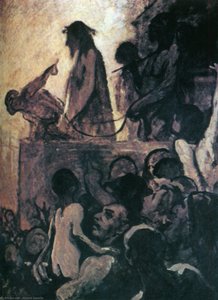
Honoré Daumier's 1862 painting, "Comedy Scene (Scene from Molière)," isn’t merely a depiction of a theatrical moment; it’s a vibrant snapshot of Parisian society grappling with wit, social commentary, and the very nature of performance. The work, rendered in stark black and white – a signature technique for Daumier – immediately draws the viewer into a scene brimming with unspoken tension and subtle gestures. Two men dominate the foreground: one, animatedly gesturing upwards, seemingly addressing an unseen audience; the other, slumped downwards, his gaze fixed on his companion, perhaps lost in thought or responding to the first man’s pronouncements.
Beyond these central figures lies a carefully constructed backdrop of three additional individuals, subtly positioned in the background. Their presence isn't one of active participation but rather serves as a quiet reminder of the broader social context surrounding this private exchange. They are not integrated into the immediate drama, yet their inclusion suggests that this scene unfolds within a larger, more complex world – a world ripe for observation and critique, precisely what Daumier excelled at capturing.
The Artist’s Vision: Realism and Social Satire
Daumier was a pivotal figure in the development of French realism, but his work transcends simple representation. He wasn't interested in idealized beauty or romanticized narratives; instead, he sought to expose the uncomfortable truths of everyday life – particularly the hypocrisy and social inequalities prevalent in 19th-century France. His art became a powerful tool for social commentary, often targeting the aristocracy, the clergy, and the legal system. “Comedy Scene” is no exception, offering a glimpse into a private conversation that hints at underlying tensions and judgments.
The painting’s monochrome palette – predominantly shades of gray and white – contributes significantly to its dramatic effect. This deliberate choice eliminates distractions, forcing the viewer to focus on the figures' expressions and body language. Daumier masterfully employs chiaroscuro—the contrast between light and dark—to sculpt the forms and heighten the sense of drama. The sharp delineation of shadows emphasizes the characters’ postures and gestures, conveying a palpable atmosphere of anticipation and potential conflict.
A Stage Within a Stage: Molière and Parisian Society
The painting's title explicitly references Molière, the renowned French playwright whose comedies satirized societal norms. Daumier wasn’t simply illustrating a scene from one of Molière’s plays; he was capturing the *spirit* of theatrical performance itself – the interplay between performer and audience, the delivery of witty dialogue, and the subtle judgments exchanged during a dramatic moment. The implied setting is likely a Parisian theater, though Daumier deliberately avoids providing specific details, allowing the viewer to project their own interpretations onto the scene.
Furthermore, the painting reflects the vibrant intellectual and artistic life of 19th-century Paris. The Comédie-Française, France’s national theatre, was a central hub for social and political discourse. Daumier's work engages with this dynamic environment, offering a critical perspective on the role of theater in shaping public opinion and exposing societal flaws.
Symbolism and Emotional Resonance
The posture of the two men is particularly revealing. The man gesturing upwards embodies assertiveness and perhaps even arrogance, projecting his thoughts or opinions to an unseen audience. His elevated position suggests a desire for recognition or validation. Conversely, the slumped figure conveys a sense of resignation, doubt, or perhaps quiet disapproval. His downward gaze hints at a critical assessment of the first man’s pronouncements – a subtle challenge to his authority or perspective.
“Comedy Scene” is not a straightforward narrative; it's an invitation to observe and interpret. It evokes a sense of unease, prompting viewers to consider the complexities of human interaction and the often-hidden judgments that shape our perceptions. Daumier’s masterful use of composition, light, and gesture creates a timeless image that continues to resonate with audiences today, reminding us of the enduring power of satire and the importance of critical engagement with the world around us.
Otázky a odpovědi
Je „Comedy scene (scene from Molière)“ od Honoré Daumier portrét, krajina nebo čtvercová kompozice?
Dílo „Comedy scene (scene from Molière)“ od Honoré Daumier má formát Portrait. Formát určuje poměry kompozice.
Jaký pocit vyvolává „Comedy scene (scene from Molière)“ od Honoré Daumier?
Zachycená nálada díla „Comedy scene (scene from Molière)“ od Honoré Daumier je Dramatic a jeho emocionální náboj je Melancholic.
Kde si mohu stáhnout „Comedy scene (scene from Molière)“ od Honoré Daumier?
Obraz díla „Comedy scene (scene from Molière)“ od Honoré Daumier si můžete stáhnout na stránce s k dispozici pro stažení Stáhnout: stažení digitálního obrazu ve vysokém rozlišení.
Biografie umělce
A Life Etched in Satire: The World of Honoré Daumier
Honoré-Victorin Daumier, born in Marseille in 1808, was a figure inextricably linked to the turbulent currents of 19th-century France. His early life, shaped by his father’s aspirations as a poet and subsequent relocation to Paris in 1814, immersed him within a city already brimming with artistic fervor. Initially destined for a legal career, Daumier's inclination swiftly shifted towards the visual arts. He began his apprenticeship under Alexandre Lenoir, absorbing the classical techniques and dramatic chiaroscuro favored by Rubens, and further honed his skills at the Académie Suisse. This foundational training wasn’t merely about mastering technique; it was about cultivating a profound sensitivity to the social injustices and political absurdities that permeated Parisian society – an awareness he would translate into his art with searing accuracy.The Sharpened Pen: Caricature and Social Commentary
Daumier's career truly ignited in the wake of the 1830 Revolution, an event that fundamentally reshaped France’s political landscape and simultaneously provided a fertile ground for his burgeoning satirical talent. He quickly established himself as a master lithographer, initially contributing anonymously to various publications before gaining recognition through his work with *Le Charivari*, a fiercely independent comic journal founded by Charles Philipon. It was within the pages of *Le Charivari* that Daumier’s genius truly blossomed. His caricatures weren't simply humorous illustrations; they were biting critiques, exposing the hypocrisy and corruption of the bourgeoisie, the failings of the legal system, and the machinations of the political establishment. He fearlessly lampooned King Louis-Philippe, a figure he viewed as weak and indecisive, earning himself a six-month imprisonment in 1832 for a particularly provocative caricature depicting the monarch as a bloated, decadent figure. This experience, rather than silencing him, served to solidify his commitment to using art as a weapon against injustice – a conviction that fueled his prolific output for decades. His lithographs became visual manifestos, capturing the spirit of dissent and offering a starkly honest portrayal of the realities faced by ordinary people. The sheer volume of his work during this period is staggering—thousands of lithographs documenting Parisian life, political events, and social commentary.Beyond Caricature: Painting and Sculptural Visions
While Daumier is most widely celebrated for his lithography, to reduce him solely to caricature would be a profound oversight. He was also a dedicated painter and sculptor, though recognition for these works came later in his life. His paintings, often depicting scenes of everyday Parisian life – the crowded third-class carriages, the weary laundresses, the pompous lawyers – are imbued with a remarkable sense of realism and empathy. They aren’t idealized representations; rather, they offer unflinching glimpses into hardship, poverty, and the struggles of ordinary people. He masterfully employed loose brushwork and dramatic lighting to convey emotion and atmosphere, anticipating some of the techniques that would later be embraced by the Impressionists. His sculptural work, largely created in clay (many pieces remaining unbaked during his lifetime), reveals a similar commitment to capturing the human form with honesty and emotional depth. These sculptures, rediscovered after his death, demonstrate a remarkable talent for modeling and an ability to convey psychological complexity through subtle gestures – a testament to Daumier’s profound understanding of the human condition.A Lasting Legacy: Influence and Historical Significance
Honoré Daumier's impact on art history is undeniable. He bridged the gap between Romanticism and Realism, laying the groundwork for future generations of artists who sought to depict the world as it truly was – with all its flaws and imperfections. His unflinching social commentary profoundly influenced artists like Gustave Courbet and Édouard Manet, both of whom embraced a more direct engagement with social issues in their work. Furthermore, Daumier’s innovative use of lithography revolutionized printmaking, transforming it from a primarily decorative medium into a powerful tool for political and social critique. His legacy continues to resonate today, reminding us of the enduring power of art to challenge authority, expose injustice, and bear witness to the complexities of the human experience. The Musée d'Orsay in Paris houses a significant collection of his paintings and sculptures, offering visitors a valuable opportunity to immerse themselves in the world he so vividly portrayed. His lithographs are widely accessible through collections like those found on OriginalUniqueArt, ensuring that his satirical genius continues to provoke thought and inspire dialogue – a testament to an artist who dared to hold power accountable. Daumier wasn’t merely an artist; he was a chronicler of his time—a visual poet whose art served as both entertainment and a potent form of social protest.
Honoré Daumier
1808 - 1879 , Francie
Rychlé informace
- Artistic Movement Or Style: Realismus, Satira
- Artists Or Movements Influenced By This Artist: ['Impressionismus']
- Artists Who Influenced This Artist:
- Lenoir
- David
- Date Of Birth: 26. února 1808
- Date Of Death: 10. února 1879
- Full Name: Honoré-Victorin Daumier
- Nationality: Francouzský
- Notable Artworks:
- Rue Transnonain
- Les gens de justice
- Place Of Birth: Paříž, Francie
Související články

Top 10 slavných obrazů vládnutých bílou barvou – Umění a inspirace pro interiér
Objevte top 10 slavných obrazů, kde bílá barva hraje klíčovou roli. Claude Monet, Van Gogh a další mistři! Inspirace pro váš interiér a reprodukce umění nejvyšší kvality na OriginalUniqueArt.com.

Monochrome Visions: Exploring the Aesthetic & Historical Significance of Black & White Photography
Explore the rich history & artistic power of black and white photography. From early techniques to iconic masters like Ansel Adams, discover why monochrome continues to captivate art lovers today. Expert insights for collectors.

Top 10 slavných obrazů s dominantní černou barvou | OriginalUniqueArt.cz
Prozkoumejte 10 nejslavnějších obrazů s dominantní černou barvou od Van Gogha, Muncha a dalších mistrů. Objevte příběhy za uměleckými díly, techniky a inspiraci. Reprodukce obrazů nejvyšší kvality na OriginalUniqueArt.com.
Shadow & Soul: Why Black & White Photography Remains the Ultimate Power Move in Modern Art
Discover why black & white photography remains a powerful force in contemporary art. Explore the impact of light, shadow, and texture through a visual journey of monochrome mastery and learn how to elevate your space with timeless grayscale aesthetics.

Monochrome Edge: The Ultimate Design Flex—Level Up Your Space with Bold Black & White Art
Master the monochrome aesthetic with high-impact Black & White art from OriginalUniqueArt.com. From custom hand-painted oils to iconic pop culture remixes, discover the ultimate design flex for your urban space. Elevate your decor with bold, premium, and timeless monochrome masterpieces.