Přepnout na tisk
 Zobrazit více







































 U děl nebo reprodukcí, u nichž je jakákoliv strana větší než 105 cm (přibližně 41 palců), bude rám dodán jako sestava v rozloženém stavu. Tato metoda zajišťuje bezpečné doručení a chrání dílo před poškozením během přepravy.


A Haunting Echo of War: Exploring Sutherland’s “Flying Bomb Depot”
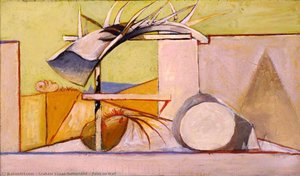
Graham Vivian Sutherland's "Flying Bomb Depot (recto)," painted in 1945, isn’t merely a depiction of wartime architecture; it’s a profound meditation on destruction, isolation, and the unsettling beauty born from devastation. Created during the tumultuous years of World War II, this oil painting offers a starkly evocative glimpse into the hidden realities of Britain's defense efforts – specifically, the clandestine network of caves used to house German flying bombs. Sutherland, an Official War Artist tasked with documenting the home front, moved beyond straightforward military scenes, instead choosing to capture the psychological and atmospheric weight of these subterranean installations.
The painting’s immediate impact is one of muted drama. Dominated by a palette of somber grays, browns, and ochres, it eschews vibrant color in favor of a restrained, almost melancholic tone. The composition centers on a partially collapsed brick structure – the entrance to a cave complex – its jagged edges and broken walls hinting at recent bombardment. The strategic placement of sparse trees, rendered with an unsettlingly organic quality, further amplifies the sense of desolation and the intrusion of nature reclaiming man-made structures. It’s not a heroic portrayal of victory; rather, it's a quiet acknowledgment of loss and the enduring scars left by conflict.
Neo-Romanticism and the Pembrokeshire Landscape
Sutherland’s style in “Flying Bomb Depot” firmly places it within the realm of Neo-Romanticism. This movement, flourishing in Britain during the interwar period and continuing through the war years, sought to reconnect with nature while simultaneously exploring themes of emotion, spirituality, and the sublime. Sutherland's work shares this dual focus – he imbues his landscapes with a sense of profound emotional resonance, mirroring the anxieties and uncertainties of the era. His earlier Pembrokeshire paintings, which profoundly influenced this piece, demonstrated a fascination with the rugged beauty of the Welsh coastline, but here, that interest is filtered through the lens of wartime experience.
Technically, Sutherland employs a layered approach, building up his image through multiple glazes and scumbles. This creates a remarkable sense of texture and depth, particularly evident in the rough-hewn brickwork and the tangled undergrowth. The brushstrokes are loose and expressive, contributing to the painting’s overall feeling of immediacy and vulnerability. He utilizes a technique reminiscent of Impressionism, capturing fleeting moments of light and shadow, yet his subject matter—a scene of destruction—elevates it beyond mere observation.
Symbolism and the Weight of History
Beyond its immediate depiction of wartime infrastructure, “Flying Bomb Depot” is rich in symbolic meaning. The caves themselves represent a hidden world – a space removed from everyday life, shrouded in secrecy and danger. The broken walls symbolize not just physical damage but also the shattered foundations of society during wartime. The lone bird perched on a branch adds an element of unsettling beauty to the scene, suggesting both resilience and vulnerability amidst the ruins. It’s a poignant reminder that even in the darkest of times, life persists.
Considering its creation in 1945, immediately following intense aerial bombardment, the painting serves as a powerful testament to the psychological impact of war on civilians. It's a far cry from celebratory wartime propaganda; instead, it offers a raw and honest portrayal of the human cost of conflict. The work’s enduring power lies in its ability to evoke a sense of unease and contemplation, prompting viewers to reflect on the complexities of history and the fragility of peace.
Collecting a Piece of History
Reproductions of “Flying Bomb Depot” offer a compelling way to bring this evocative artwork into your home or office. Available in various sizes and mediums – from high-quality prints to meticulously crafted oil paintings – it’s a unique addition to any collection. This piece is more than just decoration; it's a window into the past, a reminder of a pivotal moment in history, and a testament to the enduring power of art to capture both beauty and sorrow.
Otázky a odpovědi
Pod jakými dalšími jmény nebo pseudony je Graham Vivian Sutherland známý/á?
Mezi další jména, pod kterými je znám(a) Graham Vivian Sutherland, tvůrce díla „Flying Bomb Depot (recto)“, patří i GV Sutherland.
Pro jaké místo a za jakým účelem se doporučuje dílo "Flying Bomb Depot (recto)"?
Dílo „Flying Bomb Depot (recto)“ od Graham Vivian Sutherland se doporučuje pro Statement, ideálně do Living Room. Způsob využití a prostor společně určují, kam se reprodukce hodí.
Mohu si objednat olejnou reprodukci díla "Flying Bomb Depot (recto)"?
Ručně malovanou reprodukci díla „Flying Bomb Depot (recto)“ od Graham Vivian Sutherland si můžete objednat přímo na jeho stránce Ručně malovaná reprodukce: ručně malovaná olejová reprodukce na lněném plátně, vyrábíme na zakázku.
 Náhled v interiéru
 Sdílet
 Sdílet
 Podrobnosti o díle
 Průvodce

 Stáhnout
 Podobné položky
 Rentgenové snímky
 Slideshow
 Otázky a odpovědi
 Statistiky