Zobrazit v interiéru
 Odeslat
 Sdílet
 Podrobnosti
 Průvodce

 Stáhnout obrázek
 Podobné kousky
 Rentgenové snímky
 Slideshow
 Statistiky
An Amazon


 Přečíst si více
Umělecké dílo zobrazené na této stránce je chráněno autorským zákonem, což znamená, že nemůžeme legálně vytvářet ani prodávat jeho identickou reprodukci. Tato ochrana je vymáhána na základě mezinárodních dohod, jako například Berberská úmluva a národními zákony, včetně těch stanovených v Americký autorský zákon – Díl 17. Všechna práva vyhrazena.
Jako etickou a právní alternativu nabízíme vlastní, ručně malovaná umělecká díla inspirovaná originálem. Naši zdatní a profesionální umělci si pečlivě studují styl, náladu a uměleckou podstatu originálu, aby vytvořili nové, jedinečné dílo, které vyvolává stejný pocit – přičemž zůstává samostatným originálním tvůrčím dílem.
Tato metoda je plně v souladu s autorským právem, protože nezahrnuje kopírování ani duplikování chráněného díla. Jde o kreativní reinterpretaci – nový obraz, který je inspirován originálem, ale není s ním identický.
Ručně malovaná olejová reprodukce
Ručně malované olejné plátno v libovolném rozměru i s rámem, vyrobené našimi umělci na zakázku. ( Přepnout na tiskové verze Přepnout na digitální verzi obrazu)




P118B Kč10

P118H Kč10

P118W Kč10

P438Z Kč10

P508JH Kč12

P508YH Kč12

P805H Kč10

P805Z Kč10

P919BZ Kč10

P919G Kč10

P919XJ Kč10

P959ZH Kč10

P968JZ Kč12

W106C Kč8

W218G Kč10

W218JH Kč8

W218Y Kč10

W307PJ Kč10

W316G Kč10

W316PJ Kč8

W316Y Kč10

W398PJ Kč8

W4111J Kč10

W500HY Kč15

W500JH Kč15

W692G Kč12

W849H Kč8

W940BG Kč15

W953PJ Kč8




Vyberte si z našich přednastavených velikostí, které odpovídají původním proporcím díla.

Můžete zadat vlastní rozměry pro konkrétní rám nebo prostor. Pokud se vámi vybraná velikost neshoduje s proporcemi původního obrazu, dílo buď ořízneme, nebo jej doplníme ručně malovanými prvky. Před zahájením výroby vám bude zaslán digitální náhled ke schválení.
Upozorňujeme, že náhled na obrazovce neodpovídá skutečnému ořezu ani rozšíření. Pouze digitální náhled přesně zobrazí finální kompozici.
Ačkoliv je možné zvolit vlastní velikost, pro zachování původních proporcí doporučujeme vybrat rozměr z předdefinovaného seznamu.
Po přijetí objednávky vám tým OriginalUniqueArt.com zašle e-mail s pokyny a poskytne náhledovou verzi.
Celosvětová doprava () za 3–4 týdny namísto standardních 5 týdnů. (11 říjen). Bez kompromisů v kvalitě.

Zdarma celosvětová expresní doprava

Vysoce kvalitní lněné plátno

Úplné pojištění přepravy

Záruka vrácení celního poplatku

Záruka věrného barevného shodu

100dení lhůta pro vrácení zboží (pouze při vadách výroby)

100% garance vrácení peněz

Sleva při více objednávkách
 Skleněná varianta je dostupná pouze u rozměrů menších než 110 cm

An Amazon
Technika provedení
Velikost reprodukce
-


Celková cena
Kč 6269
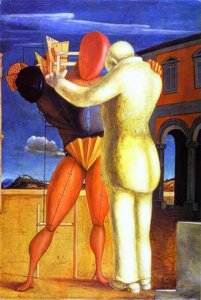
A Vision of Isolation: The Haunting Dreamscape of An Amazon
In the quiet, unsettling corridors of early twentieth-century modernism, few images possess the arresting power of Giorgio de Chirico’s "An Amazon." Completed in 1913, this masterpiece serves as a profound cornerstone of what would become known as Surrealist art, capturing a moment that feels suspended between reality and a fever dream. At first glance, the viewer is met with a striking tableau: a woman clad in a vibrant scarlet dress, perched atop a magnificent chestnut horse against the backdrop of a desolate, sun-scorched hillside. Yet, to look merely at the surface is to miss the profound existential weight de Chirico intended to convey. The painting is not simply a portrait of a rider; it is a meticulously crafted window into the human psyche, designed to provoke contemplation about solitude, strength, and the heavy silence of the unknown.
The subject matter draws deeply from the well of classical mythology, invoking the legendary Amazons—the fierce, independent warrior women of antiquity. By placing this mythic figure within such a stark, lonely landscape, de Chirimento injects a sense of heroic grandeur into an otherwise bleak setting. However, he deliberately avoids the trappings of romantic idealism. Instead of a triumphant conqueror, we see a woman whose gaze is directed inward, suggesting a state of deep introspection or perhaps a quiet resignation to her isolation. The horse, too, transcends its role as a mere beast of burden; it stands as a symbol of stability and groundedness amidst the turbulent, unseen emotions that haunt the composition.
The Architecture of a Dream: Technique and Spatial Distortion
De Chirico’s technical mastery lies in his ability to blend meticulous realism with a disorienting, dreamlike abstraction. He employs a precise hand to render the tactile details of the scene—the coarse texture of the horse’s mane, the heavy folds of the scarlet fabric, and the ruggedness of the rocky terrain. This level of detail creates a convincing illusion of reality that makes the subsequent distortions all the more unsettling. Through a technique reminiscent of Cubism but pushed toward a much more profound psychological depth, de Chirico manipulates perspective and scale to create an illogical space. The hillside does not follow the rules of conventional landscape painting; instead, it exists in muted, oppressive tones of ochre and brown, creating a sense of heavy, stagnant air.
This chromatic harmony—or perhaps disharmony—is central to the painting's emotional impact. The sudden, piercing brightness of the woman’s red dress acts as a focal point that vibrates against the desaturated earth tones, pulling the viewer’s eye into the center of this lonely drama. For collectors and interior designers, this piece offers a unique tension; it possesses the classical elegance required for sophisticated spaces, yet its avant-garde spirit provides a conversational edge that challenges the mundane. It is a work that does not merely decorate a wall but commands the atmosphere of a room, inviting guests to linger in its shadows and wonder about the stories hidden within its stillness.
A Legacy of Metaphysical Mystery
To understand "An Amazon," one must understand the era of Metaphysical Art that de Chirico pioneered. Influenced by the existential philosophies of Nietzsche and Schopenhauer, the artist sought to reveal the unsettling poetry hidden within the mundane. His work often features long, stretching shadows and empty spaces that evoke a sense of nostalgia and dread. In "An Amazon," this is achieved through the deliberate use of negative space and the isolation of the central figures. The presence of other distant figures in the periphery only serves to heighten the feeling of being alone in a vast, indifferent world.
For those seeking to bring a piece of art history into their personal collections, a high-quality reproduction of "An Amazon" offers more than just visual beauty; it offers an entry point into the subconscious. It is a painting for the thinker, the dreamer, and the aesthete—a timeless reminder that beneath the surface of our daily lives, there exists a deeper, more mysterious layer of reality waiting to be explored. Whether placed in a contemporary gallery setting or a classic study, this work continues to resonate with the same haunting, beautiful intensity it possessed over a century ago.
Otázky a odpovědi
Působí dílo "An Amazon" celkově spíše světle, nebo spíše tmavě?
U díla „An Amazon“ od Giorgio de Chirico je zaznamenána jasnost deep_shadow při luminanci Dark.
Jaká je převládající barva díla „An Amazon“ od Giorgio de Chirico?
„An Amazon“ skloní se k Golden Yellow Range tónu.
Mohu si před objednávkou prohlédnout „An Amazon“ od Giorgio de Chirico?
Náhled díla „An Amazon“ od Giorgio de Chirico je k dispozici na stránce Náhled daného uměleckého díla.
O jaký typ uměleckého díla se jedná u „An Amazon“ od Giorgio de Chirico?
Dílo „An Amazon“ od Giorgio de Chirico je klasifikováno jako WallArt. Tato kategorie určuje typ uměleckého díla, kterým je originál.
Patří dílo „An Amazon“ mezi slavná díla směru Surrealist Dreamscape?
Dílo "An Amazon" je v katalogu hodnoceno jako Iconic mezi díly z období Surrealist Dreamscape.
Kde si mohu koupit digitální kopii díla „An Amazon“ od Giorgio de Chirico?
Chcete-li získat digitální kopii díla „An Amazon“ od Giorgio de Chirico, objednejte si stažení digitálního obrazu ve vysokém rozlišení na tato stránka.
Existují díla podobná jako "An Amazon"?
Díla podobná "An Amazon" jsou uvedena na stránce Podobná díla tohoto díla.
Jakou barevnou identitu má dílo „An Amazon“ od Giorgio de Chirico?
Barevná identita díla „An Amazon“ od Giorgio de Chirico: paleta v odstínech Earthy, s převládající barvou Sap Green (#73643e).
Biografie umělce
Giorgio de Chirico: Vize einer surrealistischen Seele
Giorgio de Chirico, geboren 1988 in Volos, Griechenland, als Sohn italienischer Eltern – einer Genuesischen Baronin und eines sizilianischen Barons – begann seine künstlerische Reise mit einer einzigartigen Mischung aus klassischem Erbe und einem wachsenden Gefühl der modernen Entfremdung. Seine frühe Ausbildung an der Theatralisch-Mathematischen Schule in Athen legte eine solide Grundlage in traditionellen Techniken, doch erst seine Studien in München entfachten seinen kreativen Geist. Dort, inmitten des intellektuellen Aufbruchs Europas vor dem Ersten Weltkrieg, begegnete er Werken von Arnold Böcklin und Max Klinger – Künstlern, deren symbolische Landschaften und geisterhafte Bilder sein eigenes künstlerisches Konzept tiefgreifend prägten. Ebenfalls entscheidend für seine Entwicklung waren die philosophischen Strömungen der Zeit – die Schriften von Friedrich Nietzsche, Arthur Schopenhauer und Otto Weininger, die Themen wie Existenzialismus, die Irrationalität menschlicher Begierden und die subjektive Natur der Realität erforschten. Diese Ideen wurden zu den Eckpfeilern seiner bahnbrechenden künstlerischen Vision.Die Geburt der Metaphyschen
Um 1909 begann sich aus seinen Erkundungen ein einzigartiger Stil herauszudecken – ein Stil, den er selbst “Metaphysische” Kunst nannte. Dies war nicht nur eine stilistische Innovation; es war ein tiefgreifender Versuch, die verborgenen Realitäten unter der Oberfläche des Alltags aufzudecken, die verstörende Poesie in vertrauten Räumen zu enthüllen. Ein entscheidendes Ereignis ereignete sich während eines Besuchs in Florenz und einer Erfahrung im Piazza Santa Croce – ein Moment, der seine ikonische Serie “Metaphysischer Stadtplatz” inspirierte. Diese Gemälde zeichnen sich durch ihre unheimliche Stille, lange dramatische Schatten, willkürliche Perspektiven und die Präsenz klassischer Architektur, kontrastierend mit verstörenden Elementen wie leeren Mannequins und bedrohlichen Statuen aus. Das Ergebnis ist tief beunruhigend und erzeugt ein Gefühl von Nostalgie, Isolation und einer fast unerträglichen Sehnsucht nach etwas Verlorenem oder Unattainablem. De Chirico gründete die *Scuola Metafisica*, die einen tiefgreifenden Einfluss auf Surrealismus hatte, obwohl er sich später von dessen Interpretationen seiner Arbeit distanzierte. Seine Gemälde waren nicht dazu gedacht, Träume darzustellen, sondern vielmehr eine Realität jenseits der sichtbaren Welt zu zeigen – ein Reich, in dem Zeit und Raum fließen und die Grenzen zwischen Bewusstsein und Unterbewusstsein verschwimmen. Werke wie *Die Qualen des Denkers*, *Das Rätsel eines Herbstnachmittags* und *Das Lied der Liebe* veranschaulichen diese beunruhigende Ästhetik und laden den Betrachter ein, über die Geheimnisse der Existenz und die Zerbrechlichkeit menschlicher Wahrnehmung nachzudenken.Einflüsse und künstlerische Entwicklung
De Chiricos frühe Arbeiten zeigten deutliche Einflüsse von Böcklin und Klinger, insbesondere in Bezug auf die Verwendung von Symbolik und die Darstellung von melancholischen Landschaften. Die Begegnungen mit den philosophischen Ideen Nietzsches, Schopenhauers und Weiningers prägten seine Sichtweise der Welt und führten zu einer Auseinandersetzung mit Themen wie Isolation, Entfremdung und dem Streben nach Sinn in einer scheinbar sinnlosen Existenz. Die Erfahrung im Piazza Santa Croce in Florenz war ein entscheidender Moment, der ihn dazu brachte, die traditionelle Malerei zu hinterfragen und eine neue Art des Sehens zu entwickeln – eine, die sich auf die Darstellung von Realitäten konzentrierte, die jenseits der sichtbaren Welt lagen. Nach dem Ersten Weltkrieg begann De Chirico, seine frühere Metaphysische Kunst zu verlassen und stattdessen einen traditionelleren neoklassischen oder neobarocken Stil zu verfolgen. Diese Entscheidung stieß auf heftige Kritik, da viele Kritiker beklagten, dass er seinen innovativen Geist aufgegeben habe. Dennoch blieb De Chirico seiner künstlerischen Vision treu und erkundete weiterhin verschiedene Stile und Themen, während er sich stets für Handwerkskunst und technische Meisterschaft einsetzte.Ein Vermächtnis der Mystik
Trotz der Kritik hatte De Chiricos Werk einen nachhaltigen Einfluss auf nachfolgende Generationen von Künstlern. Seine innovative Verwendung von Raum, Perspektive und Symbolik stellte traditionelle künstlerische Normen in Frage und ebnete den Weg für neue Formen des Ausdrucks. Sein Werk ist ein entscheidender Übergang zwischen dem Symbolismus der späten 19. Jahrhunderts und dem Aufstieg des Surrealismus im frühen 20. Jahrhundert. Er wurde direkt von Künstlern wie René Magritte und Salvador Dalí beeinflusst, die seine metaphysischen Gemälde als Inspiration für ihre eigenen traumhaften Welten nutzten. Sein Werk hatte auch Einfluss auf spätere Bewegungen wie den Magic Realism, der die Darstellung alltäglicher Realität mit einem erhöhten Gefühl von Mysterium und psychologischer Tiefe suchte. Heute werden De Chiricos Gemälde in bedeutenden Museen auf der ganzen Welt ausgestellt, darunter das Museum, das seinem Werk gewidmet ist, in der Nähe der Spanischen Treppe in Rom, wodurch sein Vermächtnis als eine der wichtigsten Figuren der Kunst des 20. Jahrhunderts gesichert bleibt. Er hinterließ nicht nur ein Werk von Kunst, sondern auch eine neue Art zu sehen – eine Art, die Welt als einen Ort verborgener Bedeutungen, verstörender Schönheit und bleibender Mystik wahrnimmt.Schlüssel-Einflüsse & künstlerische Linie
- Beeinflusst von: Arnold Böcklin, Max Klinger, Friedrich Nietzsche, Arthur Schopenhauer
- Beeinflusst: Surrealismus, insbesondere Künstler wie René Magritte und Salvador Dalí. Sein Werk hatte auch Einfluss auf spätere Bewegungen wie Magic Realism.

Giorgio de Chirico
1888 - 1978 , Řecko
Rychlé informace
- Artistic Movement Or Style: Metafyzické umění
- Artists Or Movements Influenced By This Artist: ['Surrealismus']
- Artists Who Influenced This Artist:
- Böcklin
- Klinger
- Date Of Birth: 10. července 1888
- Date Of Death: 20. listopadu 1978
- Full Name: Giorgio de Chirico
- Nationality: Italský
- Notable Artworks:
- Enigma podzimu
- Zmatení myslitele
- Place Of Birth: Volos, Řekosko
Související články

Oil on Canvas: A Historical & Technical Exploration of a Timeless Artistic Medium
Explore the rich history & enduring techniques of oil painting on canvas. Discover the science behind its longevity, conservation practices, and contemporary relevance. Expert insights for art enthusiasts.

The Enduring Legacy of Oil on Canvas: Technique, History & Aesthetic Impact
Explore the rich history & techniques of oil painting – from Renaissance masters to Impressionism. Discover pigments, layering methods, and why this timeless medium endures. Expert insights for artists & art enthusiasts.

Crimson Threads of Narrative: Exploring Symbolism & Representation in Artworks Featuring the Red Dress
Explore the rich symbolism of the red dress in art history! From ancient power displays to iconic portraits like Cézanne’s 'Madame Cezanne', discover the cultural and artistic significance behind this captivating color. Expert analysis & insights.
The Noble Steed on Canvas: A Historical & Artistic Exploration of Horse Painting Across Cultures
Explore the rich history of horse painting! Discover masterpieces from Stubbs to Munnings & learn about symbolism, techniques & artists. Find museum-quality reproductions at OriginalUniqueArt.

The Enduring Power of Painting: A Historical & Contemporary Exploration of Form and Emotion
Explore the rich history & enduring techniques of oil painting with OriginalUniqueArt. Discover masterpieces, learn about art collecting, and find authentic handmade reproductions crafted by skilled artists.