
 Náhled
 Sdílet
 Sdílet
 Podrobnosti o díle

 Stáhnout
 Podobné položky
 Rentgenové snímky
 Slideshow
Joseph Anthony Jr.
 Acrylic On Canvas
- WallArt
- Romanticism
 1795
1795 76.0 x 62.0 cm
 Metropolitní muzeum umění
 Zobrazit více
Ručně malovaná olejová reprodukce
Ručně malovaná olejná barva na plátně ve vašem zvoleném rozměru i s rámem, vyrobená našimi umělci na zakázku. ( Koupit tisk Koupit obrázek)




P118B $10

P118H $10

P118W $10

P438Z $10

P508JH $12

P508YH $12

P805H $10

P805Z $10

P919BZ $10

P919G $10

P919XJ $10

P959ZH $10

P968JZ $12

W106C $8

W218G $10

W218JH $8

W218Y $10

W307PJ $10

W316G $10

W316PJ $8

W316Y $10

W398PJ $8

W4111J $10

W500HY $15

W500JH $15

W692G $12

W849H $8

W940BG $15

W953PJ $8




Vyberte si z našich přednastavených velikostí, které odpovídají původním proporcím díla.

Můžete zadat vlastní rozměry pro konkrétní rám nebo prostor. Pokud se vámi vybraná velikost neshoduje s proporcemi původního obrazu, dílo buď ořízneme, nebo jej doplníme ručně malovanými prvky. Před zahájením výroby vám bude zaslán digitální náhled ke schválení.
Upozorňujeme, že náhled na obrazovce neodpovídá skutečnému ořezu ani rozšíření. Pouze digitální náhled přesně zobrazí finální kompozici.
Ačkoliv je možné zvolit vlastní velikost, pro zachování původních proporcí doporučujeme vybrat rozměr z předdefinovaného seznamu.
Po přijetí objednávky vám tým OriginalUniqueArt.com zašle e-mail s pokyny a poskytne náhledovou verzi.
Celosvětová doprava () za 3–4 týdny namísto standardních 5 týdnů. (12 srpen). Bez kompromisů v kvalitě.

Zdarma celosvětová expresní doprava

Vysoce kvalitní lněné plátno

Kompletní přepravní pojištění

Záruka vrácení celního poplatku

Záruka přesného barevného shodu

60denní lhůta pro vrácení zboží (pouze při vadách výroby)

100% garance vrácení peněz

Sleva při hromadné objednávce
 Skleněná varianta je dostupná pouze u rozměrů menších než 110 cm

Joseph Anthony Jr.
Technika reprodukce
Rozměry reprodukce
-


Celková cena za výběr
$ 300
Popis díla
Joseph Anthony Jr.: A Newport Craftsman’s Confident Portrait
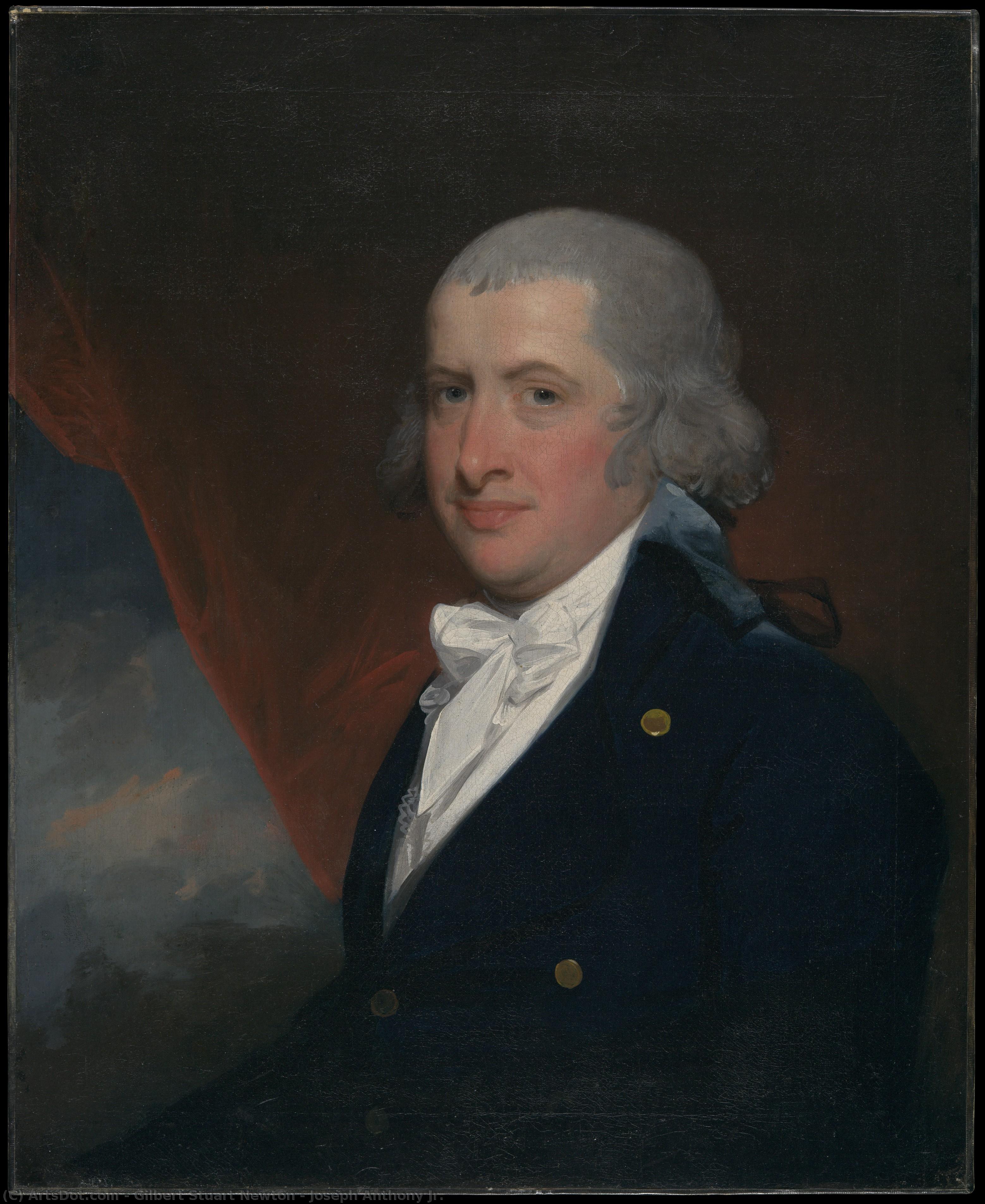
Gilbert Stuart Newton's "Joseph Anthony Jr." is more than just a portrait; it’s a carefully constructed tableau of 18th-century prosperity and quiet self-assurance. Painted in 1795, the artwork captures Joseph Anthony Jr., a native of Newport, Rhode Island, and a direct descendant of Gilbert Stuart, the renowned American portrait painter. Newton, apprenticed to his celebrated uncle, skillfully blends elements of English formal portraiture with a distinctly New England sensibility, creating an image that speaks volumes about its subject’s status and character.
The composition immediately draws the eye to Anthony's figure – a man radiating confidence despite a subtle air of thoughtful contemplation. He is depicted in a richly detailed suit of dark blue velvet, accented with gold embroidery, indicative of his family’s wealth and standing within Newport society. His posture is upright, shoulders squared, conveying an impression of authority and self-possession. The carefully arranged bow tie and the precise cut of his jacket speak to meticulous attention to detail – a hallmark of Newton's artistic approach. The subtle hint of red in his waistcoat adds a touch of warmth and vitality to the otherwise formal attire.
A Window into Newport Society
To fully appreciate “Joseph Anthony Jr.”, it’s crucial to understand the context of 18th-century Newport. The city was a thriving center for trade, shipping, and finance, fueled by the lucrative transatlantic commerce with Britain and France. Families like the Anthony's amassed considerable fortunes through maritime ventures, establishing themselves as prominent figures in the community. Newton’s portrait isn’t merely a likeness; it’s a visual representation of this social hierarchy and the values associated with it – respectability, industry, and familial lineage.
The background subtly reinforces this setting. The red curtains, reminiscent of a gentleman's drawing room, suggest an environment of refinement and leisure. While not explicitly depicted, one can almost imagine the sounds of conversation and music emanating from within, creating a sense of domestic comfort and social engagement. Newton’s use of light is masterful, illuminating Anthony’s face while casting gentle shadows that add depth and dimension to the scene.
Technique and Artistic Style
Newton's style leans heavily toward English portraiture, particularly the work of Thomas Gainsborough and Sir Godfrey Kneller. He employs a meticulous technique, evident in the incredibly detailed rendering of Anthony’s clothing, the subtle play of light and shadow, and the precise brushstrokes that define every feature. The artist skillfully utilizes chiaroscuro – the dramatic contrast between light and dark – to sculpt Anthony's form and create a sense of three-dimensionality.
The painting is executed in oil on canvas, a medium favored by Newton for its ability to capture subtle nuances of color and texture. Newton’s attention to detail extends beyond mere representation; he imbues the portrait with a palpable sense of personality. Anthony's gaze, direct and unwavering, invites the viewer into his world, suggesting an intelligence and quiet dignity.
Symbolism and Emotional Resonance
Beyond its surface appearance, “Joseph Anthony Jr.” is rich in symbolism. The man’s confident posture and carefully chosen attire represent a desire for social acceptance and recognition within Newport society. The subtle smile hints at contentment and self-satisfaction – a reflection of his family's success and his own position within it. Newton masterfully captures not just a likeness, but the essence of a man defined by his heritage and accomplishments.
Ultimately, “Joseph Anthony Jr.” is a testament to Newton’s skill as an artist and his ability to capture the spirit of a bygone era. It offers a captivating glimpse into the world of 18th-century Newport, inviting viewers to contemplate the values, aspirations, and social dynamics that shaped this vibrant community.
Biografie umělce
Gilbert Stuart Newton: Life & Legacy
Early Life and Family Background
- Birth and Origins: Gilbert Stuart Newton was born on September 2, 1795, in Halifax, Nova Scotia. He was the youngest of twelve children.
- Family Connections: His father, Henry Newton, was a customs official, and his mother, Ann, held a significant artistic lineage – she was the daughter of Gilbert Stuart, the renowned American portrait painter.
- Early Years & Return to America: The family initially resided in Boston but returned to Charlestown near Boston in 1803 following his father’s death.
Artistic Training and Influences
- Initial Path & Uncle's Guidance: Though initially intended for a commercial career, Newton was apprenticed to his uncle, Gilbert Stuart, marking the beginning of his artistic journey.
- European Studies: He traveled to Europe with an elder brother and studied painting in Florence. Later visits to Paris (1817) introduced him to artists like Charles Robert Leslie, Washington Allston, and David Wilkie.
- Royal Academy & Formal Training: Newton continued his education at the Royal Academy in London after a period spent in the Netherlands.
Artistic Style and Major Themes
- Romantic Sensibilities: Newton’s work is generally categorized within the Romantic movement, characterized by emotional intensity and dramatic narratives.
- Literary & Poetic Inspirations: He became particularly known for paintings inspired by literature and poetry. Subjects drawn from works like *Don Quixote* and Shakespeare were prominent in his oeuvre.
- Portraiture & Genre Scenes: While he painted portraits, including those of notable figures such as Washington Irving, Newton also excelled in genre scenes depicting moments from literary narratives.
Key Achievements and Recognition
- Royal Academy Affiliation: Newton was elected an Honorary Academician of the National Academy of Design (1827), an Associate of the Royal Academy (1829), and a full Academician in 1832.
- Exhibitions & Patronage: He regularly exhibited at the Royal Academy from 1818 onwards, gaining recognition and attracting patrons like the Marquis of Lansdowne.
- Public Collections: His works found their way into prominent public collections, including the National Gallery and the South Kensington Museum (now V&A).
Later Life and Legacy
- Mental Health & Final Years: Shortly after his election to the Royal Academy, Newton began to suffer from mental illness. He was admitted to an asylum at Chelsea where he continued to paint until his death on August 5, 1835.
- Burial Site: He is buried in St Mary’s Church Wimbledon, London.
- Historical Significance: Though overshadowed by his uncle Gilbert Stuart, Newton carved a niche for himself as a skilled and imaginative artist of the Romantic period. His literary-inspired paintings offer insights into the cultural tastes and artistic trends of 19th-century Britain.

gilbert stuart newton
1795 - 1835
Rychlé fakta
- Birth_Date: 1795
- Birth_Place: Halifax, Nova Scotia
- Death_Date: 1835
- Influenced_By: Gilbert Stuart (uncle)
- Movement: Romanticism
- Name: Gilbert Stuart Newton
- Nationality: British
- Notable_Works:
- Don Quixote in his Study
- Captain Macheath upbraided by Polly and Lucy
- Yorick and the Grisette
- The Window or the Dutch Girl
- Portia and Bassanio
Související články
The Digital Portrait Renaissance: Transforming Personal Photography into Timeless Oil Paintings Through Artistic Reproduction
Transform your cherished photos into timeless oil paintings with OriginalUniqueArt's expert artists. Museum-quality reproductions & custom portraits, crafted to last a lifetime. Discover the art of personal legacy.

Sir Anthony van Dyck: Courtly Portraiture & the Shaping of Baroque Identity
Explore the life & legacy of Sir Anthony van Dyck, the leading court painter of his era. Discover his innovative portraiture, Baroque masterpieces, and investment potential for discerning collectors. Learn more at OriginalUniqueArt.
Portrét jako Dědictví: Zachyťte Rodinnou Historii v Umění na Míru
Zachovejte rodinnou historii v umění! OriginalUniqueArt vytváří ručně malované portréty na míru z fotografií s garancí kvality a trvalé hodnoty. Vytvořte si jedinečné dědictví pro budoucí generace.

Často kladené otázky: Rodinné portréty – Průvodce pro náročné sběratele od
nabízí exkluzivní rodinné portréty na zakázku pro náročné sběratele. Ručně malované olejomalby, reprodukce a personalizované umění s garancí kvality a odborným poradenstvím.
Olejomalba versus Tisk: Proč Ručně Malované Plátno Zůstává Nadčasovou Investicí a Uměleckou Hodnotou
OriginalUniqueArt nabízí ručně malované olejomalby a reprodukce obrazů nejvyšší kvality. Investujte do umění, které vydrží – portréty na zakázku, mistrovská díla pro váš domov s garancí spokojenosti.

