Přepnout na tisk
 Zobrazit více







































 U děl nebo reprodukcí, u nichž je jakákoliv strana větší než 105 cm (přibližně 41 palců), bude rám dodán jako sestava v rozloženém stavu. Tato metoda zajišťuje bezpečné doručení a chrání dílo před poškozením během přepravy.


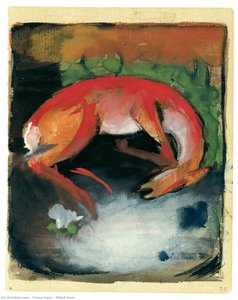
A Symphony of Color and Spirit: The Essence of Franz Marc’s “The Fox”
To step into the world of Franz Marc is to abandon the mundane surface of reality and descend into a realm where color breathes, vibrates, and speaks the language of the soul. His 1913 masterpiece, “The Fox,” stands as a cornerstone of German Expressionism—a movement that sought to express inner emotions and spiritual truths rather than merely depicting the external world. More than just a visual representation of an animal, this painting is a profound meditation on life’s fundamental forces, rendered with remarkable precision and imbued with a palpable sense of urgency. Marc’s artistic vision wasn’t simply about capturing form; he aimed to distill essence, to convey a feeling—a primal instinct—that resonated deeply within the very fabric of his being.
The painting presents a striking, cubist-inspired composition where the fox is not depicted as a unified entity, but rather as a series of interlocking shapes. Influenced by the revolutionary techniques of Picasso and Braque, Marc utilizes fragmented reality to present multiple perspectives simultaneously. The fox appears as a dynamic arrangement of reds and yellows that overlap and intersect, creating an illusion of depth and movement. This fragmentation is far from arbitrary; it reflects Marc’s belief that true understanding comes from perceiving reality in its totality, acknowledging the complex layers hidden beneath surface appearances. By avoiding smooth contours and favoring angular, energetic lines, the artist ensures that the viewer's eye is constantly in motion, mirroring the restless energy of the natural world.
The Symbolic Language of Color and Form
In “The Fox,” color serves as the primary vehicle for emotion. The dominant palette—primarily crimson red and ochre yellow—is crucial to interpreting the work's spiritual depth. For Marc, colors were not merely pigments but symbols of cosmic truths. Red, according to his spiritual convictions, symbolizes vitality, passion, and the life force itself. This is juxtaposed against the yellow, which embodies optimism and enlightenment. This chromatic tension creates a visual heartbeat within the piece, drawing the viewer into a state of heightened awareness. The presence of unexpected elements, such as the two apples and the clock positioned in the upper corner, adds a layer of surrealist intrigue, suggesting a dialogue between the organic rhythm of nature and the structured passage of human time.
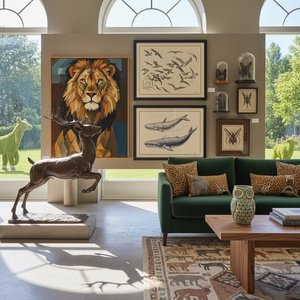
For collectors and interior designers, this artwork offers a profound sense of character and intellectual depth. It is a piece that does not merely decorate a space but transforms it, acting as a window into the early 20th-century quest for spiritual purity. The striking contrast of the red fox against its geometric surroundings makes it a commanding focal point in any sophisticated setting, whether it be a modern gallery-style living room or a curated study. Owning a high-quality reproduction of this work allows one to invite the transformative power of German Expressionism into their home, providing a daily encounter with the vibrant, pulsing energy of Marc’s visionary universe.
Otázky a odpovědi
Patří dílo „The Fox“ mezi slavná děl směru Cubist Expressionism?
Dílo "The Fox" je v katalogu hodnoceno jako Iconic mezi díly z období Cubist Expressionism.
Jakým způsobem se styl díla "The Fox" vztahuje k době svého tvůrce?
Dílo „The Fox“ od Franz Marc patří k享有 směrům Cubist Expressionism, které charakterizovaly éru Modernismus svého autora.
Kdo vytvořil "The Fox"?
Dílo "The Fox" vytvořil/a Franz Marc. Informace na této stránce popisují originální dílo umělce Franz Marc.
 Náhled v interiéru
 Sdílet
 Sdílet
 Podrobnosti o díle
 Průvodce

 Stáhnout
 Podobné položky
 Rentgenové snímky
 Slideshow
 Q&A
Q&A Statistiky