
 Náhled v interiéru
 Sdílet
 Sdílet
 Podrobnosti o díle
 Průvodce

 Stáhnout
 Podobné položky
 Rentgenové snímky
 Slideshow
 Q&A
Q&A Statistiky
Putto Picking Grapes

- 49.0 x 64.0 cm


 Zobrazit více
Giclée / Umělecký tisk
Giclée nebo plátěný tisk muzeální kvality s rychlou výrobou a širokou nabídkou povrchových úprav. ( Koupit ručně malovaný obraz Přepnout na digitální obraz)




P118B Kč10

P118H Kč10

P118W Kč10

P438Z Kč10

P508JH Kč12

P508YH Kč12

P805H Kč10

P805Z Kč10

P919BZ Kč10

P919G Kč10

P919XJ Kč10

P959ZH Kč10

P968JZ Kč12

W106C Kč8

W218G Kč10

W218JH Kč8

W218Y Kč10

W307PJ Kč10

W316G Kč10

W316PJ Kč8

W316Y Kč10

W398PJ Kč8

W4111J Kč10

W500HY Kč15

W500JH Kč15

W692G Kč12

W849H Kč8

W940BG Kč15

W953PJ Kč8




Vyberte si z našich přednastavených velikostí, které odpovídají původním proporcím díla.

Zadejte šířku a výšku, které potřebujete pro váš rám nebo stěnu. Tisk lze pouze oříznout, nikdy však nelze zvětšit obraz nad jeho původní rozměr, proto při výběru jiného formátu dochází ke ztrátě části obrazu. Před samotným tiskem vám zašleme digitální náhled k schválení. Obraz zobrazený na této stránce nenabízí skutečný výřez — ten uvidíte pouze v náhledu.
Celosvětové doručení () do 2 týdnů namísto standardních 4/5 týdnů. (2 listopad)

Zdarma celosvětová expresní doprava

Vysoce kvalitní lněné plátno

Kompletní pojištění přepravy

Záruka vrácení celního poplatku

Záruka věrného barevného souladu

100dení lhůta pro vrácení zboží (pouze při vadách výroby)

100% záruka vrácení peněz

Sleva při více objednávkách
 Skleněná varianta je dostupná pouze u rozměrů menších než 110 cm

Putto Picking Grapes
Giclée / Umělecký tisk
Rozměry reprodukce
-


Celková cena za vybrané možnosti reprodukcí
Kč 1737
Bernardino Luini’s “Putto Picking Grapes”: A Symphony of Grace and Renaissance Reverie
Bernardino Luini's "Putto Picking Grapes," painted around 1523, isn’t merely a depiction of a young boy gathering fruit; it’s a profound meditation on childhood innocence, the bounty of nature, and the enduring legacy of Leonardo da Vinci. This exquisite panel painting, now housed within the Pinacoteca di Brera in Milan, offers a glimpse into the heart of the High Renaissance, revealing Luini's unique artistic vision and his deep connection to the master who profoundly shaped his style.
Luini’s distinctive “Luinesque” aesthetic—characterized by elongated figures, gentle expressions, and an almost dreamlike quality—is immediately apparent. The central figure, a young boy with a serene countenance, is bathed in soft light that seems to emanate from within the painting itself. His posture is relaxed yet attentive, his gaze fixed on the grapes he delicately gathers from a vine. The artist masterfully employs sfumato – Leonardo’s signature technique of blurring lines and softening edges – creating an atmosphere of hazy beauty and imbuing the scene with a sense of ethereal tranquility. Notice how the details are rendered with remarkable precision, yet never feel overly realistic; Luini prioritizes capturing the *essence* of the moment over photographic accuracy.
A Dialogue with Leonardo: Influences and Techniques
Luini’s artistic journey is inextricably linked to that of Leonardo da Vinci. While the precise nature of their collaboration remains debated, it's widely accepted that Luini spent several formative years working directly under the master in Milan. This apprenticeship instilled within him a deep appreciation for Leonardo’s innovative techniques and his profound understanding of human anatomy and perspective. “Putto Picking Grapes” is a testament to this influence; observe how Luini subtly echoes Leonardo’s use of light and shadow, creating a sense of depth and volume that draws the viewer into the scene. The composition itself—a carefully balanced arrangement of figures and elements—demonstrates a clear debt to Leonardo's meticulous approach to design.
Furthermore, Luini’s work reflects the broader artistic trends of the era. The painting embodies the Renaissance ideal of *natura mortua* – the beauty of decay and the cyclical nature of life. The grapes themselves represent abundance, fertility, and the passage of time. The setting, a rustic vineyard bathed in golden light, evokes a sense of pastoral harmony—a refuge from the complexities and anxieties of urban life.
Symbolism and Emotional Resonance
Beyond its technical brilliance, “Putto Picking Grapes” is rich in symbolic meaning. The young boy embodies innocence, purity, and the promise of future growth. His simple act of gathering grapes becomes a metaphor for the acquisition of knowledge and wisdom—a fundamental theme of Renaissance humanism. The vine itself symbolizes life, connection, and the interconnectedness of all things. The overall mood is one of quiet contemplation and gentle joy, inviting the viewer to pause and appreciate the beauty of the natural world.
Interestingly, Luini’s work often features a subtle undercurrent of melancholy—a recognition that even in moments of idyllic beauty, time inevitably marches on. This poignant awareness adds another layer of depth to the painting's emotional resonance. It’s not simply a celebration of youth and abundance; it’s also a meditation on mortality and the fleeting nature of earthly pleasures.
A Timeless Masterpiece: Reproduction and Display
Reproductions of “Putto Picking Grapes” capture only a fraction of the painting's original allure. The delicate sfumato, the subtle nuances of color, and the profound sense of atmosphere are difficult to replicate fully. However, high-quality reproductions offer an accessible way to experience Luini’s genius and bring this timeless masterpiece into your home or office.
When selecting a reproduction, consider the materials used—a fine art print on archival paper will ensure that the colors remain vibrant for generations to come. Furthermore, think about the framing – a simple, elegant frame will allow the painting’s beauty to shine through without distracting from its inherent charm. “Putto Picking Grapes” is more than just a decorative image; it's a window into the soul of the Renaissance—a testament to the enduring power of art to inspire and uplift.
Otázky a odpovědi
Jsou barvy díla „Putto Picking Grapes“ od Bernardino Luini živé, nebo tlumené?
Dílo „Putto Picking Grapes“ od Bernardino Luini je zachyceno s Clear Color Presence saturací a Vivid intenzitou.
V jakém roce a v rámci kterého uměleckého směru bylo dílo "Putto Picking Grapes" vytvořeno?
Dílo "Putto Picking Grapes" vzniklo v roce 1523 v rámci směru Northern Renaissance.
Mohu využít rozšířenou realitu k tomu, abych si prohlédl(a) „Putto Picking Grapes“ od Bernardino Luini ve své místnosti?
Dílo „Putto Picking Grapes“ od Bernardino Luini si můžete prohlédnout přímo na své vlastní stěně díky stránce Náhled v rozšířené realitě s využitím rozšířené reality na kompatibilním zařízení.
Biografie umělce
A Lombard Luminary: The Life and Art of Bernardino Luini
Bernardino Luini, a name resonating softly within the annals of Italian Renaissance painting, emerged from the picturesque region surrounding Lake Maggiore around 1480. Born in Runo, a small *frazione* near Dumenza, his early life remains shrouded in some mystery, yet it’s clear that destiny propelled him towards Milan, the vibrant artistic heartland of northern Italy. By 1500, he had relocated with his father, poised to absorb the burgeoning creative energy of the city. While accounts vary regarding his initial training—some credit Giovan Stefano Scotto, others Ambrogio Bergognone—a more profound influence was undoubtedly on the horizon: Leonardo da Vinci. The precise nature of their relationship remains debated, but it’s widely believed Luini worked directly under the master, a formative experience that would indelibly shape his artistic trajectory. This apprenticeship wasn't merely technical; it was an immersion into a world of subtle observation, innovative composition, and the elusive quality known as *sfumato*, which Luini would skillfully integrate into his own unique style.The Embrace of Leonardo and the Birth of a Style
Luini’s artistic development wasn’t simply imitation; it was a sensitive assimilation of Leonardo’s techniques filtered through his own Lombard sensibility. He didn’t strive to replicate Da Vinci’s intellectual rigor or anatomical precision, but rather embraced the softer, more lyrical aspects of his style. This is particularly evident in his depictions of women—graceful figures with elongated eyes, often described as “Luinesque” by the discerning eye of Vladimir Nabokov. These captivating gazes possess a gentle melancholy, an inwardness that invites contemplation. Early works like the *Adoration of the Magi* (c. 1505) in San Pietro, Luino, already hint at this emerging style, showcasing a delicate handling of light and shadow and a growing mastery of composition. His frescoes for the Oratory of Santa Maria Nuova in Pilastrello and the subsequent commissions throughout Milan solidified his reputation as a leading artist of the region. The influence of Bernardino Zenale’s *Cantù Polyptych* is also visible in works like *St. Anthony of Padua* (1510s), demonstrating Luini's ability to synthesize diverse influences into a cohesive artistic vision.Frescoes, Palaces, and the Flourishing of Creativity
The first two decades of the 16th century witnessed a period of intense creative activity for Luini. He wasn’t confined to religious subjects; his talents were sought after for secular commissions as well. The frescoes he created between 1509 and 1514 for Villa Pelucca in Sesto San Giovanni stand as a testament to his versatility, depicting mythological scenes with a refined elegance that graced the walls of this aristocratic residence. These works, now housed in Milan’s Pinacoteca di Brera, reveal a painter equally adept at capturing the dynamism of classical narratives and the intimate beauty of human form. He continued to receive prestigious commissions, adorning churches and palaces throughout Lombardy with his distinctive style. His ability to imbue even grand-scale frescoes with an air of intimacy and emotional resonance cemented his position as one of the most sought-after artists of his time.Notable Works and Artistic Techniques
Luini’s oeuvre is characterized by a remarkable consistency in style, despite the diversity of commissions he received. His *Adoration of the Magi* (c. 1505) exemplifies his early mastery of composition and use of *sfumato*, while the frescoes in San Pietro, Luino, demonstrate his ability to create atmospheric depth and evoke a sense of solemnity. The *St. Anthony of Padua* (1510s), a cornerstone of his artistic legacy, showcases his signature elongated figures and subtle rendering of drapery. Luini’s work is particularly notable for its use of muted colors—earth tones, ochres, and browns—which contribute to the overall sense of serenity and introspection. He skillfully employed *chiaroscuro*, creating dramatic contrasts between light and shadow that heighten the emotional impact of his scenes. His meticulous attention to detail, combined with a profound understanding of human psychology, resulted in paintings that are both visually stunning and deeply moving.Legacy and Enduring Appeal
Bernardino Luini passed away in Milan in June 1532, leaving behind a legacy that extended beyond his own lifetime. His son, Aurelio, followed in his footsteps, continuing the family’s artistic tradition. However, it is Bernardino who remains the more celebrated figure, remembered for his graceful figures, delicate *sfumato*, and the uniquely captivating quality of his “Luinesque” women. His work served as an inspiration to subsequent generations of artists, influencing the development of Lombard painting and contributing to the broader currents of Italian Renaissance art. Today, Luini’s masterpieces can be found in museums and churches throughout Italy—the Pinacoteca di Brera being a particularly rich repository of his works. His paintings continue to enchant viewers with their beauty, grace, and enduring emotional power, offering a glimpse into the artistic sensibilities of a bygone era. Salome with the Head of John the Baptist, for example, continues to captivate audiences with its dramatic intensity and masterful execution, while Holy Family with Saints Anne and John the Baptist exemplifies his serene and harmonious compositions.
Bernardino Luini
1480 - 1532 , Itálie
Rychlé informace o umělci
- Artistic Movement Or Style: Renesanční, Mannerismus
- Artists Or Movements Influenced By This Artist: ['Luineský styl']
- Artists Who Influenced This Artist: ['Leonardo da Vinci']
- Date Of Birth: c. 1480
- Date Of Death: 1532
- Full Name: Bernardino Luini
- Nationality: Italanský
- Notable Artworks:
- Adorace Magů
- Sv. Antonín Paduánský
- Fresky Villa Pelucca
- Place Of Birth: Reno, Itálie
Související články

The Enduring Legacy of Fresco: Technique, History & Artistic Expression
Explore the rich history & enduring artistry of fresco painting. Discover techniques from Giotto to Michelangelo, conservation efforts, & modern applications. Learn how OriginalUniqueArt brings this timeless art form to your home.

The Enduring Legacy of Fresco: Technique, History & Artistic Expression Across Cultures
Explore the rich history & enduring legacy of fresco painting! Discover ancient techniques, Giotto's masterpieces, and modern applications. Expert insights for art lovers & professionals.

Leonardo da Vinci: Top 25 mistrovských děl pro váš domov | OriginalUniqueArt.cz
Prozkoumejte 25 ikonických děl Leonarda da Vinciho – od slavné Mona Lisy po Poslední večeři. Objevte renesanční umění, techniky a inspirativní příběhy za mistrovskými díly. Kvalitní reprodukce obrazů pro váš interiér na OriginalUniqueArt.cz

Freska jako rodinné dědictví: Zachovejte svůj původ v obrazech na stěnách
Objevte sílu fresek pro uchování rodinné historie! Kvalitní reprodukce a zakázková malba od . Inspirujte se historií umění a vytvořte jedinečný obraz vašeho původu.
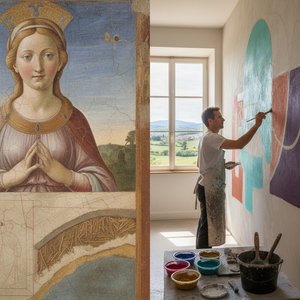
The Enduring Legacy of Fresco Painting: Techniques, History & Contemporary Relevance
Explore the rich history & enduring artistry of fresco painting – from Giotto to Michelangelo! Discover techniques, conservation efforts, & modern applications. Learn how OriginalUniqueArt brings this timeless art form to your home.

