 Náhled v interiéru
 Sdílet
 Sdílet
 Podrobnosti o díle
 Průvodce

 Stáhnout
 Podobné položky
 Rentgenové snímky
 Slideshow
 Otázky a odpovědi
 Statistiky
Crucifixion

- 29.0 x 21.0 cm


 Zobrazit více
Získejte soubor připravený k tisku, který svou kvalitou výrazně převyšuje webový náhled. Každý prodávaný digitální obraz pochází z vysokorozlišeného originálu v naší databázi – obvykle o šířce 5 000 až 15 000 pixelů – díky čemuž můžete tisknout ve velkém formátu, provádět těsný střih nebo si s jistotou užít i ty nejjemnější detaily.
Žádný soubor neopustí naše studio bez úprav. Digitální expert kontroluje barvy v porovnání s původním malířským dílem a v případě potřeby je upravuje, poté pomocí profesionálních nástrojů pro retuš zvyšuje ostrost a detailnost — přičemž vždy zůstává věrný tahům štětcem a stylu umělce. Výsledkem je obraz, který vypadá jako malba, nikoliv jako naskenovaný snímek s filtrem.
Schvalování před dokončením: náš expert vám do 72 hodin zašle obraz e-mailem k revizi. Nejsste spokojeni? Můžete požádat o úpravy či opravy, nebo si můžete vyžádat vrácení peněz, pokud kvalita neodpovídá vašim očekáváním.
Tuto kvalitu využívají vydavatelství, designová studia, galerie i tiskárny.
Digitální obrazy
Stáhněte si soubor ve vysokém rozlišení pro osobní prohlížení, tisk nebo kreativní projekty. ( Přepnout na tisk Koupit ručně malovaný obraz)
Součást každé objednávky digitálního obrazu
Profesionální digitální doručení, zaručené
Když si vyberete OriginalUniqueArt.com, nezískáváte pouze obrázek – získáváte digitální umělecké dílo s profesionálně vylepšenými detaily, zpracované s precizností a podpořené zárukou za spokojenost. Zde je vše, co vaše objednávka automaticky obsahuje:

Rychlé doručení e-mailem
Váš digitální obraz ve vysokém rozlišení vám bude zaslán e-mailem do 72 hodin od objednávky – připraven k okamžitému použití.

Digitální soubor s využitím AI
Vaše umělecké dílo je profesionálně optimalizováno pomocí pokročilých nástrojů umělé inteligence a manuální úpravy, což zajišťuje maximální úroveň detailu, ostrosti a přesnosti barev.

Doživotní bezplatné znovuodeslání digitálních obrazů
Soubor jste omylem smazali nebo ztratili? Žádný problém – kdykoliv vám ho znovu zašleme zcela zdarma.

Bez poplatků za dovoz – navždy
Užijte si své umělecké dílo okamžitě bez celních poplatků, daní nebo nákladů na dopravu – digitální stažení je vždy bez daňových povinností.

Záruka přesnosti barev
Díky profesionálním nástrojům a správě barev zajišťujeme, aby váš digitální obraz odrážel původní barvy co nejvěrněji.

100dená záruka spokojenosti
Pokud nebudete s digitálním obrázkem spokojeni, provedeme jeho revizi nebo vám vrátíme 100% platby do 100 dnů – bez jakýchkoliv dotazů.

100% záruka vrácení peněz
Nespokojeni? Získejte plnou náhradu peněz do 100 dnů od obdržení digitálního souboru – bez zbytečných dotazů.

Slevy při hromadných objednávkách
Koupě 3 obrazů ušetří 10% – Koupě 5 obrazů ušetří 15% – Koupě 10+ obrazů ušetří 20%. Ideální pro kreativní projekty, galerie a agentury.
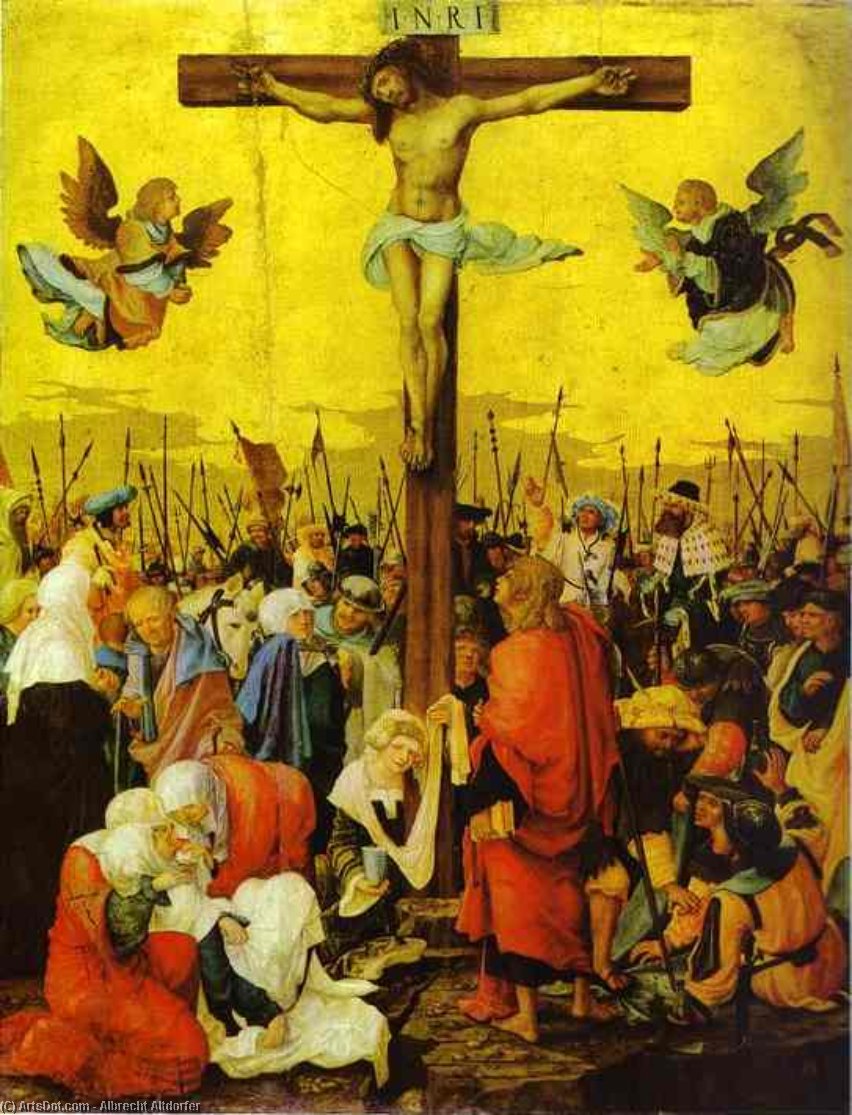
The Weight of Sorrow: Albrecht Altdorfer’s “Crucifixion”
Albrecht Altdorfer's "Crucifixion," painted in 1526, isn’t merely a depiction of a pivotal religious event; it’s a visceral experience. Emerging from the burgeoning German Renaissance, Altdorfer wasn’t simply replicating biblical narratives; he was forging a new visual language, one deeply rooted in the natural world yet imbued with profound spiritual intensity. This particular rendition transcends simple illustration, becoming a landscape saturated with grief and a haunting meditation on sacrifice. The painting immediately commands attention not through grand scale – it's remarkably intimate, measuring just 29 x 21 cm – but through its masterful manipulation of light, color, and composition to evoke an overwhelming sense of sorrow.
The scene unfolds against a dramatically rendered landscape—a brooding, almost primeval forest. The trees, rendered in thick, layered brushstrokes of deep greens, browns, and purples, seem to writhe with the weight of the event. This isn’t a picturesque vista; it's a wilderness imbued with an unsettling energy. Altdorfer deliberately eschews traditional depictions of serene backgrounds, instead presenting a landscape actively participating in the drama. The distant mountains, shrouded in mist and shadow, amplify the feeling of isolation and despair. Notice how the artist uses atmospheric perspective – lighter hues for objects further away – to create a sense of depth and distance, drawing the viewer’s eye into the heart of the scene.
A Pioneer of Landscape
Albrecht Altdorfer stands as a pivotal figure in art history, largely credited with establishing landscape painting as an independent artistic subject within Europe. Prior to his work, landscapes were typically relegated to mere backgrounds for religious or mythological scenes. However, Altdorfer recognized the power of the natural world to convey emotion and meaning. His meticulous observation of nature—evident in the detailed rendering of foliage, rocks, and atmospheric conditions—transformed the landscape from a passive backdrop into an active participant in the narrative. This shift was revolutionary, paving the way for later generations of landscape artists like Albert Bierstadt and Frederic Church.
His background as a town architect and council member further informs his artistic approach. Altdorfer possessed a keen eye for spatial relationships and a deep understanding of how to create a sense of harmony and balance within a composition. This skill is brilliantly demonstrated in “Crucifixion,” where the human figure—Jesus—is carefully positioned within the landscape, creating a dynamic interplay between the earthly realm and the divine.
Symbolism and Emotional Resonance
Beyond its technical brilliance, "Crucifixion" resonates deeply with viewers through its potent symbolism. The stark simplicity of Jesus’s pose – arms outstretched, head bowed – is profoundly moving. Altdorfer avoids any overtly dramatic or theatrical elements, opting instead for a quiet, understated portrayal of suffering. The figures surrounding the cross—angels and soldiers—are rendered in muted tones, emphasizing the central tragedy. Even the light itself seems to weep, casting long shadows across the landscape.
The choice of a dark, foreboding forest as the setting is particularly significant. Forests have historically been associated with death, mourning, and the unknown. In this context, it serves as a powerful metaphor for the spiritual darkness surrounding Jesus’s sacrifice. The painting isn't simply depicting an event; it’s exploring the profound emotional consequences of that event—the grief, despair, and sense of loss experienced by those who witnessed it.
A Timeless Masterpiece
“Crucifixion” is more than just a religious painting; it’s a testament to Altdorfer's artistic genius and his ability to capture the essence of human emotion. The meticulous detail, masterful use of color and light, and profound symbolism combine to create an unforgettable image that continues to resonate with viewers centuries after its creation. Reproductions, like this one, offer a remarkable opportunity to experience the power and beauty of this iconic work, bringing its haunting message into our own spaces.
Otázky a odpovědi
Kde si mohu koupit print díla „Crucifixion“ od Albrecht Altdorfer?
Tisk díla „Crucifixion“ od Albrecht Altdorfer si můžete objednat přímo na jeho stránce Kvalitní umělecký tisk: umělecký tisk na bavlněném plátně nebo archivním plátnovém papíře.
Kolik lidí si prohlíží „Crucifixion"?
Statistiky k dílu „Crucifixion“ od Albrecht Altdorfer naleznete na stránce Statistiky tohoto díla: měsíční návštěvnost díla, návštěvnost děl daného umělce a rozpis nedávných návštěvníků podle zemí a jazyků.
Jak intenzivní jsou barvy v díle „Crucifixion“ od Albrecht Altdorfer?
Intenzita barev díla „Crucifixion“ je Vivid. Tato hodnota vyjadřuje, jak výrazné barvy působí.
Biografie umělce
Albrecht Altdorfer: A Pioneer of German Renaissance Landscape
Albrecht Altdorfer, born around 1480 in the vibrant city of Altdorf bei Nürnberg – later known as Regensburg – stands as a truly remarkable figure bridging the late Gothic and burgeoning German Renaissance. He wasn’t merely an artist *of* his time; he fundamentally reshaped its artistic trajectory, most notably through his revolutionary approach to landscape painting. Emerging from a family steeped in artistic tradition—his father, Ulrich Altdorfer, was himself a painter and miniaturist—Altdorfer quickly distinguished himself not as a follower of established styles, but as an independent innovator, forging a path uniquely his own. Regensburg, strategically positioned on the banks of the Danube River, provided him with a stimulating environment – a crossroads of trade, culture, and artistic exchange – that profoundly shaped his sensibilities and fueled his creative vision. Beyond his artistic pursuits, Altdorfer was a man deeply involved in civic life, serving as both town architect and a respected member of the city council; this multifaceted role reflected his versatility and engagement with the world around him. His legacy rests not just on the beauty of his paintings, but on the seismic shift he instigated within the very concept of landscape representation.The Danube School and a Revolutionary Vision
Altdorfer’s place in art history is inextricably linked to the Danube School, an influential group of artists active primarily during the early 16th century in southern Germany. This collective shared a profound fascination with exploring the expressive potential of landscape, elevating it from its traditional role as mere background or setting to become a subject worthy of independent contemplation and artistic treatment. Prior to Altdorfer’s arrival on the scene, landscapes were largely relegated to serving as props within religious narratives or historical scenes – providing context rather than demanding attention. Altdorfer dared to challenge this convention, asserting that nature itself possessed intrinsic value and could be depicted with emotional depth and significance. A pivotal moment in his artistic development occurred around 1511 when he embarked on a transformative journey down the Danube River and into the rugged peaks of the Alps. The dramatic vistas – the towering mountains, the dense forests, the swirling mists – ignited within him an intense passion for capturing the *experience* of being immersed in these landscapes, not simply their visual appearance. This marked a decisive break from traditional approaches; Altdorfer became, arguably, one of the first true landscape painters, prioritizing the conveyance of feeling and atmosphere over strict topographical accuracy. His work, exemplified by pieces like “The Large Spruce,” demonstrates this shift – offering a serene and intricately detailed depiction of nature’s beauty imbued with an almost palpable sense of tranquility.Masterpieces and Artistic Influences
Throughout his career, Altdorfer produced a remarkably diverse body of work encompassing paintings, engravings, drawings, and architectural designs. Among the most celebrated achievements of his oeuvre is *The Battle of Alexander at Issus* (1529), commissioned by Duke William IV of Bavaria – a monumental painting that showcases not only his exceptional technical skill and compositional mastery but also his innovative use of landscape to heighten the dramatic tension of the battle itself. The swirling clouds, jagged mountain ranges, and chaotic melee of soldiers create an overwhelming sense of energy and spectacle, drawing the viewer directly into the heart of the conflict. His collaboration with Emperor Maximilian I in Innsbruck from 1513 further broadened his artistic horizons, providing opportunities to undertake large-scale projects that showcased his versatility and ambition. Altdorfer’s artistic style wasn't born in a vacuum; he was deeply influenced by a confluence of artistic currents. The poetic lyricism of Italian Renaissance masters like Giorgione, the expressive figures of Lucas Cranach the Elder, and the meticulous detail evident in the works of Albrecht Dürer all left their indelible mark on his art. However, Altdorfer skillfully synthesized these diverse influences into a uniquely personal vision – characterized by its intense emotionality, dramatic use of light and shadow, and evocative depictions of nature. His engravings, such as “Mucius Scaevola Burning His Hand,” demonstrate his exceptional skill in this medium, revealing delicate lines and intricate details that convey a sense of movement and drama.Legacy and Lasting Impact
Albrecht Altdorfer’s artistic legacy extends far beyond the 55 panels, 120 drawings, and numerous engravings he created during his lifetime. He fundamentally altered the way artists approached landscape painting, paving the way for future generations to explore its expressive possibilities. His influence can be seen in the works of later German Romantic painters who similarly sought to capture the sublime beauty and emotional power of nature. Today, Altdorfer’s art is proudly displayed in major museum collections across Europe – including the Museum Ostdeutsche Galerie in Germany (where his *Madonna (Beautiful Maria of Regensburg)* resides) and the Kunstsammlungen und Museen Augsburg in Austria – ensuring that his groundbreaking contributions to the history of art continue to be appreciated and studied. His innovative spirit, technical skill, and profound connection to the natural world cemented his position as a towering figure of the German Renaissance—a true pioneer who dared to see landscape not merely as scenery but as a powerful force capable of evoking deep emotion and spiritual meaning. His work stands as a testament to the enduring power of art to transform our perception of the world around us, a legacy that resonates powerfully with audiences even centuries after his death in 1538.Exploring Altdorfer’s Diverse Works
Beyond his iconic landscapes and battle scenes, Altdorfer's artistic range encompassed religious subjects, mythological narratives, and even architectural designs. His depictions of biblical stories, such as “Abraham’s Sacrifice,” are imbued with a dramatic intensity and emotional depth that set them apart from earlier interpretations. He wasn’t simply illustrating scripture; he was exploring the human condition through the lens of faith. His works often featured intimate scenes of religious figures – Christ taking leave of his mother, for example – conveying profound emotions and spiritual contemplation. His engravings frequently depicted mythological subjects, showcasing his ability to combine classical themes with a distinctly German sensibility. Furthermore, as town architect of Regensburg, Altdorfer contributed significantly to the city’s fortifications and urban planning, demonstrating his versatility and engagement with practical matters alongside his artistic pursuits. His ability to seamlessly blend technical skill with emotional depth solidified his position as a leading artist of the Renaissance. Altdorfer's work continues to be studied and admired for its innovative approach to landscape painting and its profound exploration of human emotion.
Albrecht Altdorfer
1480 - 1538 , Německo
Stručné informace
- Artistic Movement Or Style: Podunajská škola
- Artists Or Movements Influenced By This Artist: ['Německý romantismus']
- Artists Who Influenced This Artist:
- Albrecht Dürer
- Lucas Cranach
- Date Of Birth: c. 1480
- Date Of Death: 1538
- Full Name: Albrecht Altdorfer
- Nationality: Německý
- Notable Artworks:
- Bitva u Alex.
- Velký smrk
- Sv. Jiří
- Place Of Birth: Regensburg, Německo