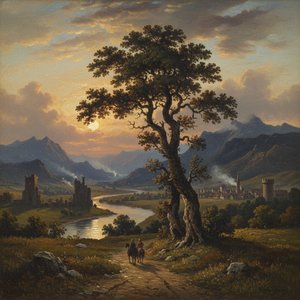
A Life Shaped by Stone and Canvas
Before he ever held a brush to capture the drama of human emotion, Pierre-Jules Jollivet walked the path of an architect. In those early years in Paris, his hands were more accustomed to the structural logic of buildings than the fluid strokes of oil. Under the guidance of Jacques-Marie Huvé and Auguste Famin, he learned the discipline of form and weight. Yet, a change of heart arrived in 1822, pulling him away from the rigid lines of architecture toward the expressive possibilities of painting. He entered the École des Beaux-arts de Paris, where the influence of Antoine-Jean Gros and François-Louis Dejuinne began to steer his vision toward historical and genre scenes.
This transition was not merely a change in medium but an expansion of his world. As he mastered the canvas, he also found himself drawn to the emerging magic of lithography. This fascination with printmaking eventually led him far from the familiar streets of Paris. In 1826, a mission to Spain took him to the Royal Palace of Madrid. There, amidst the shadows of the Spanish Royal collection, he worked on a catalog for King Ferdinand VII. The experience of documenting these works left an indelible mark on his soul. He returned to France with a palette deepened by the somber tones and gritty realism he had encountered in the works of masters like Diego Velázquez.
The Drama of History and the Spanish Influence
Upon settling back in Paris, Jollivet began to exhibit his findings, often presenting works that paid homage to his time in Spain. His early presentations were steeped in Spanish themes, reflecting a deep respect for the traditions he had studied in Madrid. The Salon recognized this talent early on; in 1833, he received a prize for his depiction of the Brigands of the Kingdom of Valencia. This period of his life was marked by an ability to blend the grand scale of history with the intimate tension of genre painting. His work often captured the raw spirit of resistance and the weight of historical moments.
His ambitions eventually led him to undertake monumental tasks for the Musée de l’Histoire de France. Under the direction of King Louis-Philippe I, he labored on large historical panels, including depictions of the Battle of Hooglede and Godefroy de Bouillon at the first assizes for the Kingdom of Jerusalem. These works required a command of narrative that could fill vast spaces with movement and significance. Even in his smaller etchings, such as those showing the Battle of Tourcoing, the sense of conflict and consequence remained central to his output.
Innovation and the Sacred
Beyond the grand narratives of war and history, Jollivet sought new ways to marry art with the physical world. He experimented with religious subjects, contributing to the decoration of several Parisian churches, including Saint-Ambroise and Saint-Vincent-de-Paul. In his work for Saint-Vincent-de-Paul, he utilized a highly unusual technique: painting on large slabs of Volvic lava. This method required him to adapt his brushwork to a rugged, volcanic surface, creating a texture that felt as ancient as the stone itself.
Not all his religious endeavors were met with quiet reverence. In 1844, while working on a tableau representing the Trinity, he produced a piece depicting Adam and Eve in Paradise. The inclusion of nudity caused such a scandal within the church that the work was removed from its position in 1861. It remained hidden from the public eye for decades, only being restored to its original place in 2011. This episode serves as a reminder of the tension between his artistic impulses and the social constraints of his era. Through it all, Jollivet remained a painter of deep conviction, moving between the delicate precision of lithography and the heavy, textured reality of stone.
Въпроси и отговори
Кои цветове използва най-често Pierre-Jules Jollivet?
Използването на цвят от Pierre-Jules Jollivet в произведенията, изброени в ето този уебсайт, може да бъде проучено на страницата за Палитра на генома на художника.
От коя държава е Pierre-Jules Jollivet?
Pierre-Jules Jollivet е роден в France.
Къде мога да видя творбите на Pierre-Jules Jollivet в 3D галерия?
3D галерия на Pierre-Jules Jollivet е страница, която представя творбите на художника в една виртуална триизмерна галерия.
Как да намеря творби на Pierre-Jules Jollivet по конкретна тема?
Работите на Pierre-Jules Jollivet могат да бъдат разгледани по ключови думи на страницата за произведения на Pierre-Jules Jollivet чрез По ключови думи. Всяка ключова дума групира съответните произведения на изкуството.