Преглед в реален мащаб
 Изпрати
 Сподели
 Детайли
 Ръководство

 Изтегляне
 Подобни артикули
 Рентгенова снимка
 Слайдшоу
 Статистика
Smooth Ascent


 Прочети повече
Ръчно изработена маслена репродукция
Ръчно рисувана маслена картина върху платно във вашия размер и рамка, изработена по поръчка от нашите художници. ( Превключване към принт Превключване към дигитално изображение)




P118B €10

P118H €10

P118W €10

P438Z €10

P508JH €12

P508YH €12

P805H €10

P805Z €10

P919BZ €10

P919G €10

P919XJ €10

P959ZH €10

P968JZ €12

W106C €8

W218G €10

W218JH €8

W218Y €10

W307PJ €10

W316G €10

W316PJ €8

W316Y €10

W398PJ €8

W4111J €10

W500HY €15

W500JH €15

W692G €12

W849H €8

W940BG €15

W953PJ €8




Изберете от нашите предварително зададени размери, които съответстват на оригиналните пропорции на произведението.

Въведете необходимата ширина и височина, за да паснат на вашата рамка или стена. Тъй като това е ръчна работа, при избор на размер с различен формат художникът може да нарисува малко повече около картината или да отреже малко от периферията — вие избирате. Преди да започне рисуването, ще ви изпратим дигитален мок업 за одобрение. Картината, показана на тази страница, не е реалният резултат — само мок업ът го показва.
След получаване на поръчка, екипът на OriginalUniqueArt.com ще изпрати имейл до клиента с инструкции и ще предостави примерен макет за преглед
Доставка по целия свят () в рамките на 3-4 седмици вместо стандартните 5 седмици. (28 Октомври). Без компромис с качеството.

Безплатна експресна доставка по целия свят

Висококачествено ленено платно

Пълно застраховане на доставката

Гаранция за възстановяване на митнически такси

Гаранция за пълно съответствие на цветовете

Политика за връщане в рамките на 100 дни (само при дефекти)

100% Гаранция за връщане на сумата

Оферта за отстъпка при поръчка на повече бройки
 Опцията със стъкло е налична само за размери под 110 см

Smooth Ascent
Вид репродукция
Размер на репродукцията
-


Обща цена
€ 264
Smooth Ascent: Decoding Kandinsky’s ‘Smooth Ascent’
Wassily Kandinsky's *Smooth Ascent*, painted in 1916, is more than just pigment on canvas; it’s a profound exploration of inner spiritual experience translated into visual form – a cornerstone of his groundbreaking approach to abstract art. This piece stands as a crucial step in his journey toward pure abstraction, moving decisively beyond recognizable imagery towards the emotive power of color and composition. It's a testament to Kandinsky's conviction that art could directly evoke emotional responses in the viewer, bypassing the need for literal representation – a principle deeply rooted in Theosophical beliefs and his fervent desire to unite art with music. He famously asserted that colors possessed inherent musical tones, reflecting this belief in a symbiotic relationship between sensory experience.The Birth of Abstraction: Historical Context
Emerging from the turbulent atmosphere of World War I, *Smooth Ascent* reflects a broader cultural transformation away from traditional artistic conventions toward subjective expression. Kandinsky and fellow artists within the *Der Blaue Reiter* (The Blue Rider) group actively sought to convey inner states and spiritual truths through non-objective means – a radical departure from established norms. This movement was fueled by intellectual currents of the time, notably Theosophy, which championed esoteric knowledge and challenged conventional understandings of reality. Kandinsky’s artistic vision wasn't merely aesthetic; it represented an earnest attempt to grapple with existential questions and communicate profound spiritual insights.Deconstructing the Visual Language: Style & Technique
*Smooth Ascent* is characterized by its dynamic arrangement of geometric shapes – triangles, rectangles, circles, and lines – gracefully floating within a subtly textured ochre-toned field. Kandinsky’s technique involves layering translucent washes of color, creating depth and luminosity that imbues the painting with an ethereal quality. The brushwork isn't overtly visible; instead, he achieves remarkable smoothness through meticulous blending, prioritizing tonal harmony over detailed depiction. This deliberate imbalance—a subtle asymmetry—prevents the eye from settling comfortably on any single point, encouraging continuous observation of the canvas and fostering a contemplative response. It’s a masterful demonstration of Kandinsky's commitment to conveying emotion rather than simply replicating visual reality.Symbolism & Interpretation: A Spiritual Journey
While Kandinsky resisted imposing fixed meanings onto his abstract works, *Smooth Ascent* is widely interpreted as representing spiritual ascension – a striving towards higher consciousness or enlightenment. The upward trajectory of the forms serves as a powerful visual metaphor for this aspiration, mirroring musical scales and conveying a sense of dynamism and progress. The interplay of colors—warm reds and yellows contrasted with cooler blues and greens—is particularly significant. Scholars suggest that these hues correspond to specific musical tones, reinforcing Kandinsky’s belief in the interconnectedness of art and music as pathways to spiritual understanding. Furthermore, some interpretations posit that the shapes themselves hold symbolic significance, referencing sacred geometry or representing fundamental principles of existence – inviting viewers to engage in a personal dialogue with the artwork's emotive core.Emotional Resonance & Lasting Legacy
*Smooth Ascent* evokes a rich tapestry of emotional responses—optimism and exhilaration mingling with contemplation and serenity. Its vibrant palette and dynamic composition generate an invigorating energy, while the underlying tonal balance suggests a feeling of peace and resolution. Kandinsky’s masterpiece solidified his position as a pioneer of abstract art and profoundly influenced subsequent generations of artists who embraced similar expressive strategies. Today, *Smooth Ascent* resides in the Städtische Galerie im Lenbachhaus, Munich—a captivating focal point for interior design projects seeking to infuse spaces with artistic inspiration. A high-quality reproduction captures the essence of Kandinsky’s vision, offering an accessible gateway to experiencing the transformative power of abstract art.- Style: Abstract Expressionism, Early Abstraction
- Medium: Oil on Canvas
- Current Location: Städtische Galerie im Lenbachhaus, Munich, Germany
- Key Themes: Spirituality, Inner Experience, Musicality of Color, Abstraction
Въпроси и отговори
Къде е най-подходящо да бъде окачана репродукция на „Smooth Ascent“ на Wassily Wassilyevich Kandinsky?
Благодарение на формата си Квадрат, репродукцията на „Smooth Ascent“ е подходяща за Дневна.
В кое художествено направление и в коя епоха се поставя „Smooth Ascent“ на Wassily Wassilyevich Kandinsky?
"Smooth Ascent" принадлежи към направлението The artwork exemplifies Expressionist principles t, а неговият създател е творил в епохата на XIX век.
Как да изтегля изображението на „Smooth Ascent“ на Wassily Wassilyevich Kandinsky?
За "Smooth Ascent" е налично сваляне: страницата за Изтегляне на дигитален файл на произведението предлага дигитално изтегляне на изображение с висока резолюция.
Биография на художника
A Life Immersed in Color and Spirit
Wassily Wassilyevich Kandinsky, born in Moscow in 1866, was a revolutionary figure who irrevocably altered the course of modern art. His journey wasn’t one of immediate artistic calling; initially destined for a career in law and economics at the University of Moscow, it was a profound encounter with Impressionist painting – specifically Claude Monet's “Haystacks” – and a deeply moving experience witnessing Wagner’s opera "Lohengrin" that ignited within him an irrepressible desire to pursue art. This pivotal moment, occurring around age thirty, marked not merely a career change but a complete transformation of perspective, setting him on a path toward pioneering abstraction. He soon relocated to Munich, enrolling at the prestigious Academy of Fine Arts and studying under Franz von Stuck, though even within formal training, Kandinsky’s spirit yearned for exploration beyond conventional boundaries. Early influences included Russian folk art, gleaned from an ethnographic expedition to the Vologda region in 1889, which instilled a fascination with vibrant color palettes and symbolic imagery. This foundation would prove crucial as he began to develop his unique artistic language. These early explorations weren’t simply about aesthetic preference; they were rooted in a deep cultural connection and a burgeoning understanding of how art could communicate beyond the literal. He was particularly drawn to the rich symbolism embedded within Russian icons, which informed his initial approach to color and composition.The Dawn of Abstraction: From Expressionism to Inner Necessity
Kandinsky’s early works reveal a strong expressionistic bent, characterized by bold colors and emotional intensity – pieces like “Papeln (Poplars)” from 1902 exemplify this period. These paintings were imbued with intense feeling, often depicting landscapes and figures in a highly subjective manner. However, he wasn't content with merely representing the external world; he sought to express inner realities, spiritual truths that transcended mere visual depiction. This quest led him gradually away from representational art and toward a revolutionary exploration of color, form, and their emotional resonance. He believed that colors possessed inherent psychological effects, capable of evoking specific feelings and sensations in the viewer. This conviction was deeply intertwined with his burgeoning interest in Theosophy, a spiritual movement emphasizing esoteric knowledge and universal brotherhood. As he delved deeper into these ideas, Kandinsky’s paintings became increasingly non-objective, shedding recognizable forms in favor of abstract compositions driven by an “inner necessity.” This wasn't simply about abandoning representation; it was about discovering a new visual language capable of expressing the intangible realms of emotion and spirituality. He sought to create a visual equivalent of music, where color and form harmonized to evoke profound emotional responses.- Key Influences:** Russian folk art, Impressionism (Monet), Wagnerian opera
- Early Style:** Expressionistic landscapes and figures with bold colors
Geometric Harmony and Spiritual Resonance
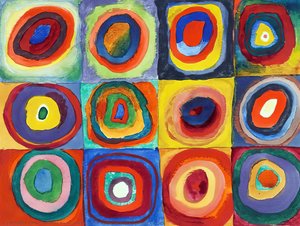
The period following his involvement with the influential artist group Der Blaue Reiter (The Blue Rider), which he co-founded in Munich in 1911, saw a further evolution in Kandinsky’s style. While earlier works often featured fluid, organic shapes, he began to explore geometric abstraction, focusing on the interplay of circles, triangles, and squares. “Several Circles” (140 x 140 cm) stands as a prime example of this phase – a dynamic composition where color and form interact in a harmonious yet energetic dance. He believed that these basic forms held inherent spiritual significance, representing fundamental elements of existence. Kandinsky’s theoretical writings, most notably “Concerning the Spiritual in Art” (1911), articulated these beliefs, laying the groundwork for a new understanding of abstract art as a vehicle for expressing profound spiritual truths. He argued that art should not aim to imitate nature but rather to reveal the artist’s inner world and connect with the viewer on a deeper, more intuitive level.- Key Work:** “Several Circles” (1913)
- Theoretical Contribution:** "Concerning the Spiritual in Art" – outlining his philosophy of abstract art
Bauhaus Influence and Lasting Legacy
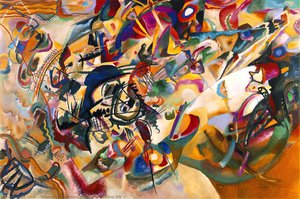
The outbreak of World War I forced Kandinsky’s return to Russia in 1914, but following the Russian Revolution, he found himself increasingly at odds with the prevailing artistic climate. In 1920, he accepted a teaching position at the Bauhaus school in Germany, where he profoundly influenced generations of artists with his theories on color, form, and abstraction. The Bauhaus provided an ideal environment for Kandinsky to further develop his ideas and explore new creative avenues. He continued to experiment with geometric forms and vibrant colors, often incorporating layered impasto techniques to create textured surfaces that added depth and complexity to his compositions – as seen in later works like “An Intimate Party” (1942). After the closure of the Bauhaus by the Nazi regime in 1933, Kandinsky moved to France, where he remained for the rest of his life. His impact on modern art is immeasurable; he is widely recognized as a pioneer of abstract expressionism and a key figure in the development of non-representational painting. His works are held in major museums worldwide, including the Tretyakov Gallery in Moscow, which houses his monumental “Composition VII,” a testament to his artistic vision and enduring legacy.- Key Period:** 1920s – Bauhaus influence
- Later Style:** Geometric abstraction with layered impasto techniques

Wassily Wassilyevich Kandinsky
1866 - 1944 , Русия
Бърза информация
- Artistic Movement Or Style: Абстрактно изкуство, Експресионизъм
- Artists Or Movements Influenced By This Artist: ['Абстрактен експресионизъм']
- Artists Who Influenced This Artist:
- Клод Моне
- Ричард Вагнер
- Date Of Birth: 1866
- Date Of Death: 1944
- Full Name: Wassily Wassilyevich Kandinsky
- Nationality: Руски, Френски
- Notable Artworks:
- Мурнау с Радуженным
- Линия къбрада
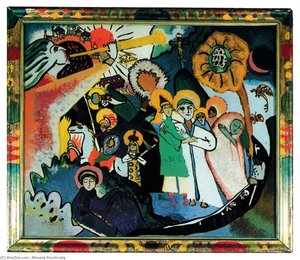
- Всички светии II
- Place Of Birth: Москва, Русия
Свързани статии

Топ 10 шедьовъра на геометричната абстракция за Вашия дом | OriginalUniqueArt.com
Разгледайте топ 10 шедьовъра на геометричната абстракция – Кандински, Мондриан и други! Открийте историите зад тези емблематични картини и добавете елегантност към дома си с репродукции от OriginalUniqueArt.com. Разгледайте пълната колекция онлайн!

Топ 10 шедьовъра на абстрактния експресионизъм – изкуство за вашия дом от OriginalUniqueArt.com
Разгледайте топ 10 шедьовъра на абстрактния експресионизъм – Полък, Ротко, де Кунинг и други. Открийте историите зад тези емблематични картини и преобразете дома си с изкуство от OriginalUniqueArt.com! Разгледайте пълната колекция онлайн.

Топ 25 шедьоври на Василий Кандински: Абстрактно изкуство за вашия дом | OriginalUniqueArt.com
Разгледайте топ 25 шедьоври на Василий Кандински – пионер на абстрактното изкуство и експресионизма. Открийте историите зад цветните композиции, техниките и вдъхновението му. Купете висококачествени репродукции на картини Кандински за вашия дом на OriginalUniqueArt.com!
Color Field Painting: The Emotional Power of Pure Abstraction and Chromatic Depth
Explore the profound emotional depth of Color Field painting. Discover the history of mid-century abstraction, from Rothko to Newman, and learn how pure color transforms the viewer's experience through our expert art history guide.

Neo-Abstract Art: The High-Impact Evolution of Modern Visual Energy and Geometric Sophistication
Discover the power of Neo-Abstract art. Explore how bold geometric forms and high-impact visual energy are redefining modern design. Learn to curate sophisticated, high-energy spaces with the latest trends in contemporary abstraction and structural color.