

 Преглед в реален мащаб
 Изпрати
 Сподели
 Детайли
 Ръководство

 Изтегляне
 Подобни артикули
 Рентгенова снимка
 Слайдшоу
 Q&A
Q&A Статистика
Landscape (Wanaka)
 Watercolor
- WallArt
- Impressionism
 1939
1939 22.0 x 27.0 cm
 Te Papa
 Прочети повече
Изкуството, представено на тази страница, е защитено от законите за авторско право, което означава, че не можем законно да създаваме или продаваме идентични репродукции. Тази защита се прилага съгласно международни споразумения като Бернска конвенция и от националното законодателство, включително разпоредбите на Закон за авторското право на САЩ – Раздел 17.
Този метод е напълно съвместим с законите за авторско право, тъй като не включва копиране или дублиране на защитеното произведение. Вместо това става въпрос за творческа реинтерпретация – нова картина, която е вдъхновена от оригинала, но не е идентична с него.
Жикле / Художествен принт
Giclée печат или принт върху платно с музейно качество, бързо производство и гъвкави опции за завършен вид. ( Купете ръчно рисувана картина Превключване към дигитално изображение)




P118B €10

P118H €10

P118W €10

P438Z €10

P508JH €12

P508YH €12

P805H €10

P805Z €10

P919BZ €10

P919G €10

P919XJ €10

P959ZH €10

P968JZ €12

W106C €8

W218G €10

W218JH €8

W218Y €10

W307PJ €10

W316G €10

W316PJ €8

W316Y €10

W398PJ €8

W4111J €10

W500HY €15

W500JH €15

W692G €12

W849H €8

W940BG €15

W953PJ €8




Изберете от нашите предварително зададени размери, които съответстват на оригиналните пропорции на произведението.

Въведете необходимата ширина и височина, за да паснат на вашата рамка или стена. Принтовете могат само да се изрязват, но никога не могат да бъдат по-големи от оригиналната картина, така че при размер с различен формат част от изображението ще бъде загубена. Преди да започнем печат, ще ви изпратим дигитален мок업 за одобрение. Изображението, показано на тази страница, не показва реалното изрязване — само мок업ът го показва.
Доставка по целия свят () в рамките на 2 седмици вместо стандартните 4/5 седмици. (31 Октомври)

Безплатна експресна доставка по целия свят

Висококачествено ленено платно

Пълно застраховане на доставката

Гаранция за възстановяване на митнически такси

Гаранция за пълно съответствие на цветовете

Политика за връщане в рамките на 100 дни (само при дефекти)

100% Гаранция за връщане на сумата

Оферта за отстъпка при поръчка на повече бройки
 Опцията със стъкло е налична само за размери под 110 см

Landscape (Wanaka)
Жикле / Художествен принт
Размер на репродукцията
-


Обща цена
€ 71
A Moment Frozen in Time: Rita Angus’s “Landscape (Wanaka)”
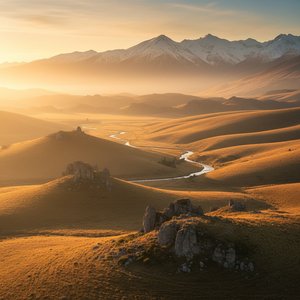
Rita Angus's "Landscape (Wanaka)," painted in 1939, isn’t merely a depiction of a New Zealand vista; it’s a carefully constructed meditation on light, memory, and the profound connection between humanity and the natural world. Captured with her signature hard-edged style – a deliberate rejection of Impressionism's hazy atmosphere – Angus presents a remarkably precise yet deeply felt portrayal of the Wanaka landscape. The painting immediately draws the eye to the rolling tussock hills, rendered in fluid washes of color that suggest both the ruggedness and the surprising softness of the terrain. The purple-tinged mountain ranges in the distance aren’t simply sketched; they're imbued with a sense of ethereal mystery, hinting at the vastness and timelessness of the region.
Angus’s technique is particularly noteworthy. She employs a wet-on-wet watercolor approach, layering translucent washes to build up form and texture. The deliberate use of white paper – leaving sections untouched with unpainted areas – creates a dynamic interplay between color and void, adding a surprising element of lightness and highlighting the delicate structure of the landscape. These ‘holes’ in the paint aren't accidental; they are integral to Angus’s vision, acting as visual punctuation marks that draw attention to key elements and contribute to the painting’s overall sense of immediacy. The fine lines meticulously capturing trees and a distant fence suggest an almost obsessive attention to detail, balanced by the broader, more atmospheric treatment of the hills and mountains.
A Pioneer's Perspective: Contextualizing Angus’s Vision
To fully appreciate “Landscape (Wanaka),” it’s essential to understand Rita Angus’s place in New Zealand art history. Born in 1908, she emerged as a leading figure during a period of intense artistic experimentation and national identity formation. Following her father's work as a construction manager, Angus spent much of her childhood moving between Palmerston North and Napier, an experience that instilled in her a keen observational eye and a sense of independence. Her early training at the Canterbury College School of Art laid the foundation for her distinctive style, influenced by movements like Cubism and Byzantine art – influences she skillfully integrated into her own unique vision.
The painting was created during a time of significant social and political change in New Zealand. The Great Depression loomed large, and there was a growing desire to define a distinctly ‘New Zealand’ aesthetic—one that moved beyond European artistic traditions. Angus's work, with its focus on the landscape and its rejection of romanticized notions of beauty, can be seen as part of this broader movement. Her decision to sign her paintings as Rita McKenzie after a personal upheaval reflects a deliberate assertion of agency and control over her own identity and artistic legacy.
Symbolism in the Landscape: More Than Meets the Eye
Beyond its purely visual appeal, “Landscape (Wanaka)” is rich with symbolic meaning. The vast expanse of green pasture, punctuated by white flowers, evokes a sense of abundance and fertility – a direct reference to the pastoral traditions of New Zealand. The distant mountains, rendered in cooler tones, represent permanence and stability, anchoring the scene within a broader historical context. The carefully placed picket fence, a seemingly minor detail, serves as a subtle reminder of human presence and intervention within this wild landscape.
Furthermore, the painting’s stark clarity can be interpreted as a response to the uncertainties of the era. Angus's deliberate rejection of atmospheric perspective—flattening the depth of field—suggests a desire to confront reality head-on, rather than softening it with illusionistic techniques. The painting isn’t simply about depicting a beautiful scene; it’s about capturing a specific moment in time and conveying a complex range of emotions – from tranquility and serenity to a sense of quiet contemplation.
Bringing “Landscape (Wanaka)” into Your Space
Reproductions of Rita Angus's "Landscape (Wanaka)" offer a remarkable opportunity to bring this evocative artwork into your home or office. The painting’s bold colors, sharp lines, and dynamic composition create a striking visual impact that will undoubtedly become a focal point in any room. The interplay between color and white space adds depth and dimension, while the meticulous detail invites close inspection and contemplation.
Whether you're an art collector seeking to expand your collection or simply looking for a piece of artwork that embodies New Zealand’s unique beauty and artistic spirit, “Landscape (Wanaka)” is a truly exceptional choice. Its timeless appeal and profound emotional resonance ensure that it will continue to captivate viewers for generations to come.
Въпроси и отговори
Колко светлина изглежда, че отразяват цветовете на "Landscape (Wanaka)"?
Записаната светлост за „Landscape (Wanaka)“ на Рита Ангус е Bright Balance.
Мога ли да използвам добавена реалност, за да видя „Landscape (Wanaka)“ на Рита Ангус в моята стая?
„Landscape (Wanaka)“ предлага преглед с добавена реалност: страницата Преглед с AR на произведението го показва в собственото ви пространство чрез съвместимо устройство.
Как мога да купя цифров файл на „Landscape (Wanaka)“ на Рита Ангус?
За да получите цифров файл на „Landscape (Wanaka)“ на Рита Ангус, поръчайте дигитално изтегляне на изображение с висока резолюция от неговата страница Дигитален образ.
Биография на художника
A Pioneering Vision: The Life and Art of Rita Angus
Henrietta Catherine Angus, universally known as Rita Angus, remains a towering figure in the landscape of 20th-century New Zealand art – an artist whose unique vision continues to captivate and challenge viewers today. Born on March 12, 1908, in Hastings, her early life was shaped by a nomadic existence, a consequence of her father’s career as a carpenter and builder, constantly relocating the family across the North Island. This itinerant upbringing instilled within her a keen observational eye, an independent spirit, and perhaps unknowingly, a deep connection to the ever-changing landscapes of New Zealand. As the eldest of seven children, Rita demonstrated artistic talent from a young age, receiving private lessons that nurtured her burgeoning passion – a seed planted early that would blossom into a remarkably distinctive style. Her formal education at Palmerston North Girls’ High School from 1922 to 1926 provided a solid foundation, with teachers recognizing and encouraging her innate abilities, setting the stage for her future artistic pursuits.Forging a Distinctive Style: Influences and Innovation
Rita Angus's artistic journey was not forged in isolation; she was profoundly influenced by a confluence of factors – from the formal training she received at Canterbury College School of Art in Christchurch to the broader currents of modern art circulating internationally. Her studies there, spanning from 1927 to 1933, exposed her to the principles of Renaissance and medieval art, alongside the work of masters like Vermeer and Cézanne, whose emphasis on light, composition, and observation deeply resonated with her artistic sensibilities. Crucially, she was also captivated by the radical experimentation of Cubism, particularly its fragmentation of form and exploration of multiple perspectives – a style exemplified by Christopher Perkins’ evocative depictions of Mount Taranaki, which captured the unique quality of New Zealand light in a way that profoundly influenced her own approach. Beyond Western art, Angus drew inspiration from Far Eastern aesthetics and philosophies, incorporating elements of symbolism and spirituality into her work, reflecting a desire to connect with universal themes of humanity and existence. This synthesis of influences – tradition and modernity, European and Pacific – resulted in a style characterized by clear, hard-edged forms, simplified shapes, and a vibrant, often emotionally charged color palette; a departure from strict realism that prioritized personal vision over mere representation.The Crucible of Early Years: Personal Turmoil and Artistic Emergence
The early years of Rita Angus’s career were marked by significant personal upheaval – the breakdown of her marriage in 1934 to fellow artist Alfred Cook, followed by a divorce in 1939. However, this period coincided with a remarkable artistic emergence, as she began exhibiting her work within the Canterbury Society of Arts and gaining recognition for her portraits and landscapes. During these formative years, Angus developed a distinctive visual language – one that reflected both her personal struggles and her growing confidence as an artist. She adopted the name “Rita Mackenzie” in 1930, a subtle nod to her paternal grandmother’s surname, reflecting a desire for independence and self-definition. Despite facing financial hardship and social isolation, she persevered, working as a commercial illustrator and teaching art part-time – all while relentlessly pursuing her artistic vision. This period of resilience and creative exploration laid the groundwork for her later achievements.Landscapes and Portraits: Themes and Symbolism
Throughout the 1930s and 1940s, Rita Angus’s work explored a range of themes, from the dramatic landscapes of Canterbury and Otago to intimate portraits capturing the essence of her subjects. Her paintings of the New Zealand countryside – such as *Cass* (1936), a deceptively simple depiction of a small railway station – are imbued with a sense of quiet contemplation and symbolic depth. *Cass*, famously voted New Zealand’s most-loved painting in 2006, stands as a testament to her ability to distill complex ideas into visually arresting forms. Simultaneously, she created a series of powerful self-portraits, offering intimate glimpses into her evolving identity – a process that can be interpreted as a visual diary documenting her inner life and struggles. Her pacifist beliefs found expression in the *Rutu* series (1940s), a collection of goddess images embodying strength, resilience, and the pursuit of peace. These works, alongside others like *Central Otago*, demonstrate Angus’s ability to imbue seemingly simple subjects with profound meaning and emotional resonance.Legacy and Enduring Influence
The later years of Rita Angus's life were marked by mental illness, culminating in a period of hospitalization in the late 1940s. Despite these challenges, she continued to paint prolifically, producing some of her most celebrated works – including the poignant self-portraits *Sun Goddess* (1949) and *Rutu*. Her final years were spent in Wellington, where she established a home at 194A Sydney Street West, which later became an artist residency. Rita Angus’s legacy extends far beyond her artistic achievements; she remains a symbol of creative independence, resilience, and the power of art to express profound human experiences. Her unique style – characterized by its precision, boldness, and symbolic depth – continues to inspire artists today, while her story serves as a reminder of the importance of supporting creativity and mental well-being. Rita Angus’s commitment to art, coupled with her profound belief in its power to express peace, humanity, and individual identity, ensures that her work will resonate with audiences for years to come.
Рита Ангус
1908 - 1970 , Нова Зеландия
Бърза информация
- Artistic Movement Or Style: Модернизъм, Регионализъм
- Artists Who Influenced This Artist: ['Christopher Perkins']
- Date Of Birth: 12 март 1908
- Date Of Death: 25 януари 1970
- Full Name: Henrietta Catherine Angus
- Nationality: Новозеландка
- Notable Artworks:
- Cass
- Rutu
- Central Otago
- Fay Birkinshaw
- Place Of Birth: Хастингс, Нова Зеландия
Свързани статии

Ephemeral Visions: Exploring the Artistic Legacy & Contemporary Practice of Watercolor Painting
Explore the captivating world of watercolor painting! Discover its rich history, essential techniques, influential artists & collecting tips. A comprehensive guide for art enthusiasts from OriginalUniqueArt.

Топ 10 шедьоври на акварела, променили изкуството завинаги | OriginalUniqueArt.com
Разгледайте топ 10 шедьоври на акварела от Turner, Monet и Sargent! Открийте историите зад тези емблематични картини, техниките им и как промениха изкуството. Купете висококачествени репродукции за вашия дом в OriginalUniqueArt.com.

Ephemeral Visions: Exploring the History & Emotional Resonance of Watercolor Painting
Explore the captivating history of watercolor painting, from ancient techniques to modern masters like Kandinsky & Blake. Discover essential artists, collecting tips & the emotional power of this luminous medium. Expert insights for art enthusiasts.

Ephemeral Visions: Exploring the Artistic Legacy & Nuances of Watercolor Painting
Explore the captivating world of watercolor painting! Discover its rich history, essential techniques, influential artists & collecting tips from art experts. A comprehensive guide for enthusiasts.
Grahame Sydney: Evoking Otago's Soul Through Light & Landscape
Explore the captivating landscapes of Sir Grahame Sydney, a leading New Zealand artist renowned for his magic realism & evocative depictions of Otago's beauty. Discover key works and delve into his artistic legacy.